

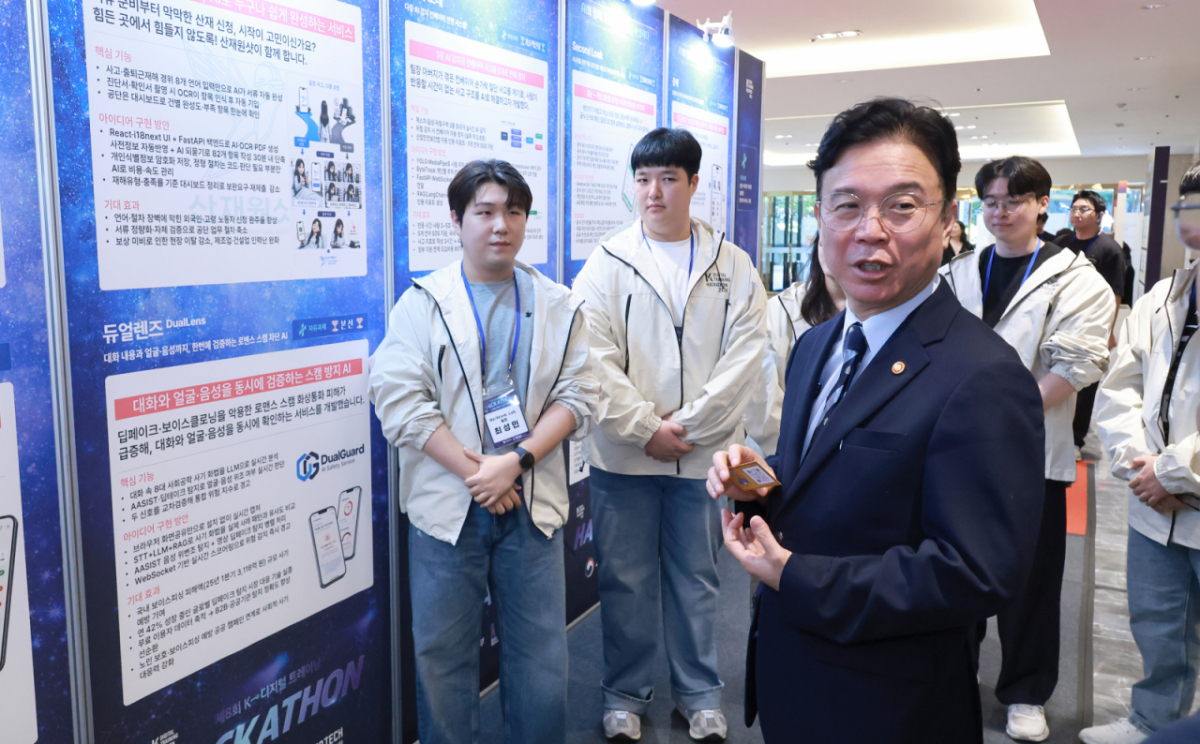
Minister Kim Young-hoon stated that demands by the Samsung Electronics labor union to receive a certain percentage (N%) of operating profit as performance bonuses could now be deemed illegal. He emphasized the need for flexible approaches regarding exceptions to the 52nd-hour weekly work limit for certain job categories, such as research positions.
Kim Young-hoon appeared on SBS Radio's "Kim Tae-hyun's Political Show" on the 8th and said, "I believe it would not be difficult if performance bonuses are prioritized over everything and deducted first from operating profit." Under the Ministry of Employment and Labor's newly issued 'Implementation Guidelines for Labor Disputes Over Performance Bonuses,' unions that go on strike demanding N% of operating profit as performance bonuses could face legal consequences.
Kim Young-hoon explained, "The Samsung Electronics union has frequently demanded N% performance bonuses during negotiations. There was a concern about whether it is appropriate to deduct performance bonuses first from operating profit before covering interest payments, financial costs, taxes, and shareholder dividends."
He further added, "If performance bonuses are deducted before even paying taxes, foreign observers might unnecessarily misunderstand that 'this country prioritizes unions over everything.' This could lead to reduced investment and weaken corporate competitiveness. Therefore, the intent is to restrict such performance bonus demands."
However, Kim Young-hoon clarified that not all performance bonuses would be excluded from dispute targets. He noted, "In the past, companies have reduced fixed wages while increasing the proportion of performance bonuses. If we now restrict all of them entirely, it is unlikely the labor sector would accept such measures."
When the host asked, "The recent strike by Samsung Electronics' early-career union cannot be applied retroactively, but under these new guidelines, would it be considered an illegal strike?" Kim Young-hoon replied, "Yes," and added, "Although there was no agreement on a specific percentage of operating profit at that time, deducting performance bonuses first from operating profit would still be difficult under the spirit of the new guidelines."
Regarding the government's recent push for 'White Collar Exemption' (work hour exceptions for professional occupations) through the Mega Special Zone Act, he stated, "It must be handled flexibly," while emphasizing, "However, we cannot allow exemptions indefinitely."
Kim Young-hoon pointed out, "For example, when inspiration strikes, one should work intensively. It is not acceptable to say, 'It's time to leave; let's do this much research and go home.' While I agree with this point, allowing indefinite exemptions raises separate concerns."
He remarked, "In China, there is a practice called 996, where employees work from 9 a.m. to 9 p.m., six days a week. It is true that China is rapidly catching up, but can any country surpass China through sheer quantity?" He questioned further.
He continued, "We must adopt more innovative approaches. If labor, management, and the government pool their wisdom, I believe we can find our own sustainable method that balances flexibility with protecting workers' health rights while boosting corporate productivity."
On the proposal to provide unemployment benefits for voluntary resignations among youth under 35, Kim Young-hoon explained, "While the form may appear voluntary, many cases are actually involuntary. Thus, this plan was designed to give young people one additional chance. However, due to criticism of populism, it has been excluded from next year's budget."
To address youth unemployment challenges, he emphasized expanding 'K-Neural Academy,' a program where companies operate vocational training initiatives supported by the government.
Kim Young-hoon stated, "One major criticism of youth employment policies is that one-time cash support alone is insufficient. What young people truly want is to gain practical experience in their respective fields."
He added, "K-Neural Academy began as a pilot program for 8,200 participants this year, allowing young people to experience job training programs from major corporations they prefer. If the government covers training costs while connecting youth with companies, young people can understand real-world workplace dynamics immediately, and companies can observe and mentor these youths up close."
On the proposal to extend the statutory retirement age from the current 60 to 65 years, he expressed concern: "In an era of a 100-year lifespan, a retirement age of 60 is too low. Even Japan is moving toward a retirement age of 70. However, given that youth employment opportunities are already scarce, extending the retirement age could worsen the situation."
He further noted, "If retirement ages increase in high-quality jobs such as public sector positions, large corporations, and financial institutions, young people may feel they have nowhere to go. The President has also indicated that while this issue must be addressed jointly, extending the retirement age is necessary."

 in ECONOMY
