

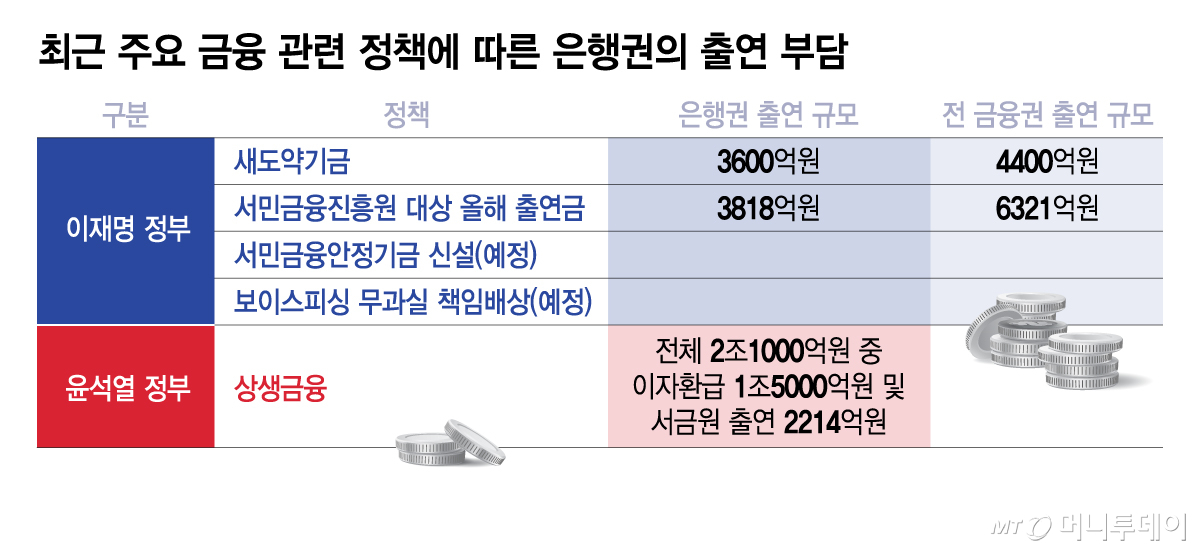
"Banks are shouldering not only an increase in education taxes but also various contributions and financial support obligations driven by government policies. Following the previous administration's push for 2 trillion won in Mutual Prosperity Finance, the Lee Jae-myung administration has continued with bad bank contributions, increased contributions to low-income finance, and expanded inclusive finance, leading to a cumulative accumulation of policy cost burdens on banks."
"According to financial sector data released on the 11th, banks contributed 360 billion won to the New Leap Fund, which launched last year, by January. The New Leap Fund is a bad bank that purchases long-term delinquent debts of up to 50 million won with over seven years of arrears for debt restructuring and write-offs. The 360 billion won contributed by banks accounts for more than 80% of the total private sector contribution of 440 billion won."
"Contributions made to the Financial Services Commission to provide products such as the Sunshine Loan for low-credit individuals have also increased. A revision to the Enforcement Decree of the Low-Income Finance Act, implemented in April, raised the common contribution rate for banks from 0.06% to 0.1% of outstanding household loan balances. As a result, annual bank contributions are expected to increase by 134.5 billion won from the previous level, reaching 381.8 billion won. This represents about 60% of the total financial sector contribution of 632.1 billion won."
"Plans to further raise the contribution rate are also being discussed in the National Assembly. According to a review report by the National Assembly's Political Affairs Committee, if the rate is raised to 0.2%, bank contributions could reach at least 672.8 billion won; if applied at 0.3%, they could rise as high as 1.92 trillion won."
"As contribution amounts increase, it has become increasingly difficult for banks to pass these costs on through loan interest rates. Since the revised Banking Act and its Enforcement Decree took effect on July 1, banks are no longer allowed to reflect statutory costs such as new guarantee fund contributions, existing guarantee fund contributions, regional guarantee fund contributions, contributions to the Financial Services Commission, and education taxes in their loan interest rates."
"Additional burdens are also looming. First, the establishment of a Low-Income Financial Stability Fund is being pursued. The current obligation to contribute at a rate of 0.1% is set to expire on October 8. Once the fund is established, it will create a structure where the financial sector continuously shares the resources needed for policy-based low-income finance."
"The no-fault liability compensation system for voice phishing scams is another factor adding to the burden. A bill requiring financial institutions to compensate victims within a certain scope, regardless of intent or negligence on their part, is currently pending before the National Assembly. The bill includes provisions to set the maximum compensation limit at 50 million won."
"Beyond direct contributions, the burden of inclusive finance is also growing. Five major financial holding companies—KB, Shinhan, Hana, Woori, and NH Agricultural Cooperative—have agreed to supply a total of 70.7672 trillion won in inclusive finance by 2030. These five financial institutions supplied 11.2912 trillion won in inclusive finance in the first half of this year alone, and also conducted internal debt restructuring on delinquent debts totaling 2.2653 trillion won. Some cases of inclusive finance have led to actual contributions. NH Financial Services plans to contribute 100 billion won this year to establish the NH Microfinance Foundation."
"Within the banking sector, there is a growing perception that the burden of 'inclusive finance' under the current administration is greater than the 'mutual prosperity finance' of the previous government. During the Yoon Suk-yeol administration, banks supplied funds totaling over 2.1 trillion won in the name of mutual prosperity finance. Of this amount, 1.5 trillion won was used for interest refunds to individual business owners and small merchants, while 221.4 billion won was allocated to contributions to the Financial Services Commission. Even considering only direct financial burdens such as interest refunds and contributions—excluding low-interest loans and various social service funds—the total exceeds 1.7 trillion won."
"A banking sector official stated, 'If the mutual prosperity finance of the previous administration was a one-time support measure, the current situation has shifted to a structure where banks must continuously bear costs through contributions to low-income finance and expanded inclusive finance.' The official added, 'If bank profitability and capital adequacy come under greater pressure, burdens will inevitably be passed on to shareholders and customers in various forms.'"

 in FINANCE
