

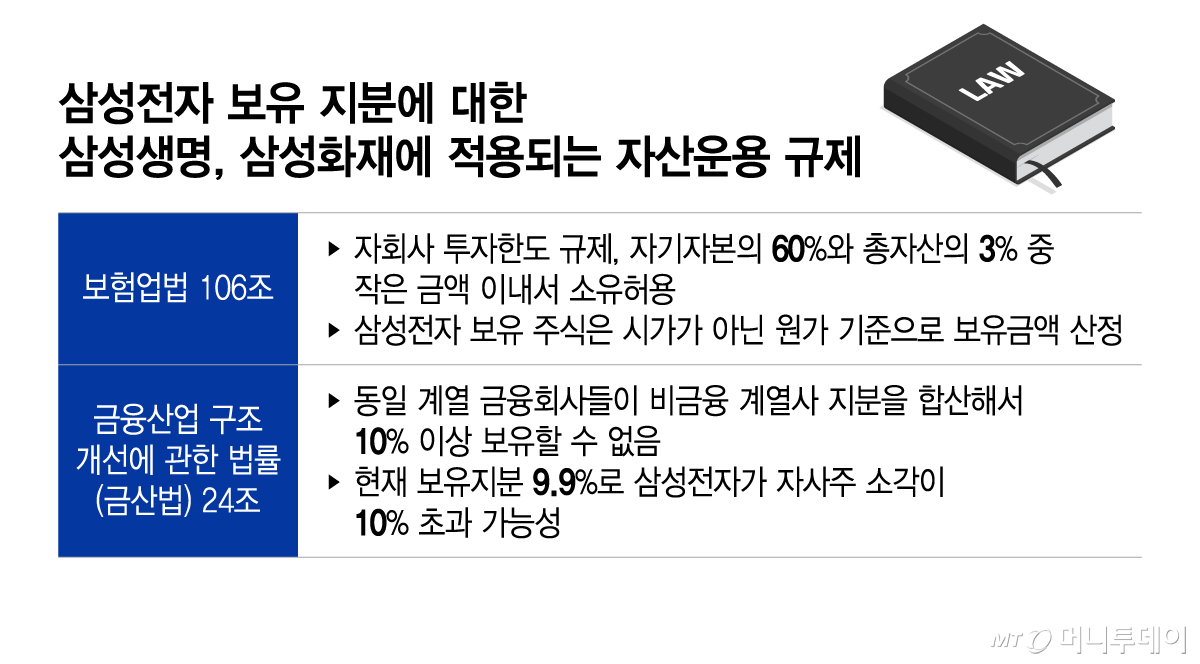
Criticism is mounting that the ex-ante asset management regulation, which effectively says "do not invest at all," fails to reflect changing times. Representative examples include the Insurance Business Act, which limits investments in insurance subsidiaries to 3% of total assets, and the Financial Industry Structure Improvement Act (Financial Separation Act), which restricts financial group companies from holding more than 10% of shares in non-financial affiliates within the same group. These are "ex-ante regulations" established in 2003 and 1997, respectively.
Strict ex-ante regulation also acts as a headwind for Samsung Electronics’ 'value-up program.' Samsung Life and Samsung Fire & Marine Insurance currently hold up to the maximum limit (10.0%) permitted by the Financial Separation Act in non-financial affiliate Samsung Electronics. Although Samsung Electronics recently announced a shareholder return policy worth 110 trillion won, it did not immediately confirm share buyback or cancellation plans as the market had expected. This is because cancelling shares could cause the largest shareholder, the Samsung financial group, to exceed the 10th% limit allowed under the Financial Separation Act. Without separate approval from financial authorities, any portion exceeding 10% must be sold immediately, a matter directly tied to the group’s corporate governance structure.
As strengthening shareholder rights clashes head-on with the Financial Separation Act, voices calling for an exception specifically for share cancellations are growing louder. While re-examining the Financial Separation Act, which was established during the foreign exchange crisis over 30 years ago, is necessary, there is also significant skepticism about whether it can truly pass the National Assembly threshold.
The regulation on investment limits in subsidiary stocks and bonds under Article 106 of the Insurance Business Act is also an 'Achilles' heel' for the Samsung financial group. The remaining capacity for affiliate investments by Samsung Life and Samsung Fire & Marine Insurance is ample, nearing 6 trillion won (5.8 trillion won). However, if the 10th% stake in Samsung Electronics were valued at market price rather than acquisition cost, it would far exceed investment limits. Insurers avoid exceeding these limits because they value stocks at acquisition cost rather than market price, unlike other industries. Nevertheless, accusations of "special treatment for Samsung" have persistently been raised.
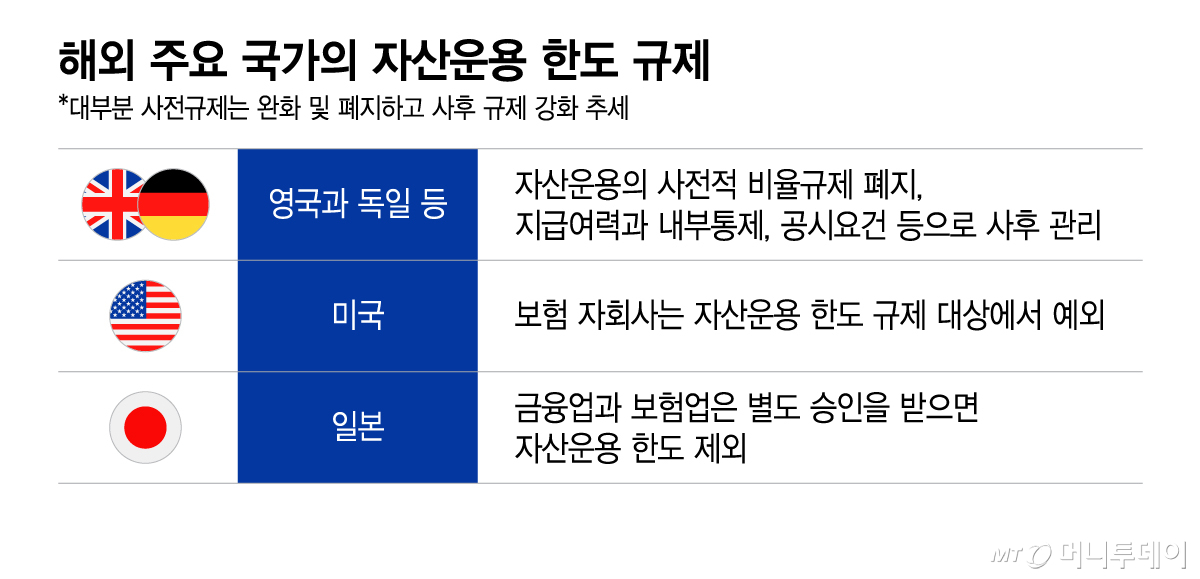
However, experts point out that the more important issue is whether ex-ante regulations on investment limits are even necessary, rather than debating "market price versus acquisition cost." The European Union’s Solvency II does not impose separate asset management limits but instead regulates risks in asset management ex-post. In Korea, this corresponds to regulation via K-ICS (Korean Insurance Capital Standard). Additionally, there are multiple layers of strict ex-post regulations, including supervision of financial conglomerates, the Monopoly Regulation and Fair Trade Act, and corporate governance laws.
A financial industry official stated, "The Financial Separation Act emerged from the experience after the Great Depression in the U.S., where industrial capital and banks became entangled and suffered simultaneous insolvency. However, given that financial authorities now manage the sector meticulously, we must reconsider whether applying past logic dogmatically is appropriate." The official added, "We need a broad discussion on whether ex-ante regulations like 'you are not even allowed to date' are necessary, or whether we should allow relationships but impose strong accountability for problems through ex-post regulation."

 in FINANCE

