

The government's stance on 'productive finance' is showing subtle signs of wavering. As the issue of a credit cliff for actual homebuyers and a shortage in housing supply have come to the forefront, the government has begun classifying real estate project financing (PF) for housing supply as 'high-productivity activity,' urging active funding support. In response, banks that had adjusted their loan portfolios to shift funds from real estate to advanced industries are sensing confusion and bewilderment.
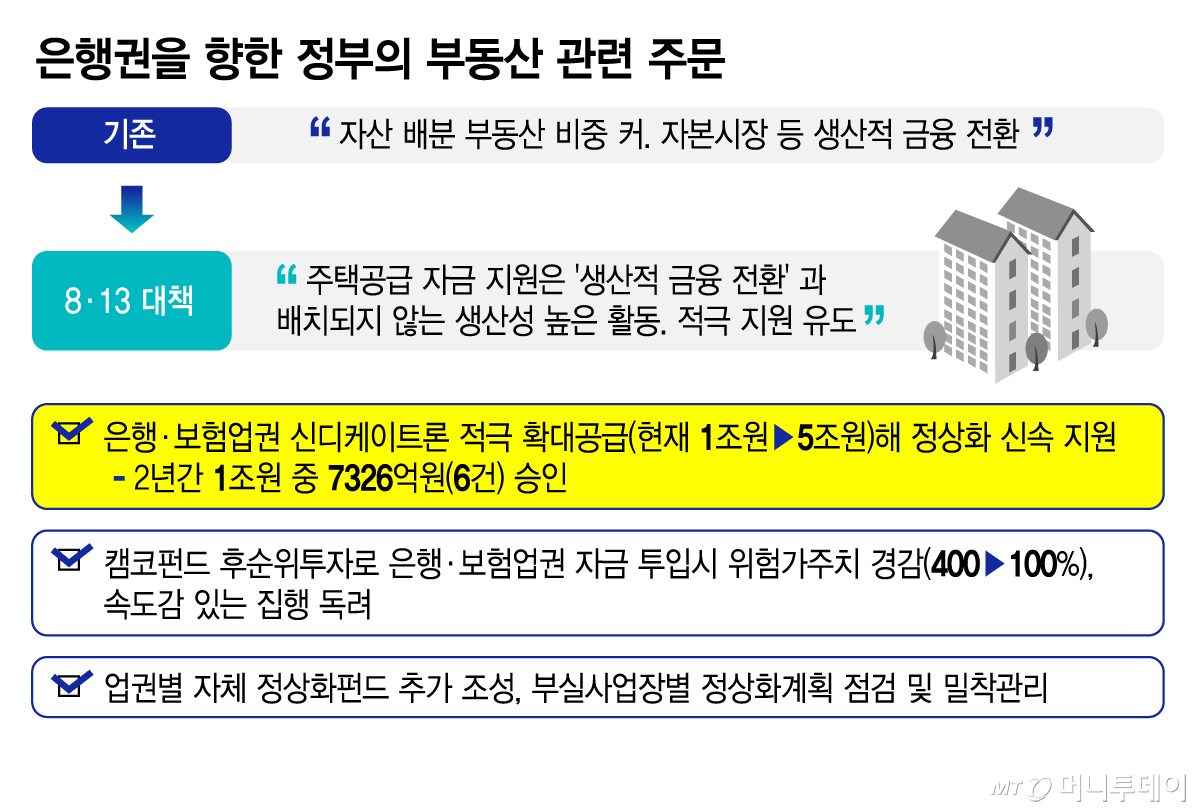
According to financial industry sources on the 2nd, the Financial Services Commission stated through its the 13th measures that it will actively encourage support for PF funding for housing supply as a high-productivity activity that does not conflict with the government's 'productive finance' policy.
Confusion has arisen within the banking sector. Productive finance is fundamentally about shifting funds concentrated in household loans, real estate, and rental businesses toward advanced industries and innovative companies. However, the government has newly classified housing supply PF as high-productivity finance. Banks have been adjusting their loan portfolios by reducing the share of real estate and rental business loans while expanding corporate financing to align with the government's policy direction.
The Financial Services Commission reportedly held a 'Financial and Construction Industry Regular Meeting Kickoff' on the 28th of last month, inviting the five major banks (KB Kookmin, Shinhan, Hana, Woori, NH Nonghyup) and construction industry representatives. The meeting encouraged swift loan approval and fund execution for existing PF projects while requesting ideas to increase PF supply. Additionally, it urged rapid approval of funds for PF syndication loans established by the banking and insurance sectors in 2024. Originally, this PF syndication loan, initially sized at 1 trillion won, received only six approvals (732.6 billion won) over two years. However, the government announced in its the 13th measures that it would expand the scale to 5 trillion won.
Nevertheless, even with the government's requests, the banking sector is expected to face limits in accelerating PF fund execution. In practice, although departments responsible for real estate finance may rush loan execution for existing projects, the approval and risk management departments holding approval authority are reportedly taking a conservative stance citing potential defaults. There is also a view that swift execution of PF syndication loans will be difficult since all five major banks must approve them before funds can be disbursed.
A bank official stated, "Projects with clear profitability and expected strong sales often already have financial institutions involved." They added, "For projects where funding is currently delayed, there are usually valid reasons, so the approval or risk management departments inevitably consider, 'What if a default occurs?'"
Financial authorities are reportedly even discussing exemption measures to reduce liability for bank employees in case of defaults during active fund supply processes. However, given that disciplinary actions and bank losses from loan defaults remain separate issues, the burden remains significant.
Banks also find it difficult to immediately significantly increase PF or real estate and rental business loans in response to government requests. This is because banks pre-set and manage annual exposure limits by industry at the beginning of each year. In fact, major banks have reportedly not separately changed their internal classification criteria for productive finance even after the the 13th measures.
Critics also point out that seeking the cause of housing supply shortages within the financial sector itself has inherent limitations. The reason for insufficient housing supply in key areas of Seoul and other metropolitan regions is attributed more to a lack of new land, delays in demolition and redevelopment permits, and project viability than to a shortage of PF funds. A bank official remarked, "Finance cannot precede physical reality," adding, "It is not the case that apartment supply is halted because financial institutional investors are not providing PF."
On the other hand, some view that the policy direction is not necessarily contradictory. This is because loans generated in the process of buying and selling existing homes differ economically from construction and PF finance that actually creates new housing. The logic holds that new housing PF can be considered productive finance since it triggers land acquisition, construction, employment, and ultimately increases housing supply.
Within the banking sector, there are calls for the government to clearly define the boundary between housing supply finance and productive finance and even provide specific recognition criteria if it aims to simultaneously pursue its medium-to-long-term policy goal of 'productive finance' and the immediate short-term issue of expanding housing supply.

 in FINANCE
