

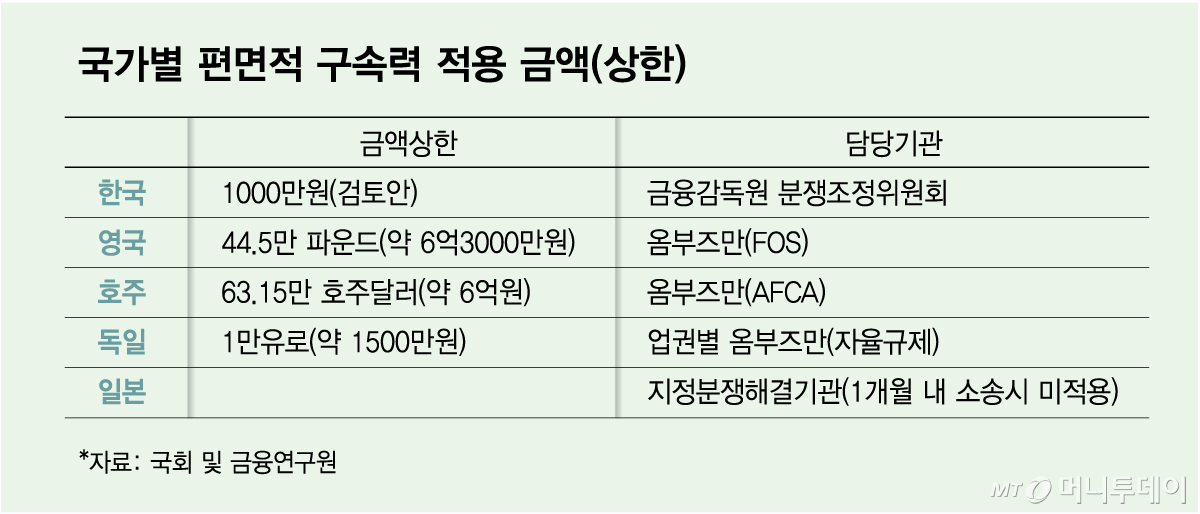
The standard for the 'unilateral binding force' system, which mandates that financial institutions must comply with Financial Supervisory Service dispute adjustment rulings (compensation amounts) unless consumers reject them, is expected to be set at a 'ruling amount of 10 million won.' Once the system is introduced, approximately 50% to 60% of financial disputes could be finally resolved through Financial Supervisory Service dispute adjustment without resorting to court litigation.
According to financial authorities on the 30th, the Financial Services Commission and the Financial Supervisory Service have settled on a threshold amount for introducing unilateral binding force in financial dispute adjustments as 'a ruling amount of 10 million won by the Dispute Adjustment Committee.' This means that if the Financial Supervisory Service's Dispute Adjustment Committee rules that a financial institution must compensate an amount of 10 million won or less, and the consumer accepts this, the financial institution is obligated to unconditionally follow the adjustment plan.
Unilateral binding force is a system requiring financial institutions to mandatorily comply with Financial Supervisory Service dispute adjustment plans in cases of small-amount disputes between financial companies and consumers. It is one of the national tasks of the Lee Jae-myung administration. The system is already implemented in countries such as the United Kingdom, Germany, Australia, and Japan, but this will be its first introduction in South Korea. From the perspective of financial consumers, it reduces the burden of time and cost compared to litigation while enabling swift relief from damages; however, it also presents the issue that the right of financial institutions to a trial is partially infringed upon.
The pros and cons for financial companies and consumers depend on how the amount threshold for small-amount dispute adjustments subject to unilateral binding force is set. Since small-amount disputes are currently defined as those under 20 million won under the Financial Consumer Protection Act, an application amount of 20 million won or less was initially considered a strong candidate based on the dispute adjustment application amount. Most bills submitted to the National Assembly also use 20 million won as the threshold amount.
However, financial authorities decided to apply the Dispute Adjustment Committee's ruling amount rather than the application amount, which reflects consumers' subjective judgment, in order to minimize uncertainty as much as possible. If a ruling amount of 10 million won or less is applied, it is estimated that 50% to 60% of financial disputes will fall under the scope of unilateral binding force. As of 2024, there were a total of 24,175 financial dispute cases, of which 58.5% were for amounts of 10 million won or less, and 66.8% were for 20 million won or less.
Given that the right of financial institutions to a trial is restricted, financial authorities are also considering allowing limited re-review (litigation) by financial companies if procedural or substantive errors are identified. Additionally, to ensure the independence and expertise of the Financial Supervisory Service's Dispute Adjustment Committee, they are promoting a plan to appoint an external former judge as a full-time chairperson, rather than a Financial Supervisory Service executive.
Consequently, while the effectiveness of dispute adjustment is expected to increase going forward, backlash from the financial sector is also likely to be strong. This is because the amount financial companies must compensate could snowball based on a single dispute adjustment ruling. Although it was not a small-amount dispute case, in 2018, the Dispute Adjustment Committee ruled in favor of consumers in an immediate annuity dispute, resulting in a compensation burden of nearly 1 trillion won for insurance companies at the time. Insurance companies filed lawsuits objecting to this and ultimately won at the Supreme Court.

 in FINANCE
