

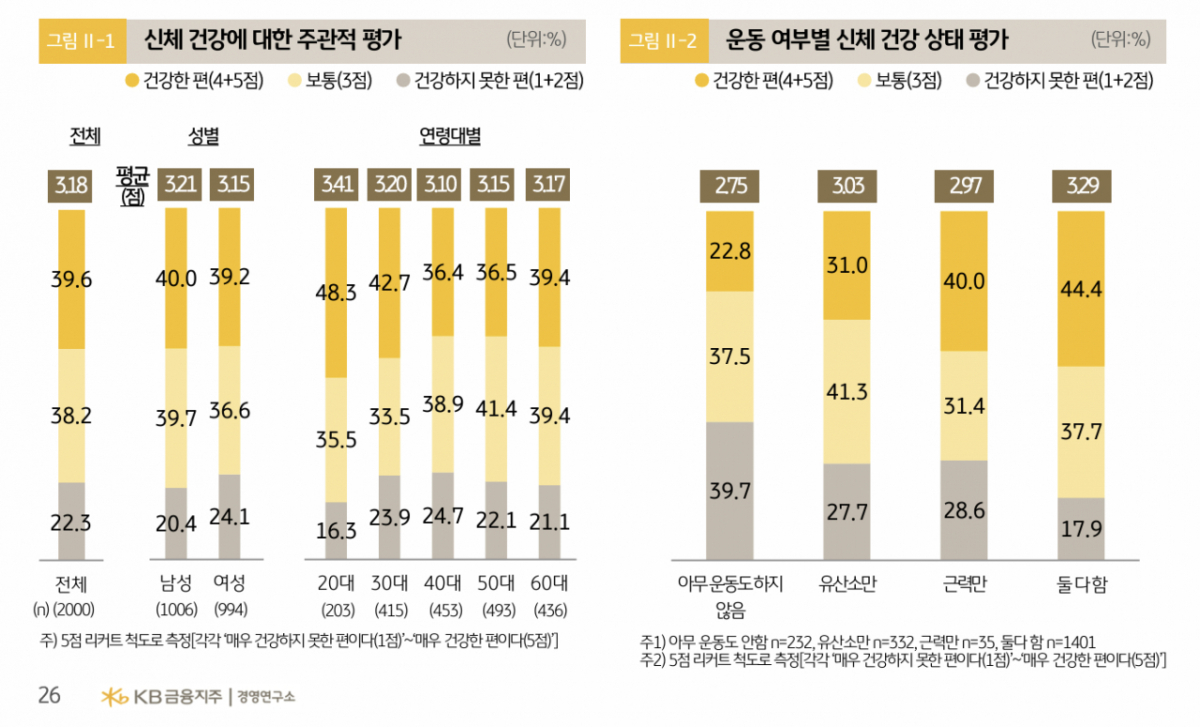
Satisfaction with health and quality of life was lowest among Koreans in their 40s. This age group reported lower satisfaction than other age groups across all areas, including physical health, mental health, interpersonal relationships, and living environment. In contrast, those in their 60s were found to have the highest levels of mental health and life satisfaction.
40s rank low in satisfaction with physical, mental, social, and environmental wellness
According to the "2026 Korean Wellness Report" published on the 25th by the KB Financial Group Management Research Institute, a survey of 2,000 Koreans on life satisfaction found that the average score for those in their 40s was 3.16 out of 5 points. This is lower than those in their 20s (3.27), 50s (3.19), and 60s (3.27), and is at a similar level to those in their 30s (3.15).
The most notable difference was observed in mental health. The satisfaction with mental wellness among those in their 40s was 3.11 points, falling below the overall average of 3.26 points. The proportion of respondents who were dissatisfied with their mental health was also the highest across all age groups at 26.7%. This means that more than one in four people in their 40s feel they are not mentally healthy.
On the other hand, satisfaction with mental health among those in their 60s was the highest at 3.44 points. The proportion of respondents who were satisfied was 51.8%, the only age group to exceed half, while the proportion who were dissatisfied was just 12.4%.
The most commonly cited reasons for dissatisfaction with mental health were "having a lot of stress" (50.1%) and "finding it difficult to have mental peace" (42.7%). In particular, those in their 40s stood out for finding it more difficult than other age groups to get sufficient rest or sleep.
A similar trend was observed in physical health. The satisfaction with physical wellness among those in their 40s was 3.09 points, lower than the overall average of 3.18 points. The dissatisfaction rate was high at 23.8% compared to other age groups. In particular, 39.8% of those in their 40s responded that it is difficult to consistently practice and maintain health management.
Interpersonal relationships and living environment were no exception. Satisfaction with social wellness among those in their 40s was 3.09 points, and satisfaction with environmental wellness was 3.08 points, recording the lowest scores across all age groups in each area. The dissatisfaction rate was also the highest at 21.9% in both areas.
The difficulties faced by those in their 40s were also evident in health management activities. Only 56.7% of those in their 40s reported having exercised within the past year, the lowest proportion among all age groups. In contrast, the exercise practice rate for those in their 60s was the highest at 73.2%.
In terms of mental health as well, the proportion of those in their 40s who answered that they are "managing their mental health" was the lowest at 31.3%. This appears to also affect fatigue in daily life. The proportion who responded that physical and mental fatigue is not relieved even after resting sufficiently was also the highest at 59.4%.
A gap was also observed between perceptions of health and actual management behaviors. When asked which areas are included in "wellness," meaning a healthy and happy life, 90.7% of respondents cited mental health, more than physical health (87.1%). However, only 26.3% responded that they had practiced "mental care" within the past year. This level is less than half of those who practice diet management or take health functional foods (66.6%) or exercise (63.9%).
Among health management activities they would like to increase in the future, exercise was the most cited at 71.7%, while mental care was the least at 26.7%. This suggests that although awareness of the importance of mental health has increased, actual health management activities are still centered on physical health.
Increased interest in obesity treatments… 3 out of 10 have intention to use
Meanwhile, high attention was paid to GLP-1 class obesity treatments such as Wegovy and Mounjaro. The proportion of respondents who answered that they had "heard of" GLP-1 class obesity treatments was recorded at 78.0%.
While awareness was similarly high across most generations, actual usage experience showed a generational gap. Usage experience was higher among younger age groups. Only 2.9% of baby boomers answered that they had used the treatment within the past year, whereas Generation Z was 5.7 times higher at 16.5%.
When asked if they would intend to use obesity treatments in the future if conditions permitted, 33.9% of all respondents answered "very likely to use" or "somewhat likely to use." By generation, the intention to use was higher among younger age groups. Baby boomers were recorded at 28.2%, while Generation Z was 39.7%. This is a trend proportional to actual usage experience rates.
However, concerns about side effects were also high. When asked about perceptions of obesity treatments, more than half of respondents, 57.3%, answered that they are "worried about side effects." The response "it seems like a temporary trend" was the second most common at 29.2%. Positive responses such as "it is an effective weight management method" (25.7%) and "it is a supplement for cosmetic purposes" (18.8%) were relatively less frequent.

 in FINANCE
