

"If you switch to the 5th generation, it inevitably becomes a loss-making contract. Is there really any bold insurance CEO (Chief Executive Officer) who would push for this?" (An insurance company representative)
The government will implement contract repurchase (contract transition discount system) for the first time next month to restructure voluntary medical insurance, but observations suggest it is highly likely to "fail" just as in the past. Analysis indicates that the incentive structure, under which existing voluntary medical insurance (1st and 2nd generation) subscribers who switch to the 5th generation pay only "half price" premiums for three years, will be ignored by both insurance companies and policyholders.
According to the insurance industry on the 27th, as a system offering premium discounts for switching from 1st and 2nd-generation voluntary medical insurance sold before 2013 to the 5th generation launched in May this year takes effect next month, it is predicted that the more contracts are switched, the greater the financial shock will be for insurance companies.
This is because old voluntary medical insurance attached as a special clause to main contracts generates Contractual Service Margin (CSM), which is future profit in accounting terms, but switching these contracts to the 5th generation turns them into loss-making contracts, resulting in a structure that reduces the previously secured CSM.
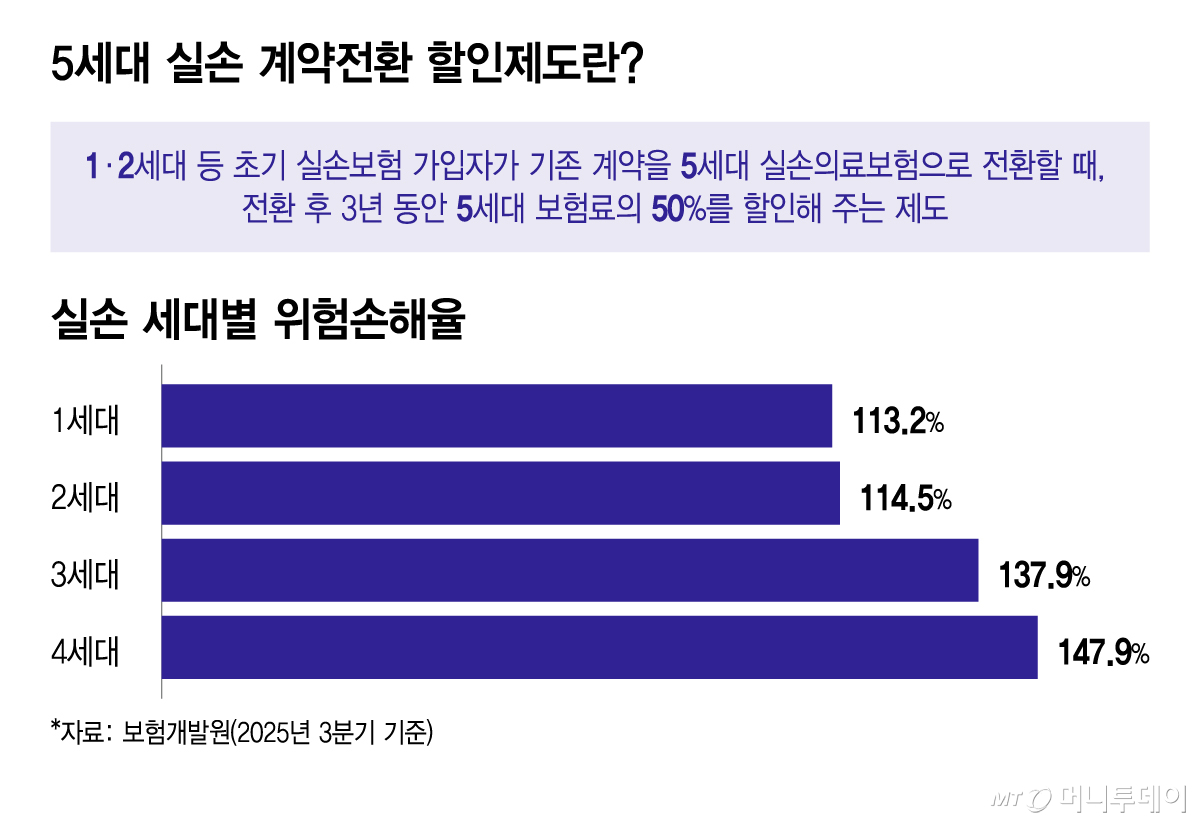
Insurance companies must apply the 4th-generation level to the accounting loss ratio assumption (the value obtained by dividing paid insurance benefits by received premiums) when switching to the 5th-generation voluntary medical insurance, in accordance with the financial authorities' loss ratio guidelines for voluntary medical insurance. The problem is that while the loss ratios for the 1st and 2nd generations are relatively favorable at 113–114%, the 4th generation is at a serious level approaching 150% (147.9%).
If contracts are switched to the 5th generation, the previously applied accounting loss ratio of over 110% rises to 150%, meaning it must be assumed that future insurance benefits will be higher. However, premiums must be discounted by 50% for three years. To make matters worse, premium renewals are blocked for the next three years while empirical statistics accumulate, due to financial authority regulations.
This is why it is pointed out that there is no incentive at all for insurance company CEOs with terms of around three years to switch to the 5th generation. Maintaining existing contracts secures CSM, whereas switching to the 5th generation accumulates only "loss-making contracts" where high insurance benefits are paid and premiums cannot be raised, requiring them to endure financial shock. This ultimately leads to deteriorating performance for insurance companies.
A finance officer at an insurance company said, "The loss ratios for 1st and 2nd-generation voluntary medical insurance have recently been improving," adding, "In contrast, for the 5th generation, premium income is low, premiums cannot be raised for three years, and the loss ratio assumption must be set even higher, so there is no incentive for management to push it through."
Not only insurance companies, but policyholders may also find the incentives not very attractive. The 1st and 2nd generations have no re-enrollment cycle (policy changes), so insurance companies cannot arbitrarily reduce coverage content, but switching to the 5th generation significantly reduces non-covered medical benefits, and there is a possibility that coverage content could be changed in the future. This is why opinions are divided on whether a 50% premium discount will truly be attractive to policyholders.

 in FINANCE
