

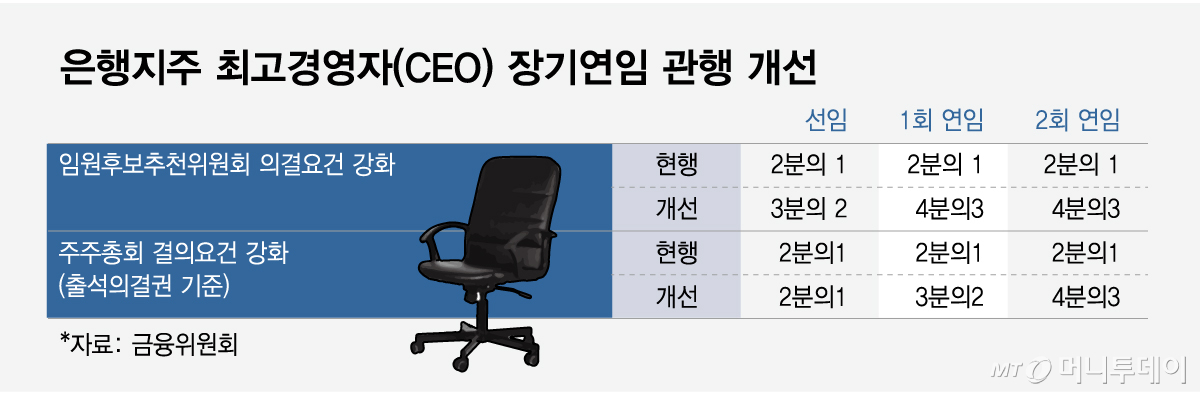
For a financial holding company chairman to be reappointed or serve a third term, they must receive approval from more than 75% of the Executive Nomination Committee (or Chairman Nomination Committee), which is composed entirely of independent directors. In addition, at the shareholders' meeting, special resolutions requiring approval from more than two-thirds for reappointment and three-quarters for a third term must also be passed. However, if these requirements are met, the holding company chairman can serve for three or more consecutive terms without limit.
The Financial Services Commission and the Financial Supervisory Service finalized an amendment to the Financial Company Governance Act containing these key provisions on the 11th following consultations between the ruling party and the government, and decided to improve the practice of long-term consecutive terms for bank holding company CEOs. This improvement plan was released approximately 11 months after President Lee Jae-myung directly criticized financial holding company chairmen serving long consecutive terms as a "corrupt inner circle" during the Financial Services Commission's business report in December last year.
The eight bank holding companies have dispersed shareholder structures without a controlling shareholder, limiting individual shareholders' ability to check management. Criticisms have been raised that shareholder control is minimal and the transparency of succession procedures, such as the "self-reappointment" of bank holding company chairmen, is low. Accordingly, financial authorities plan to raise the threshold for long-term consecutive terms by strengthening voting requirements at the nomination committee and shareholders' meetings.
First, at the nomination committee, more than two-thirds approval is required for initial appointment, while more than three-quarters (75%) approval is required for reappointment or beyond. This can be seen as a significant strengthening compared to the current requirement of a simple majority vote. Currently, KB Financial Group, Woori Financial Group, and BNK Financial Group have nomination committees composed of all seven independent directors; if two or more members vote against, the chairman's reappointment and third term will fail. Hana Financial Group, Shinhan Financial Group, and others have nomination committees composed of nine independent directors, meaning reappointment is impossible if three or more members vote against.
Financial authorities have also decided to legally mandate that nomination committees be composed entirely of independent directors. As a result, BNK Financial, JB Financial Group, and NH Financial Group must exclude holding company executives or non-executive cooperative chairmen from their nomination committee memberships. This makes it significantly harder for the chairman to build entrenched positions.
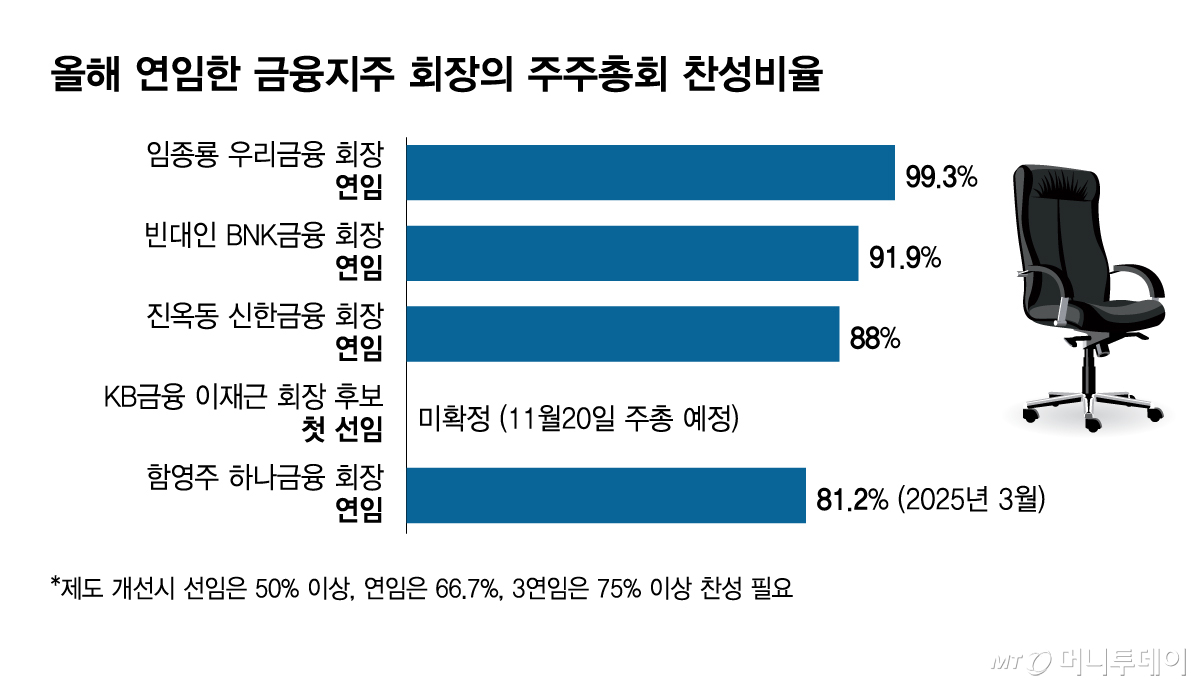
Special resolutions at shareholders' meetings will also be newly introduced. Currently, CEO appointment at a shareholders' meeting requires approval from more than half of attending shareholders and more than one-quarter of total issued shares. Going forward, reappointment and third-term appointments will require approval from more than two-thirds of attending shareholders (and more than one-third of total issued shares) and three-quarters of attending shareholders (and more than one-half of total issued shares), respectively. Among past financial holding companies, there was a case where Shinhan Financial Group Chairman Cho Yong-byung recorded a 56% approval rate at the shareholders' meeting during his reappointment in 2020, failing to meet the two-thirds (66.7%) threshold.
However, Im Jong-yong, Woori Financial Group chairman, who successfully secured reappointment this year (99.3%), Bin Dae-in, BNK Financial Group chairman (91.9%), and Jin Ok-dong, Shinhan Financial Group chairman (88%), all exceeded the two-thirds approval rate by a wide margin, and even met the three-quarters requirement, raising questions about the effectiveness of introducing special resolutions.
Financial authorities initially considered options such as requiring unanimous consent (100%) from the nomination committee for third terms or outright restricting third terms. Jeon Yo-seop, Director of the Financial Policy Bureau at the Financial Services Commission, explained, "During discussions in the National Assembly, it was pointed out that [such measures] do not align with global standards and are excessive from a constitutional perspective, so opinions converged on strengthening voting rights." Additionally, when asked whether long-term consecutive terms of three or more would be possible if formal requirements were met, he stated, "Of course, long-term consecutive terms are possible," while emphasizing, "However, since more than three-quarters approval is required from the nomination committee appointment stage as well as at the shareholders' meeting, and the independence of independent directors will be strengthened, cases may arise where reappointment fails if one or two members vote against."
The strengthened requirements are expected to take effect in the second half of next year. Even if legislative amendments are completed within this year, implementation requires six months after promulgation. Consequently, it will be difficult to apply the strengthened standards to this month's extraordinary shareholders' meeting for the appointment of Lee Jae-geun as KB Financial Group chairman candidate, or to the currently ongoing process for selecting the iM Financial Group chairman.
Meanwhile, financial authorities have decided to curb excessive courtesy practices toward former financial holding company chairmen, who are referred to as "retired kings." Bank holding companies have been paying excessive special contribution fees, such as an annual average of 700 million won over four years, to former chairmen and executives. Going forward, compensation standards for financial support when appointing advisors must be established and disclosed, and they will also be subject to reviews regarding the appropriateness of these standards.
In addition, to prevent holding company chairmen from improperly paying advertising fees for reappointment purposes, they are required to disclose third-year advertising costs compared to first- and second-year costs during their term.

 in FINANCE

