

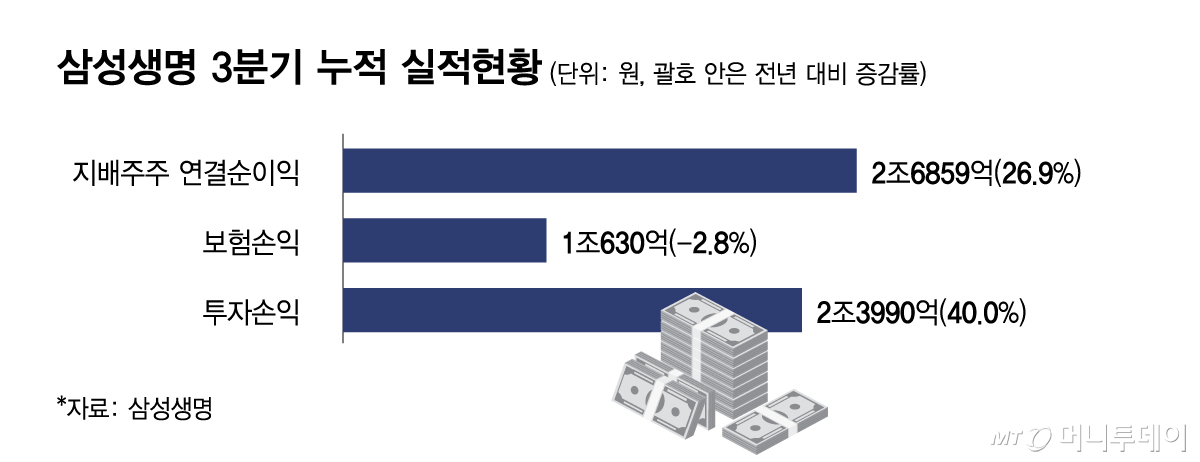
Samsung Life Insurance posted a net profit approaching 2.7 trillion won through the third quarter of this year, surpassing its all-time high for last year (2.3028 trillion won) in just three quarters, driven by improved investment gains.
Although insurance underwriting income declined slightly, overall performance was lifted as investment gains rose by 40% due to improved dividend income and subsidiary results. In particular, the impact of valuation gains on held shares, reflecting the rise in Samsung Electronics' stock price, was significant.
According to management results announced by Samsung Life Insurance on the 12th, cumulative net profit attributable to owners of the parent company for the first three quarters of this year reached 2.6859 trillion won, a 26.9% increase from the same period last year. Standalone net profit for the third quarter was 792 billion won, up 9.6% from the same period last year.
Insurance underwriting income, which indicates the profitability of core insurance operations, stood at 1.063 trillion won, a 2.8% decrease from the same period last year, due to expanded losses in Contractual Service Margin (CSM).
However, standalone insurance underwriting income for the third quarter improved to 529 billion won, a 102.4% increase from the same period last year.
In contrast, investment gains increased significantly. Cumulative investment gains for the first three quarters of this year reached 2.399 trillion won, a 40.0% increase from 1.713 trillion won in the same period last year, driving the overall growth in net profit.
General insurance investment gains rose by 49.3% to 904 billion won compared to the same period last year. Interest income increased by 2.0% to 3.471 trillion won, while dividend income grew by 12.8% to 1.488 trillion won.
Gains on disposals and other items also expanded significantly to 305 billion won from 121 billion won in the same period last year. Investment gains attributable to subsidiaries and consolidation effects also increased by 37.2% to 1.602 trillion won compared to the same period last year. The performance of subsidiaries such as Samsung Card and Samsung Securities was reflected in consolidated earnings, supporting profitability in the investment segment.
However, standalone investment gains for the third quarter decreased by 21.9% to 541 billion won from the same period last year. This was largely due to a 64.0% drop in general insurance investment gains to 105 billion won.
The expansion of held equity value due to the rise in Samsung Electronics' stock price also impacted improvements in financial soundness. Valuation gains on financial assets increased by 4.4 trillion won since the beginning of this year, with valuation gains related to Samsung Electronics reaching 5.34 trillion won.
Conversely, valuation losses from bonds and other instruments decreased by 940 billion won. However, valuation gains on Samsung Life Insurance's stake in Samsung Electronics are reflected in Other Comprehensive Income (OCI) and are not directly included in net profit for the period.
New Contract CSM, a key indicator of future profits, also continued its growth trend. Cumulative New Contract CSM for the first three quarters of this year reached 2.6259 trillion won, a 14.3% increase from the same period last year. Although New Contract CSM for health insurance declined, expansion in New Contract CSM for whole life insurance and financial products drove overall growth.
As a result, held CSM as of the end of September stood at 1.43 trillion won, an increase of 110 billion won from 1.32 trillion won at the end of last year.
Among total CSM, health insurance accounted for 56%, whole life insurance for 36%, and financial products for 8%. The solvency ratio (K-ICS), a capital soundness indicator, rose by one percentage point to 209% as of the end of September compared to the previous quarter. The basic capital K-ICS ratio fell by one percentage point to 176% from the previous quarter.

 in FINANCE
