

[For more diverse corporate information on the startups mentioned in this article, you can view them on the Unicorn Factory big data platform 'Data Lab'.]
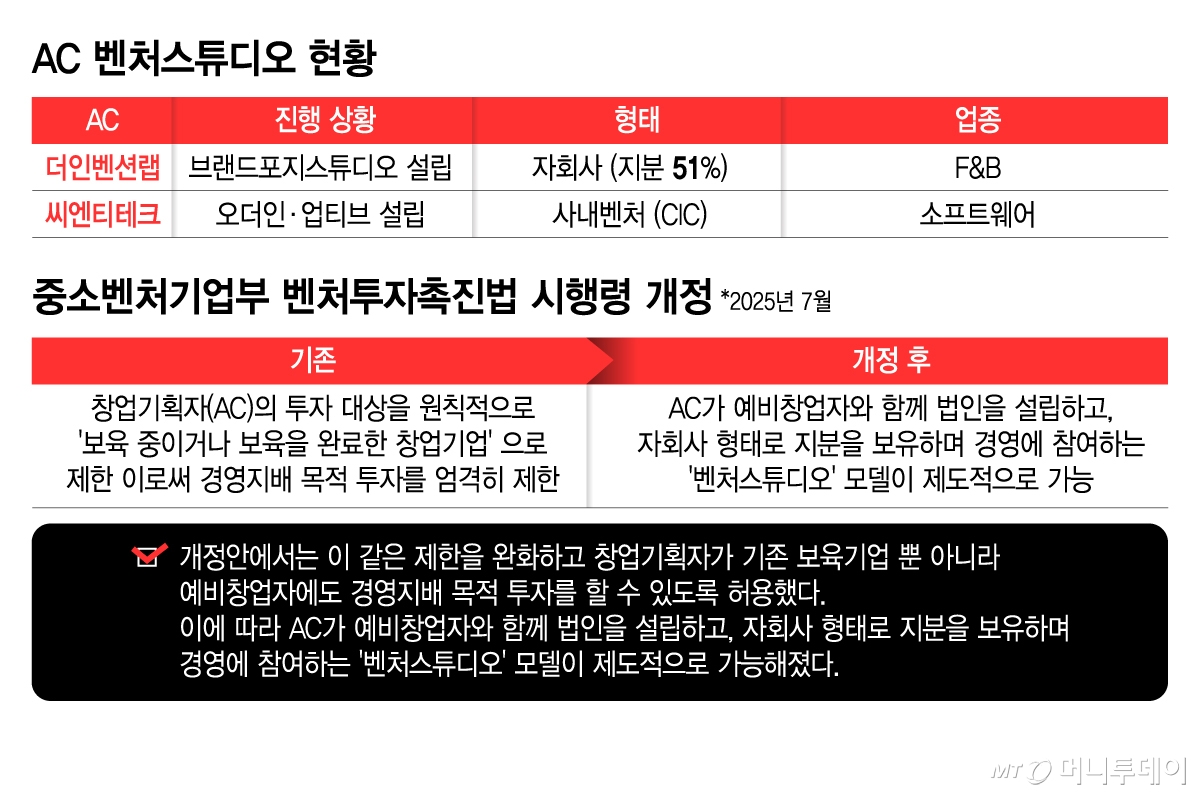
With domestic startup incubators (ACs) now permitted to operate venture studios that directly establish startups, ACs are actively moving to set up subsidiaries. Interest is focused on whether the venture studio model can become a new breakthrough for the AC industry, which has reached growth limits due to business regulations and intensifying competition.
According to a comprehensive MoneyToday investigation on the 27th, The Invention Lab recently completed the establishment of its F&B (food and beverage) subsidiary, Brand Forge Studio. The company is developing consumer-facing B2C (business-to-consumer) products as separate brands using flavor sauces developed by Nongshim. It plans to officially launch the brand as early as next month.
Kim Jin-young, CEO of The Invention Lab, said, "We have completed sensory testing for the product and plan to finalize a production plant contract soon," adding, "We intend to showcase various products on a trial basis." The Invention Lab plans to link Brand Forge Studio in the future with government-supported programs such as the private investment-type matching loan program 'LIPS' (Leveraging Investment for Private Startups) and support its global expansion.
In addition to The Invention Lab, more ACs are launching their own companies. CNT Tech established two internal ventures (CICs), Orderine and UpTive, in August last year. Orderine is developing unmanned store operation technologies such as automatic check-in, while UpTive develops services based on GIS (Geographic Information System) technology. Currently, CNT Tech holds less than 20% equity in these internal ventures but plans to gradually increase its stake to 51% and convert them into subsidiaries.
Chun Hye-sung, CEO of CNT Tech, stated, "We designed a program so that startup CEOs can focus solely on business without the stress of subsequent fundraising," adding, "If necessary, we will acquire additional equity and move toward converting them into subsidiaries."
Regulatory easing in July last year...AC industry says "venture studios are a growth breakthrough"
Initially, ACs were prohibited from operating venture studio models that directly launch startups. The Venture Investment Promotion Act only allowed ACs to invest in "startups currently being nurtured or those whose nurturing has been completed." Consequently, Blue Point Partners and Dojin BizOn launched startups but received correction orders from the Ministry of SMEs and Startups. Following criticisms of excessive regulation, the Ministry of SMEs and Startups revised the Enforcement Decree of the Venture Investment Promotion Act in July last year to permit such activities.
The AC industry expects this venture studio model to spread going forward. In the global startup ecosystem, the venture studio model has already become a common means of venture investment and nurturing. Representative cases include Moderna, Dollar Shave Club, and Snowflake, which were grown by venture investment firms that planned and developed business ideas and technologies and recruited personnel.
Especially recently, as venture investment in early-stage startups has contracted, the AC industry is adopting the venture studio model as a breakthrough for growth. According to the Ministry of SMEs and Startups, the proportion of venture investment in early-stage companies with three years or less of operating history—the core area of ACs—accounted for only 17.5% of total venture investment in the first three quarters of last year. This represents a 9.4 percentage point decrease compared to the same period two years ago (26.9%).
An AC industry official said, "Under Korea's AC system, there are limits to growth through nurturing and investing in early-stage companies alone," adding, "As a result, more companies are considering adopting the venture studio model or transitioning to VC (venture capital) status." The official further stated, "In the case of venture studios, ACs can leverage their experience in nurturing various early-stage startups to demonstrate competitiveness, so we expect the number of companies adopting this model to increase rapidly."
[MoneyToday Startup Media Platform Unicorn Factory]

 in FUTURE
