

[For more diverse information on the startups mentioned in this article, please visit Unicorn Factory's big data platform 'Data Lab'.]
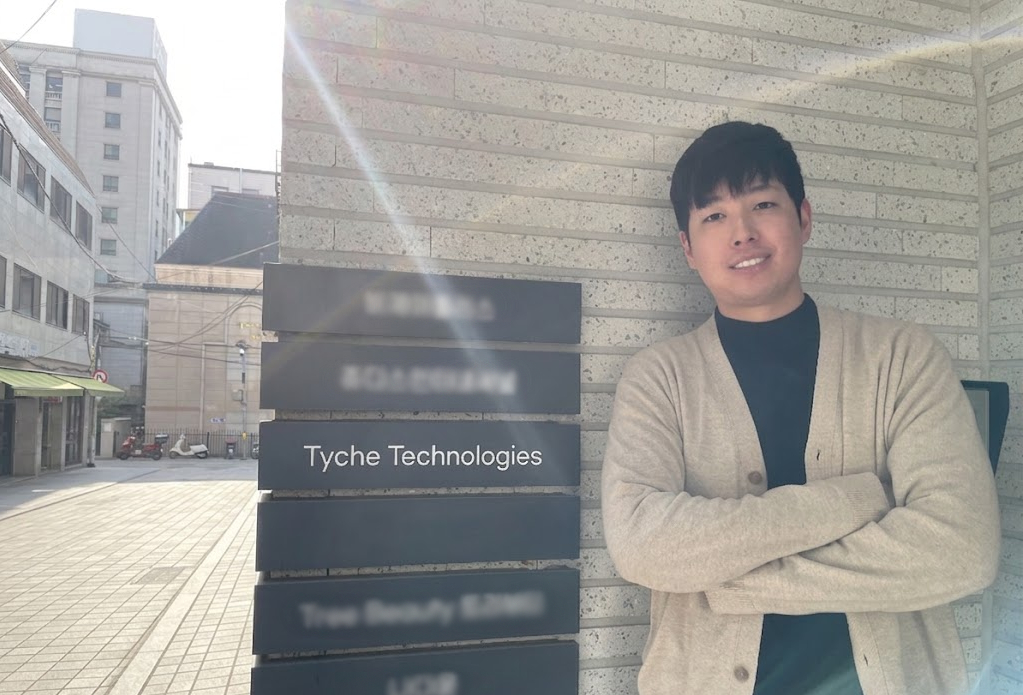
"Like my first startup venture, the shared kitchen business, I felt a strong pull toward innovating inefficient industries that have remained stagnant and unevolved for decades. While observing my father's business as an imported car dealer, I realized that the auto parts distribution market was severely opaque in terms of information, leading to significant price differences between countries. I believed that by leveraging data and AI (artificial intelligence), we could create a massive 'global arbitrage' opportunity."
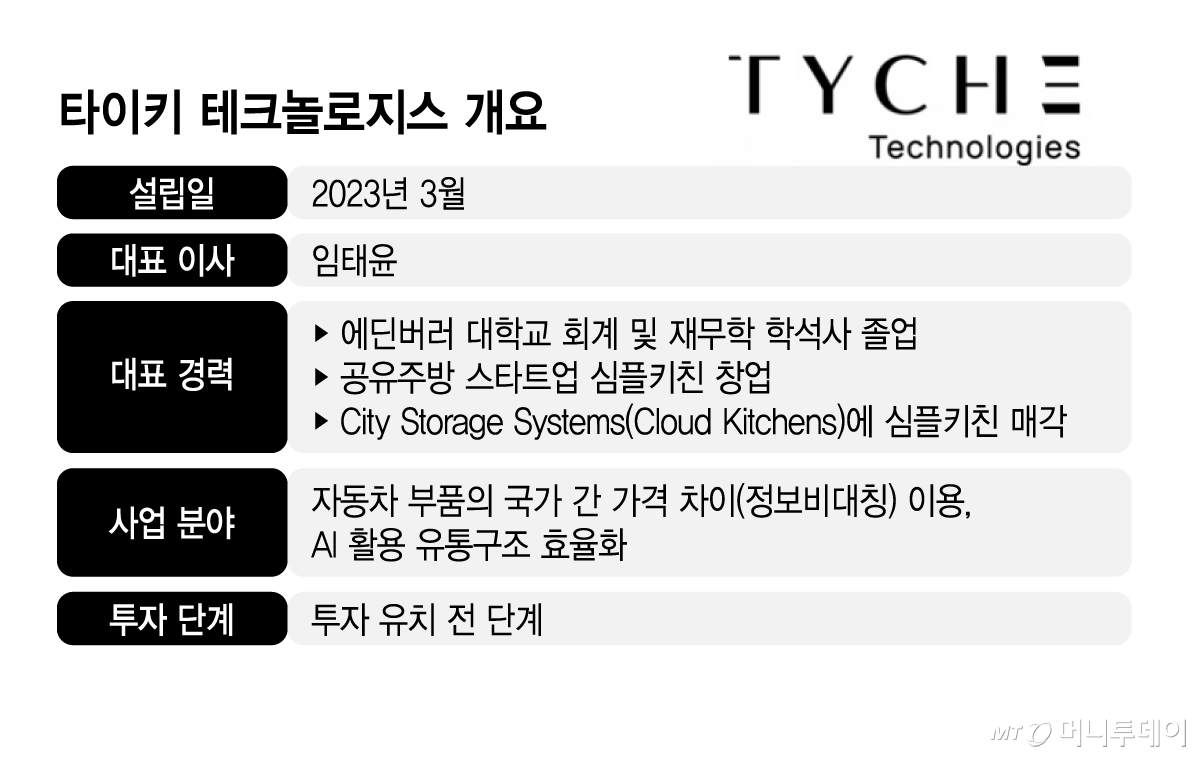
Lim Tae-yoon, CEO of Taiki Technologies, explained his reasoning for choosing 'auto parts' as his second startup venture in this manner. Having majored in accounting and finance at the University of Edinburgh in the UK, he launched his first startup in 2017 with a shared kitchen concept, establishing 'Simple Kitchen.'
At the time, Simple Kitchen gained market attention by solving the chronic issues of high initial costs and closure risks in the offline food service startup market through a sharing platform. Subsequently, in 2019, he sold his company to 'City Storage Systems (Cloud Kitchen),' led by Uber founder Travis Kalanick, for approximately 10 billion won.
Following the sale, he worked for four years at Cloud Kitchen's global business organization, serving as the head of Korea and overseeing business development and strategy for the Asia-Pacific (APAC) region. After leaving the company, he founded Taiki Technologies in 2023 to embark on a new challenge.
Taiki Technologies is an IT startup aiming to revolutionize the distribution structure by using data and AI to innovate price differences and information asymmetry across countries for auto parts. It began based on a 'global arbitrage' model that sells parts available at low prices in Korea to expensive markets overseas. To minimize inventory risk, it conducts pre-sales followed by procurement, while accumulating data on price differences between countries and demand patterns.
Launched its services in earnest in January 2024, Taiki Technologies had exported auto parts to approximately 100 countries as of February 2026, achieving a cumulative transaction volume of 2,000 deals and cumulative sales of 2 billion won.
Lim (CEO) has envisioned the company's medium-to-long-term growth roadmap in three stages. The current first stage involves purchasing parts in Korea and selling them globally. The subsequent second stage is to build a 'global-to-global' remote trading network that facilitates transactions between third countries beyond Korea. For example, this involves finding inexpensive parts in Turkey and remotely selling them to buyers in Germany to capture the price difference. Through this stage, the company aims to achieve annual sales of 10 billion won to 15 billion won by next year.
The final third stage is a leap toward an 'AI-based global auto parts trading platform' with complete information transparency. This involves precisely analyzing hundreds of millions of fragmented part specifications using AI to match global demand, clearly identifying variables such as shipping costs and tariffs, and creating an ecosystem where direct transactions can occur.
This meticulous, profitability-focused global roadmap was built upon his experience at Cloud Kitchen. He witnessed firsthand from the front lines how shared kitchen startups that raised massive capital collapsed due to excessive focus on superficial expansion, unable to withstand bloodshed competition (chicken games).
Lim (CEO) realized that generating stable profits is more essential to business than raising investments, and conceived a venture capable of entering the global market from the outset rather than being limited to the Korean market. Taiki Technologies plans to secure external investment only after firmly validating its own business model and viability, once it demonstrates cash flow levels equivalent to annual sales of 10 billion won to 15 billion won. The secured funds will be used for building global infrastructure and recruiting top-tier talent to transition to the third stage.
Lim (CEO)'s ultimate goal is not merely superficial growth but to simultaneously prove maximized efficiency and solid profitability through AI technology. He stated, "When the distribution business reaches a scale of 100 billion won, the era has come where what once required 100 people can now be done by just 10." He added, "We will actively leverage AI to build systems that operate with superior competitiveness."
[MoneyToday startup media platform Unicorn Factory]

 in FUTURE

