

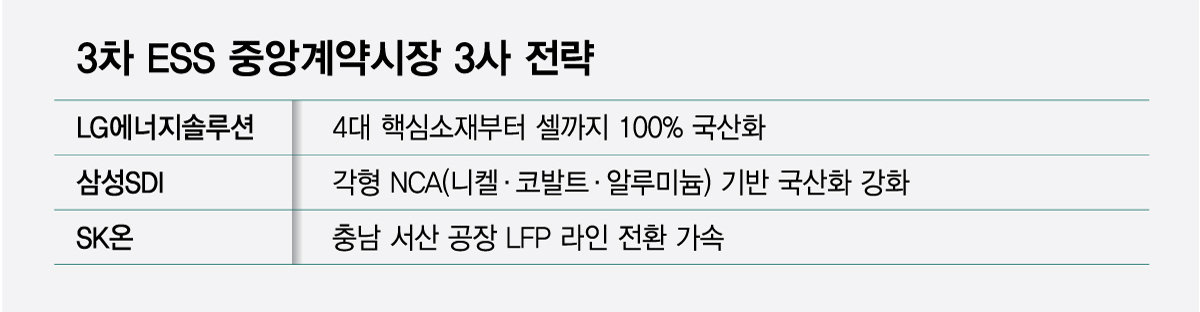

LG Energy Solution's emphasis on domestic battery production and localization of key materials in the government-led ESS (energy storage system) bidding contest is closely linked to its painful defeats in the two previous Central Contract Market tenders held last July and this February. As non-price evaluation criteria increasingly prioritize industrial and economic contributions, establishing a domestic production base and supply chain has emerged as a critical factor in winning bids.
Samsung SDI showcased domestically produced NCA (nickel-cobalt-aluminum) prismatic batteries in both the first and second tenders. NCA is a ternary system product that Korean industry has long prioritized, with sufficient domestic capacity for material supply. SK On also presented a strategy to strengthen its domestic production capabilities in the second tender. As a result, Samsung SDI was selected as the top supplier in the first round, while SK On secured the same position in the second round. LG Energy Solution captured only 24.2% of the volume in the first tender and 14% in the second.
In response, LG Energy Solution adopted a localization strategy for this third tender. Its reliance on LFP (lithium iron phosphate) batteries has previously been criticized as a weakness in supply chain evaluation. While LFP offers superior price competitiveness compared to ternary systems, its global supply chains are dominated by Chinese companies, limiting LG Energy Solution's options. The company plans to address these challenges through partnerships with domestic material suppliers and secure competitive advantages.
The government announced the third tender's total scale at 1,180 MW (megawatts), significantly larger than previous rounds, intensifying competition among bidders. Given that large volumes will be supplied over an extended period, this represents a strategic opportunity for companies to secure stable ESS demand. Additionally, securing supply records in Korea's Central Contract Market could provide advantages when expanding into the global ESS market, making it an attractive prospect.
Samsung SDI and SK On are also strengthening their responses to capture the third tender. Samsung SDI is focusing on enhancing the price competitiveness of its NCA-based prismatic batteries while maintaining strengths in domestic production and supply chain capabilities. Reports indicate the company is exploring the possibility of utilizing LFP products, as competitors have introduced relatively lower-priced LFP batteries.
SK On is consolidating its domestic supply chain for LFP batteries following its success in the second tender. It is converting a 3GWh (gigawatt-hour) LFP battery production line at its Seosan, Chungcheongnam-do facility for ESS use and considering expanding total ESS-grade LFP production capacity to up to 6GWh. Recently, SK On has signed successive supply agreements with POSCO Future M and L&F for LFP cathode materials, prioritizing securing domestic materials.
Industry observers view this tender as a catalyst for developing Korea's LFP ecosystem. While the global ESS market is rapidly reorganizing around LFP batteries due to their price competitiveness and safety, Korea's ecosystem has historically centered on high-nickel ternary systems. A company official stated, "Increased participation of domestic material companies in LFP battery projects will strengthen Korea's value chain. In the long term, production and supply chain experience accumulated domestically could serve as a foundation for enhancing the competitiveness of Korea's battery industry in the global ESS market."