

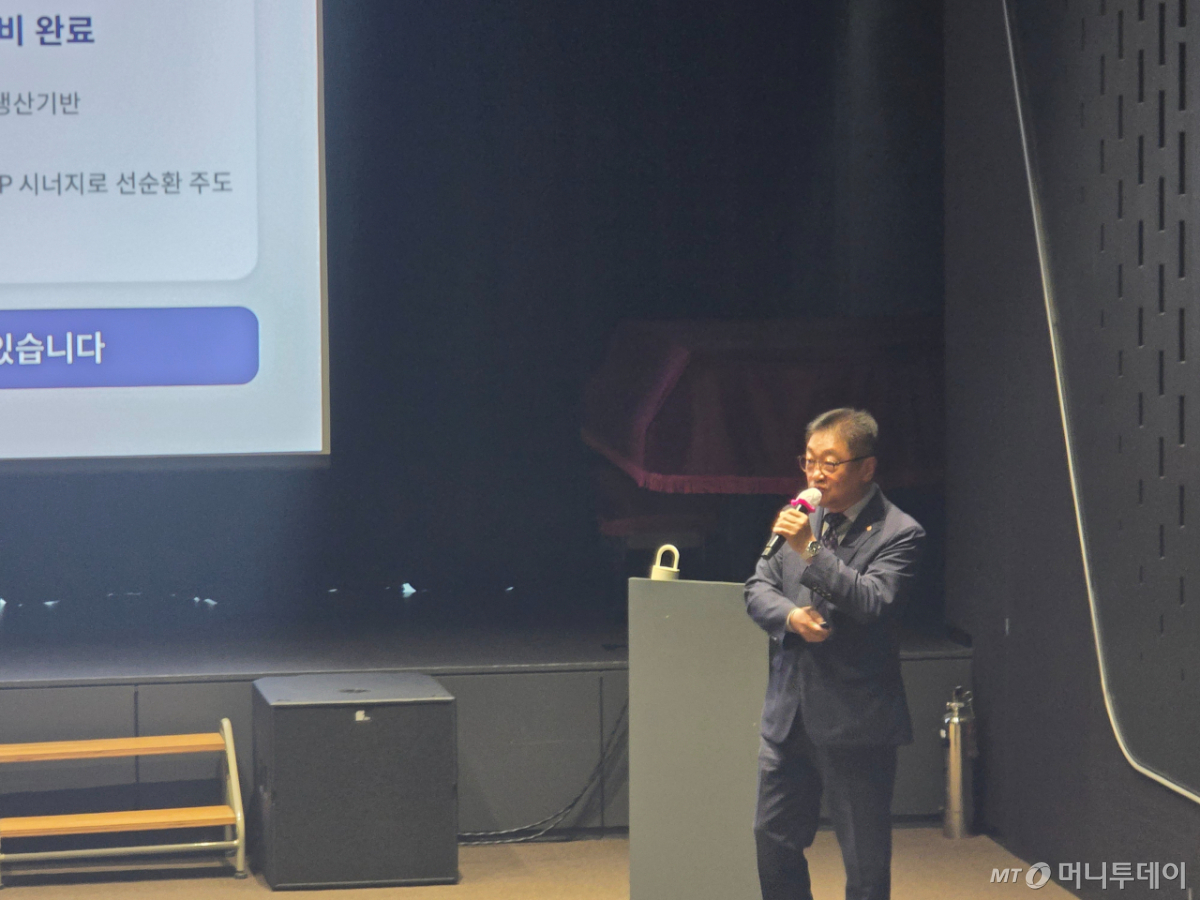
“If we succeed first in developing perovskite tandem cells, we can eliminate China’s advantage in the existing silicon solar cell market.”
Hanwha Group said Friday that Ryu Jae-yeol, executive vice president and head of Korea business at Hanwha Solutions' Qcells division, made the remarks at the Solution Academy event for reporters on Thursday.
A tandem cell is a concept that stacks a layer of the new material perovskite on top of silicon solar cells, which are currently widely used. The upper layer first absorbs strong light, and the lower layer reabsorbs the remaining light, theoretically enabling an efficiency of over 40%. It was explained that this can dramatically boost the performance of existing silicon solar cells (25–26%), which have approached their theoretical efficiency limit (approximately 29%).
Hanwha Solutions is pursuing a strategy to change the landscape of the solar market, which has been dominated by China, through next-generation solar cell technology. The company has built and is operating a pilot line at its plant in Jincheon, Chungcheongbuk-do Province, with the goal of mass-producing tandem cells and modules by the end of 2028.
Ryu said, “Hanwha Solutions’ speed can be considered the fastest in the world in terms of commercialization.”
Beyond manufacturing solar modules, Hanwha Solutions plans to expand its business into power generation projects and electricity trading. The company will expand its Power Purchase Agreement (PPA) business, which connects renewable energy generators with electricity demand companies, and also pursue a Virtual Power Plant (VPP) business.
However, Hanwha Solutions judges that it is difficult to secure the competitiveness of the domestic solar industry solely through next-generation technology development and business expansion. It was pointed out that policy support is needed to maintain the domestic manufacturing base, as Chinese companies have expanded their production capacity based on government support.
Ryu said, “Solar cells are the area with the highest technological dependence and greatest added value in the value chain,” adding, “The core of the domestic manufacturing base is maintaining the cell production foundation.”
He also stated that for the upcoming Domestic Production Incentive Tax System to provide substantive help to companies, a direct cash payment method should also be introduced. The tax reform plan, often referred to as the “Korean version of the IRA (Inflation Reduction Act),” includes provisions offering tax credit benefits when products are manufactured domestically.
While the specific method for providing benefits has not been finalized, proposals mainly focus on reducing corporate tax burdens. Questions have been raised about its effectiveness, as companies operating at a loss and thus not paying corporate tax find it difficult to fully benefit from tax credits.
Senior Executive Vice President Yoo advised, “The United States has systems for both direct payments and tax credits, but these are not yet included in the domestic system,” adding, “For the Domestic Production Incentive Tax System to be an effective regime, such mechanisms must be introduced together so that it can provide substantive help to companies.” He further added, “The Domestic Production Incentive Tax System is necessary not only for the profitability of individual companies but also for the national economy and energy security,” concluding, “Maintaining the domestic solar manufacturing base is also important for securing a stable supply chain and reducing dependence on overseas energy through the transition to renewable energy.”

 in INDUSTRY
