

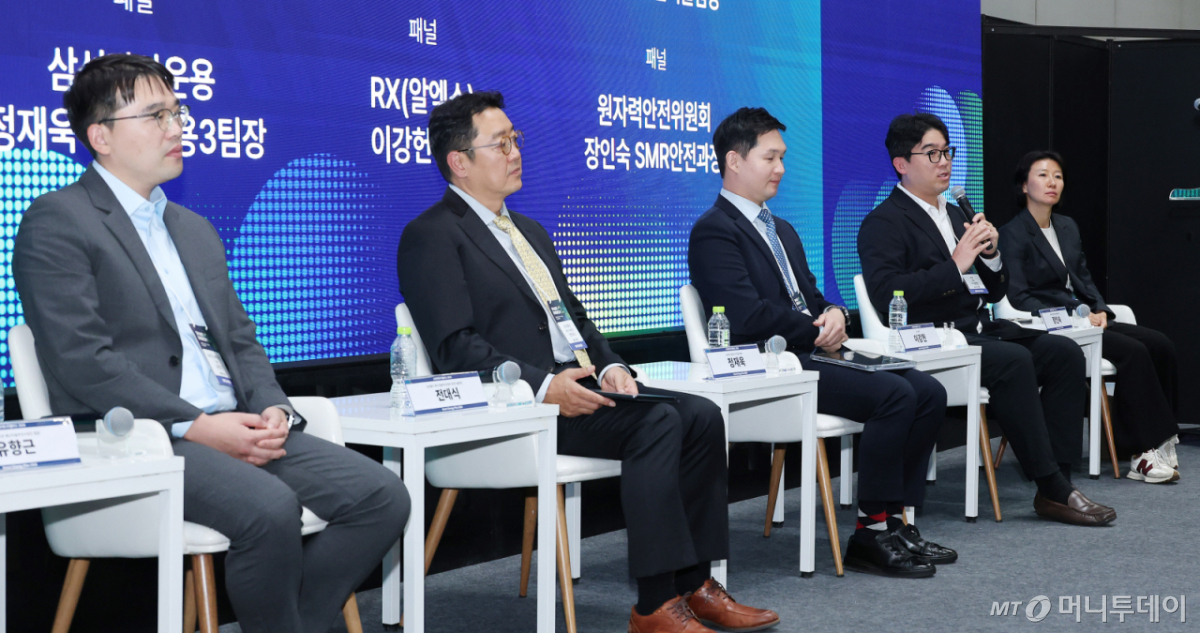
A special session exploring the potential of Small Modular Reactors (SMRs) as a power source for AI data centers was held on the 28th at Hall B of COEX in Seoul Samsung-dong, during 'Smart Energy Plus (SEP) 2026.' At the event, momentum built behind the forecast that the role of SMRs will become more prominent after 2030.
Yoo Hyang-geun, team leader of the Energy Solutions Business Division at SK Innovation, stated, "It is questionable whether large nuclear power plants, LNG (Liquefied Natural Gas), and renewable energy alone can meet all future market demand," adding, "The commercialization pipeline for SMRs will grow rapidly."
SK Innovation is advancing its SMR business in partnership with TerraPower, a U.S. company founded by Bill Gates. The company is collaborating on TerraPower's sodium reactor demonstration project underway in Wyoming, United States. Team Leader Yoo said, "The key is who can complete the demonstration faster and how commercialization will be achieved," expressing confidence that "several initial commercial reactors will emerge in the U.S. before 2035."
Jeon Dae-sik, team leader of the Nuclear Technology Team in the Energy Solutions Business Division at Samsung C&T, focused on the shortened construction period for SMRs. Team Leader Jeon explained, "Through modularization, a construction period reduction effect of at least 20 to 30 percent can be achieved," adding, "Pre-fabrication at factories reduces on-site work and offers advantages in terms of quality control." Lee Kang-heon, CEO of SMR startup RX, stated, "Our goal is to rapidly modularize proven technology and supply it at the price customers desire."
A question was raised on site regarding the scenario where "power demand is met by large nuclear power plants before SMRs are commercialized." Team Leader Yoo responded, "Large nuclear power plants face issues such as location and resident acceptance," adding, "SMRs can secure a place in the energy mix." Team Leader Jeon also elaborated, "As AI data centers expand, (SMRs) can be built on adjacent land and connected," noting, "There is a difference in flexibility compared to large nuclear power plants."
Jung Jae-wook, team leader of ETF Management Team 3 at Samsung Asset Management, stated, "There are both cautious views that the economic viability of SMRs has not been verified and perspectives that new pipelines are beginning to take shape," advising, "Even if AI develops rapidly, there may be a time lag in nuclear power demand, so this should be taken into account."
Jang In-sook, section chief of the SMR Safety Section at the Nuclear Safety and Security Commission, emphasized, "SMRs are ultimately a race for speed, and regulations must be prepared to match that pace," adding, "The revised goal is to begin developing review criteria starting in 2027." She continued, "It is important to gain public trust through clear and transparent regulations and scientific and independent licensing procedures."

 in INDUSTRY
