

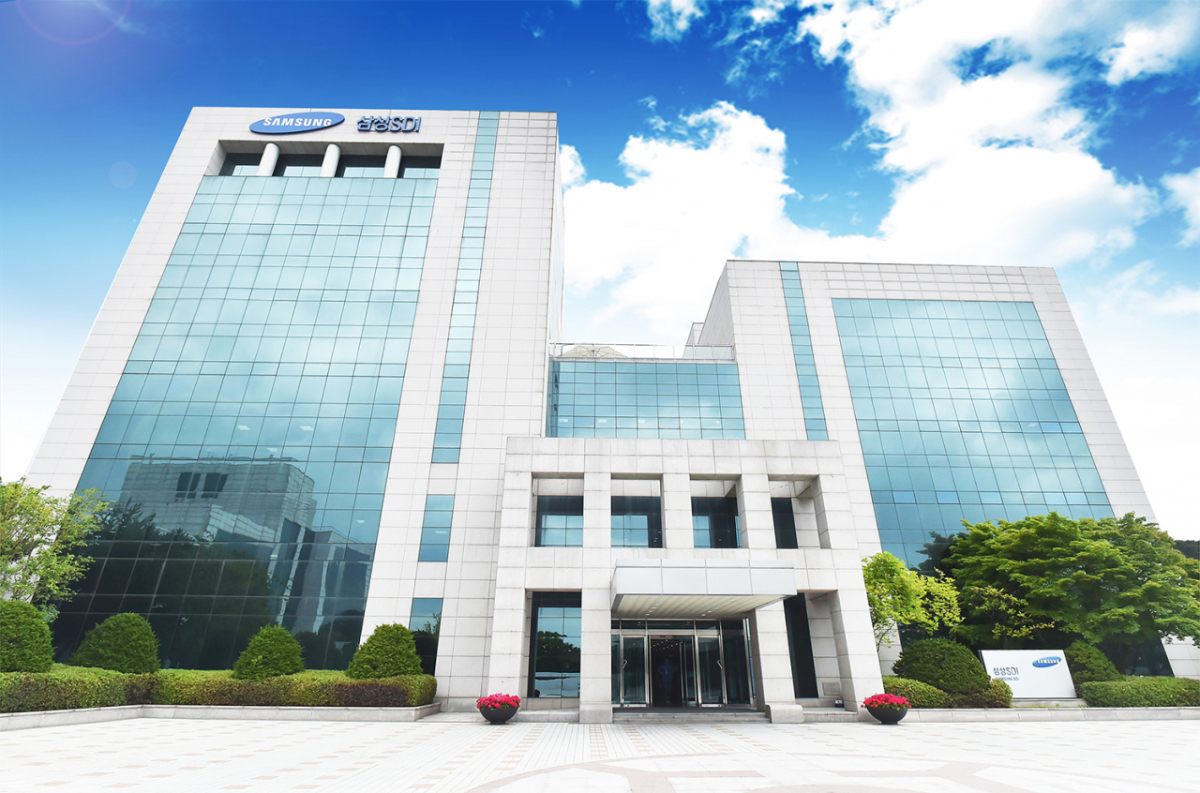
Samsung SDI said Thursday that it recorded revenue of 4.6856 trillion won and an operating profit of 407.8 billion won in the third quarter of this year. Revenue increased by 52.6% year-on-year, while the operating profit turned to a surplus.
In particular, the operating profit doubled compared to the previous quarter (203.8 billion won). It is the largest amount since the third quarter of 2023 (496 billion won). The improvement in performance was driven by increased demand for energy storage systems (ESS) and battery backup units (BBU) due to expanded investment in artificial intelligence (AI) data centers.
Revenue from the battery division was 4.4099 trillion won, a 55.3% increase year-on-year. The operating profit turned to a surplus at 361.9 billion won. While ESS and BBU sales increased significantly, sales of cylindrical batteries used in power tools and electric vehicles also expanded.
The electronic materials division recorded revenue of 275.7 billion won and an operating profit of 45.9 billion won. These figures increased by 18.9% and 18.3%, respectively, compared to the same period last year. Performance was supported by increased sales of semiconductor patterning materials and display film materials for foldable smartphones.
Samsung SDI is also accelerating its efforts to capture the rapidly growing U.S. ESS market. Since the beginning of this year, it has secured over 60 GWh (gigawatt-hours) of ESS orders in the United States alone. The company utilizes its Synergy Cells plant in Indiana, U.S., as a production hub for high-demand ESS batteries. It plans to gradually expand production capacity to strengthen its local supply base.
The lithium iron phosphate (LFP) battery business is also being fully launched. Starting this month, it began mass production of high-capacity prismatic LFP cells at the Star Plus Energy (SPE) plant in the United States. In Europe, it secured an LFP battery project for electric vehicles. It has also signed a long-term supply contract for LFP cathode materials with major domestic material manufacturers to respond to 'de-China' supply chain demand in the U.S. market.
The company is expanding its product lineup targeting the AI data center market. Recently, it unveiled cylindrical LFP cells for BBU use. Analysts note that as power demand at data centers grows rapidly, ESS and BBU are emerging as new battery demand sources complementing electric vehicles.
For next-generation batteries, the company is focusing on broadening application areas. For all-solid-state batteries, it has shipped samples for humanoid robots to proceed with customer evaluation and commercialization preparations. For cylindrical batteries, it secured new customers in the aerospace and humanoid fields.
Samsung SDI forecast that the growth trend in the ESS market will continue in the fourth quarter. It predicted that while demand in the electric vehicle market will increase in Europe, a slowdown is expected to persist in the United States for the time being.
Accordingly, it plans to expedite the conversion of its LFP battery production lines in the U.S. for ESS use. It aims to finalize long-term supply contracts for power ESS and uninterruptible power systems (UPS) currently under negotiation within this year. Domestically, it will expand its ESS business by participating in the third central contract market bidding.
For electric vehicle batteries, it will build prismatic battery mass production lines and supply chains centered on its Hungarian production hub. It will also pursue new orders utilizing a product portfolio including high-nickel, LFP, and mid-nickel batteries. For small batteries, it plans to expand the LFP cylindrical battery product lineup and increase supply volumes to global cloud service providers (CSPs).
A Samsung SDI official stated, "We will continuously pursue medium- to long-term growth based on profitability," adding, "We expect the solid growth trend in the ESS and small battery businesses to continue in the fourth quarter as well, maintaining a surplus posture."

 in INDUSTRY
