

It is reported that financial authorities are internally reviewing past cases of ELW (Equity Warrant) regulation in connection with measures targeting single-stock leveraged ETFs (Exchange-Traded Funds). This comes from the perspective that if the effects of previously announced measures do not materialize, extraordinary regulations similar to those applied to past ELWs will become inevitable. With the government introducing secondary supplementary measures such as setting individual investment limits, it is assessed that changes have already begun.
According to the financial investment industry on the 1st, the Financial Services Commission (FSC) and the Financial Supervisory Service (FSS) are internally reviewing past cases of ELW regulation in connection with measures targeting single-stock leveraged products. There is a deep-seated concern that in order to prevent overheating of single-stock leveraged ETFs, they will have no choice but to resort to extraordinary regulatory measures like those taken against past ELWs.
A senior official in the financial investment industry stated, "Although the current financial authorities have prepared measures, during the ELW era, initial regulations failed to curb investment demand, leading to the introduction of high-intensity regulatory measures that effectively killed the market. Since the industry currently judges that the measures for single-stock leveraged ETFs are insufficient, it is highly likely they will follow the path of past ELW regulation."
Another official remarked, "Even during the period when short selling was completely banned, financial authorities considered other supplementary measures taking international consistency into account, but ultimately could not withstand pressure from public opinion and the political sphere. Since this has become a political issue, they will have no choice but to tread the same path as with short selling."
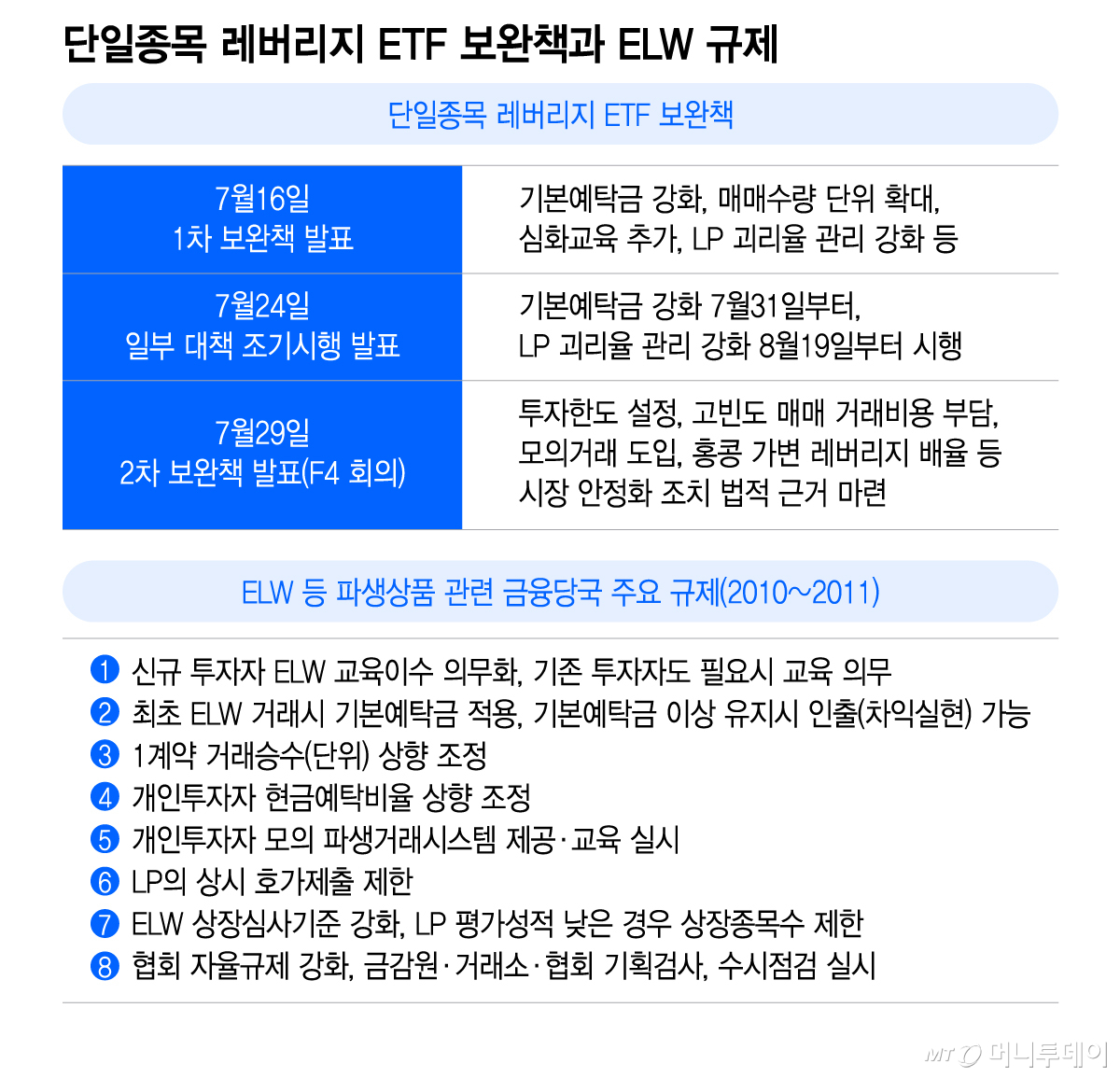
The ELW case occurred when market speculation became a problem, prompting financial authorities to implement three rounds of strong regulations in 2010-2011. Initially, measures such as introducing a basic deposit system and mandating education were implemented. This is similar to the measures announced by financial authorities on the 16th.
However, speculative demand was not curbed, leading to the additional implementation of regulations restricting LP (Liquidity Provider) quotes. As spreads widened, investors could no longer trade at desired prices, reducing investment attractiveness. Investment demand dropped drastically. ELW daily average trading volume, which reached 1.6 trillion won in 2010, was slashed to one-tenth, down to around 110 billion won by November 2013 after being hit directly by the regulations.
Changes by financial authorities have already begun. The government announced on the 29th that it would implement secondary supplementary measures for single-stock leveraged ETFs during an emergency market situation review meeting (F4). This comes just 14 days after the announcement of primary supplementary measures on the 16th. Until the 24th, the stance was to observe the policy effects of raising the basic deposit limit, scheduled for early implementation on the 31st, before discussing additional measures; however, the position changed within six days.
According to the "Additional Measures Explanation Document for Single-Stock Leveraged Products" released by the Financial Services Commission the previous day, proposals include imposing punitive transaction costs on frequent traders, setting individual investment limits, and introducing simulated trading in addition to pre-education. Legal grounds will also be established allowing financial authorities to take market stabilization measures in emergency situations, similar to cases of variable leverage ratios in Hong Kong. The plan is to discuss detailed measures and implement them as early as possible.
In addition, the market is discussing other options such as further raising the basic deposit limit, temporarily suspending trading when the deviation rate widens beyond a certain level, and restricting LP liquidity provision. Like ELW regulation, all these methods involve making trading difficult and complex to encourage investors to leave the market on their own.
Financial authorities initially faced strong criticism that "ELW regulations effectively ruined the derivatives options market," creating an atmosphere of caution requiring careful review; however, given the increased market volatility, they are expected to accelerate additional supplementary measures.

 in STOCK

