

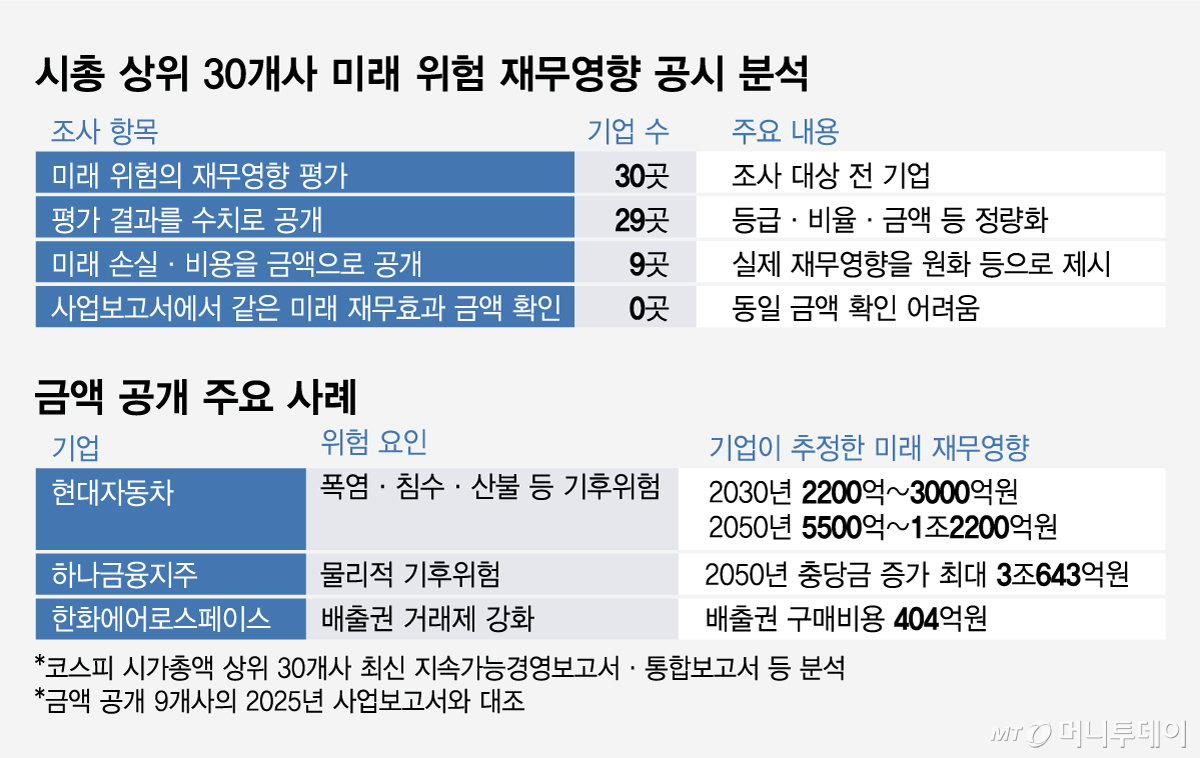
Among the top 30 KOSPI companies by market capitalization, nine directly calculated and disclosed potential losses ranging from hundreds of billions to trillions of won due to future risks such as climate change. Yet, in statutory business reports—the official filings—there was not a single instance where these figures could be verified. While the volume of disclosures has increased, core information necessary for investors to assess corporate valuation remains fragmented across multiple reports. Critics argue that greater emphasis should be placed on improving the quality and connectivity of investment information rather than merely expanding disclosure volume.
An analysis by Money Today on the 7th of the latest sustainability reports and integrated reports from the top 30 KOSPI companies revealed that all 30 firms assessed the financial impact of future risks on their operations, with 29 disclosing results numerically. However, only nine companies presented actual potential losses or costs in monetary terms.
The disclosed amounts are substantial. Hyundai Motor estimated annual losses from physical climate risks such as heatwaves, flooding, and wildfires at 220–300 billion won by 2030 and 550 billion to 1.22 trillion won by 2050. Hana Financial Group projected that provisions for physical climate risks could reach up to 3.064 trillion won by 2050. Hanwha Aerospace calculated the long-term financial impact of increased carbon credit purchase costs due to stricter emissions trading regulations at 40.4 billion won.
The problem lies in the fact that investors must visit company websites and locate separate sustainability reports to verify these figures. Even when cross-referencing the 2025 business reports of the nine companies that disclosed future financial effects in monetary terms, none of them contained the corresponding risk-related future financial impact amounts in their statutory filings.
Business reports do not entirely lack risk-related content. Hyundai Motor explains its carbon neutrality goals and climate change response strategies, while Hanwha Aerospace includes accounting treatments for greenhouse gas emission allowances and related liabilities. However, Hyundai Motor's projected maximum loss of 1.22 trillion won or Hanwha Aerospace's estimated 40.4 billion won cost for purchasing emission allowances can only be confirmed by consulting separate sustainability reports. When critical future financial information already calculated and disclosed by companies remains disconnected from statutory disclosures, investors are forced to navigate multiple reports to understand the same risks associated with a single company.
Additionally, there is a timing gap: business reports are typically submitted in March, while sustainability reports are published several months later. Moreover, mechanisms to link newly calculated and disclosed future financial information with existing statutory disclosures—enabling investors to easily access them—are insufficient.
This issue will become even more critical starting in 2028, when sustainability disclosures are integrated into statutory requirements. The Financial Services Commission plans to institutionalize sustainability disclosures beginning with the 2028 reporting cycle (covering fiscal year 2027), initially applying them to KOSPI-listed companies with connected assets exceeding 10 trillion won.
The International Sustainability Standards Board (ISSB) also emphasizes that international disclosure standards should focus not merely on increasing disclosure volume but on enabling investors to understand how sustainability risks affect a company's financial position, performance, and cash flows. Connectivity between sustainability information and existing financial data is also a core principle.
Recently, Japan has also begun reforming its disclosure system to prioritize the quality and connectivity of investment information over sheer volume. On the 4th, the Japanese Financial Services Agency held discussions with Norway's Government Pension Fund Global (NBIM), one of the world's largest institutional investors, on revising disclosure frameworks from an investor perspective. Previously, Japan's Ministry of Economy, Trade and Industry revised guidelines on "integrated disclosure" to reduce redundant reporting burdens on companies and improve the effectiveness of information delivery to investors.
Kim Hoon-jeong, a certified public accountant at Kwangwoon Accounting Firm, stated, "The key to disclosures is not merely quantity but ensuring that investors can easily grasp how critical risks affect corporate valuation and financial performance." He added, "Sustainability disclosures must also be restructured to enhance their connectivity with existing financial information."

 in STOCK
