

Although companies have recently released more information, it is not easy for investors to understand corporate performance and business changes as a single flow. This is because key figures and the reasons behind them are divided among annual reports, ad hoc disclosures, and earnings announcement materials (IR). While dividing information across documents with different purposes is inevitable, critics point out that there is a lack of connections between the information necessary for investment decisions.
Operating profit of 1.3 trillion won, but a deficit if subsidies are excluded... Connecting numbers is up to investors
On the 7th, Money Today analyzed major disclosures and IR materials from seven representative listed companies—Samsung Electronics, SK Hynix, Hyundai Motor, LG Energy Solution, Doosan Enerbility, Kakao, and Hanwha Aerospace—and found that key investment information is fragmented across annual reports, ad hoc disclosures, and earnings announcement materials (IR). To properly grasp corporate performance and business changes, investors must connect these pieces themselves. These seven listed companies have diverse business structures in semiconductors, automobiles, batteries, platforms, nuclear power plants, and defense industries, and are highly attractive to retail investors.
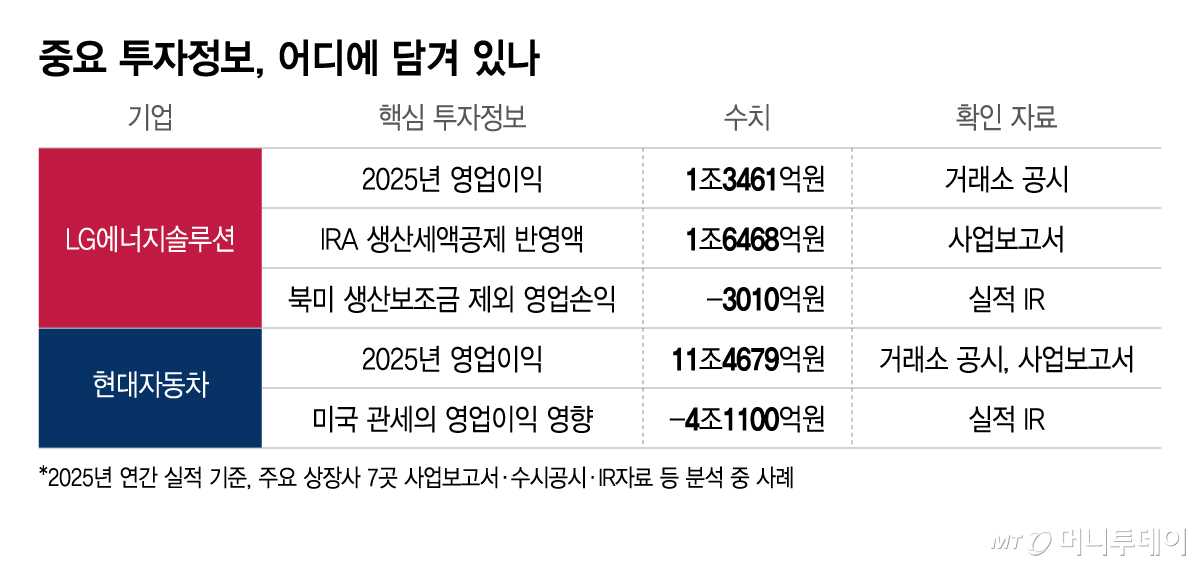
Even core information that significantly influences a company's annual operating profit requires cross-referencing multiple disclosure documents to see the full picture. For instance, LG Energy Solution's North American production subsidies amounted to 122% of last year's operating profit, while Hyundai Motor's exposure to U.S. tariffs acted as a burden equivalent to 36% of its operating profit. However, performance data, the factors influencing it, and specific financial impacts are divided among annual reports, stock exchange disclosures, and earnings announcement materials (IR).
LG Energy Solution announced via a Korea Exchange disclosure in January that last year's operating profit was 1 trillion 346.1 billion won. However, examining the annual report reveals another figure constituting profits: 1 trillion 646.8 billion won from advanced manufacturing tax credits under the U.S. Inflation Reduction Act (IRA) were reflected in other operating income. The company's annual performance IR material further clarifies the relationship between these two figures. The IR materials indicate that last year's operating result, excluding North American production subsidies, was a deficit of 301 billion won.
These three figures explain the same company's same performance. Stock exchange disclosures quickly inform the public of the company's annual operating results, while annual reports contain finalized financial statements and details on how subsidies are accounted for. IR materials go a step further by separately presenting performance excluding subsidies. While each document fulfills its role, investors must navigate between multiple documents to directly connect the relationships between figures in order to properly understand the company's performance.
A similar problem arises with Hyundai Motor. Last year's U.S. tariffs were a key variable determining the company's performance. According to the company's annual performance IR materials, the negative impact of U.S. tariffs on operating profit reached 4 trillion 110 billion won, accounting for 35.8% of last year's total operating profit of 11 trillion 467.9 billion won. Although the annual report explains U.S. tariffs as a major business environment and risk factor, investors must consult IR materials to determine exactly how much they affected actual operating profit.
Necessary information is scattered, while similar explanations are repeated
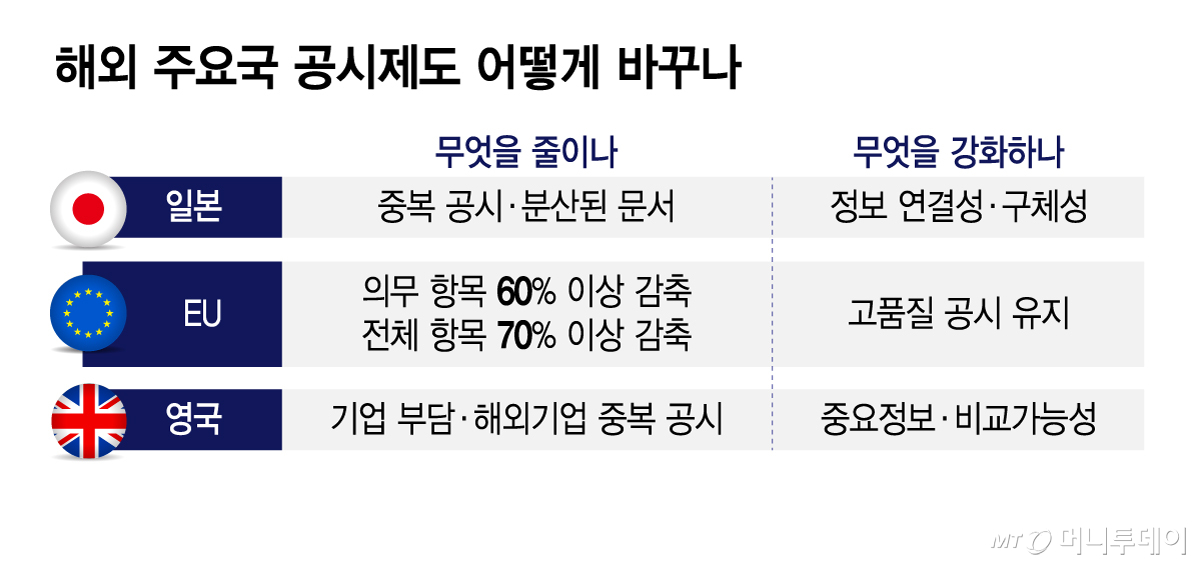
International sustainability disclosure standards also emphasize 'Connected Information.' The International Sustainability Standards Board (ISSB)'s IFRS S1 (General Requirements for Disclosure of Sustainability-related Financial Information) requires that relationships between different pieces of information be understandable to investors and that unnecessary duplication of information be avoided. To this end, it mandates providing necessary explanations and cross-references, as well as consistent use of data, assumptions, and measurement units.
The problem lies not in the fact that information is divided across multiple documents, but rather that these pieces of information do not easily connect into a single flow answering questions such as △what happened, △how it affected performance, and △how the company explains this. Critics also argue that there is a need for connecting mechanisms that allow investors to easily track financial information released after initial disclosures.
There is also the problem of repeatedly providing similar information. Among the seven companies analyzed, some information on business status and corporate governance appeared across multiple documents, including annual reports and corporate governance reports. While connections between necessary information are lacking, if similar explanations are repeated across multiple documents, investors may only face an increase in the amount of information they need to read.
The 'dispersion' and 'disconnection' of disclosures are different. Information can be divided into multiple documents according to purpose, but structures requiring investors to directly infer relationships must be improved. The IFRS Foundation also views disclosure connectivity as a crucial element for investors to comprehensively understand companies. The key is not to eliminate different disclosures, but to enable investors to grasp the relationships between information.
Kim Hoon-jeong, an accountant at Kwanghwa Accounting Firm, stated, "Investors should be able to easily track a single event and its corresponding financial impact." He added, "There is a need to improve the disclosure system by reducing unnecessarily repeated information and connecting key information from different disclosures through cross-references."

 in STOCK

