

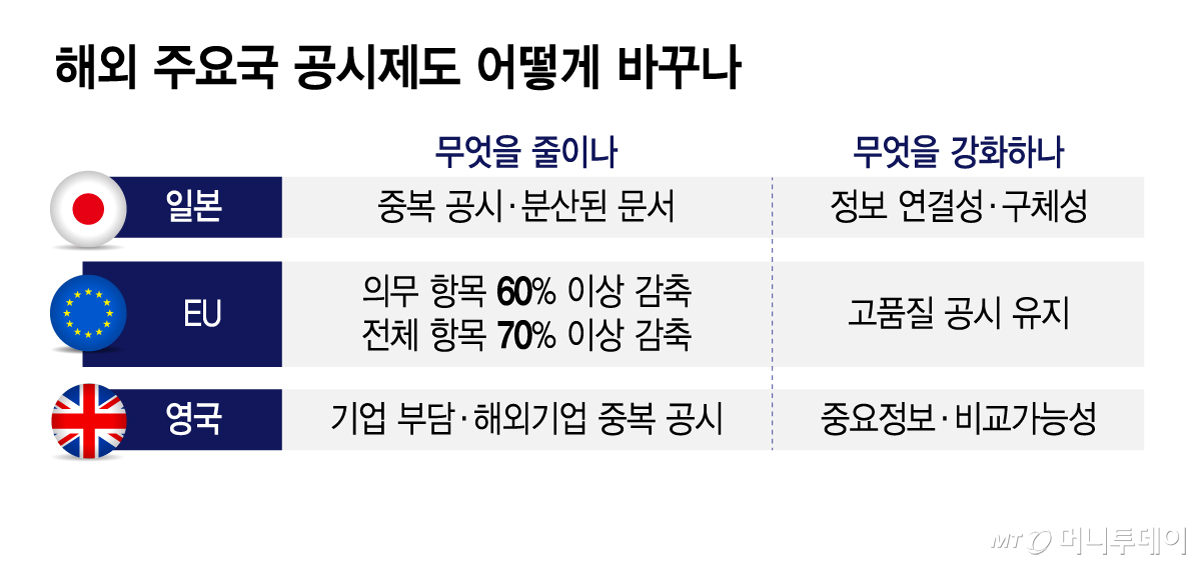
Japan's financial authorities are reevaluating corporate disclosures from an investor perspective. The goal is to streamline the disclosure system by eliminating redundant information and making it easier to find and connect data essential for investment decisions. The European Union (EU) has also reduced mandatory sustainability disclosure items by over 60%. These successive overseas market reforms signal a shift in focus from "more" to "more useful." As South Korea prepares to introduce mandatory sustainability disclosures by 2028, experts argue that a "disclosure diet" is equally necessary.
Japan prompts global institutional investors to reexamine disclosure systems
According to Japan's financial services industry on the 7th, the Financial Services Agency (FSA) held the sixth meeting of its Financial Council's "Discloser Working Group" on the 4th, inviting the Norwegian Government Pension Fund Global (GPFG), managed by the Norwegian Government Pension Fund Global Investment Management (NBIM). The meeting discussed reforms to reduce redundant corporate disclosures while improving the quality and connectivity of information critical to investors.
During the meeting, NBIM pointed out that Japanese listed companies produce abundant disclosures but suffer from excessive redundancy, with insufficient specificity and accessibility for investment decisions. An analysis of disclosure systems at six Japanese listed companies revealed that corporate investment information was fragmented across 7–17 documents, with 47 overlapping areas identified. Additionally, 32 critical pieces of information outside mandatory disclosures were flagged.
The Japanese government is accelerating efforts to streamline its disclosure system. The aim is not merely to reduce disclosure volume but to eliminate unnecessary bulk while enhancing the density and connectivity of information essential for investment decisions.
In May, the Ministry of Economy, Trade and Industry (METI) revised operational guidelines (FAQs) to make "integrated disclosure" (ittai-kaiji)—merging business reports and financial statements under the Companies Act with securities reports under the Financial Instruments and Exchange Act—easier for companies to adopt. While integrated disclosure is already permissible under current regulations, the revision aims to expand its use, reducing redundant reporting burdens on companies and delivering information more effectively to investors.
Reducing disclosure burdens while sharpening investment information
The EU significantly reduced the number of disclosure items themselves. In July, the European Commission adopted revised European Sustainability Reporting Standards (ESRS), cutting mandatory data items by over 60% and total data items by more than 70%. By simplifying standards to be concise and clear, reporting costs per company are expected to drop by at least 30%.
Reducing disclosures does not mean eliminating important information. The European Commission emphasized maintaining high-quality disclosures while alleviating administrative burdens on companies. The goal is to distinguish between information essential for investment decisions and non-essential data, thereby increasing disclosure density.
Earlier this year, the UK finalized its UK Sustainability Reporting Standards (UK SRS), incorporating general sustainability disclosures (S1) and climate-related disclosures (S2) based on International Sustainability Standards Board (ISSB) standards. The Financial Conduct Authority (FCA) is advancing regulatory reforms to align listed company disclosures with these standards. While climate-related disclosures are mandatory, certain newly introduced disclosures will adopt a "comply or explain" approach to balance corporate burdens.
Overseas listed companies have also been advised to minimize overlaps with existing domestic disclosure requirements. The objective is to provide investors with clear, consistent financial information critical to investment decisions while enhancing cross-market comparability and reducing unnecessary redundant disclosures.
South Korea, approaching the 2028 transition of sustainability disclosures to mandatory status, faces the urgent task of restructuring its current disclosure system. Experts stress the need to improve connectivity among scattered critical information across mandatory, ad-hoc, and sustainability disclosures while eliminating redundancies. The core priority is not merely adding disclosure items but ensuring investors can easily locate and understand essential information.

 in STOCK
