

Stocks of semiconductor companies, which experienced extreme volatility last July, have begun to trend upward this month. While rebounds were seen across various sectors such as materials, industrial goods, and consumer goods last month, the rise in semiconductor-related stocks has been particularly pronounced this month. Analysts say this momentum helped the KOSPI close above the 7,000 mark on the 10th despite concerns over rising global oil prices and U.S. Treasury bond yields.
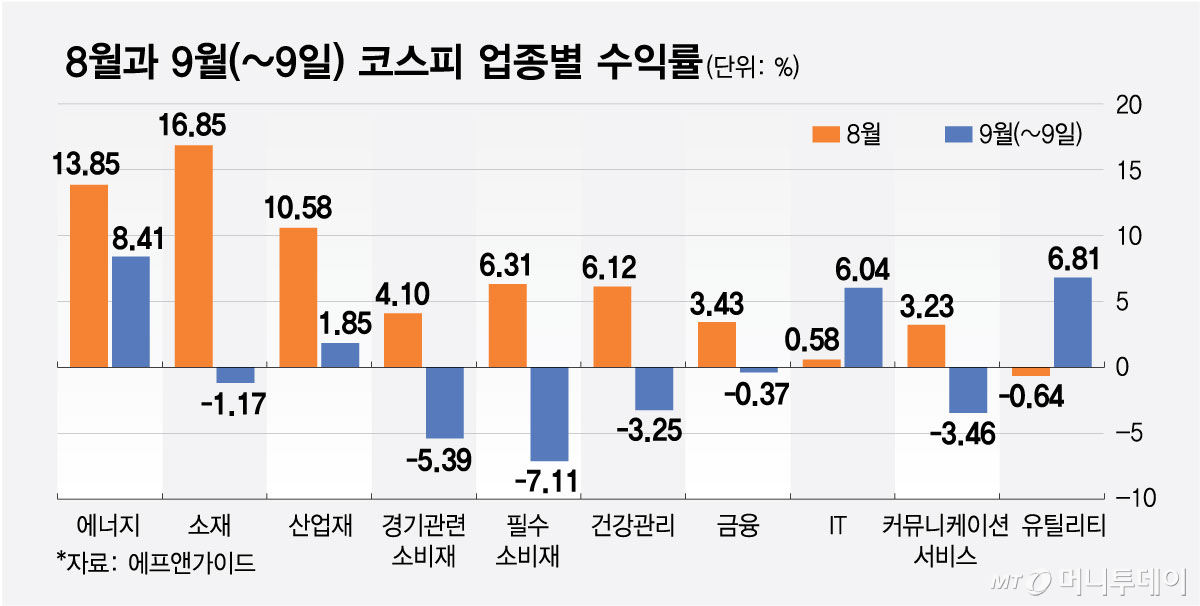
According to financial information platform F&Guide and the financial investment industry as of the 9th, the return for the IT sector, which includes KOSPI’s leading semiconductor stocks, reached 6.04% this month.
Compared to last month's 0.58% and July's -29.11%, this early-month rebound is notable. Despite global geopolitical instability, the release of OpenAI’s next-generation AI (artificial intelligence) model "GPT-6 Astra" has reconfirmed expectations for a semiconductor supercycle, reviving investor sentiment.
Experts believe that the recent upward momentum in semiconductors is spreading across the broader IT sector. Han Ji-young, a researcher at Kiwoom Securities, stated, "Looking only at the 9th, while semiconductors rose 1.6%, other AI infrastructure sectors such as IT appliances (5.4%), chemicals (5.2%), and machinery (3.9%) showed stronger gains that drove the index higher." She added, "The fact that upward momentum has spread beyond semiconductors to other sectors even amid high uncertainty in the Middle East and macroeconomic conditions indicates that the supply-demand foundation and resilience of the domestic stock market have improved compared to before."
In fact, energy (8.41%) and utilities (6.81%) sectors, which are closely linked with AI and data center power demands, recorded higher returns than the IT sector this month. Even as concerns over rising oil prices and interest rates persisted on the day, the KOSPI dipped below 6,900 during trading hours but managed to hold above 7,000 by recovering some of its losses in the latter half of the session, closing at 7,033.92 led by semiconductor stocks.
Im Jeong-eun, a researcher at KB Securities, said, "Although Samsung Electronics and SK Hynix closed nearly flat, TSMC’s August sales hitting an all-time high supported investor sentiment."
However, the sector rotation pattern (sequential movement of buying pressure) seen across all sectors last month has weakened. In August alone, the materials sector recorded the highest return at 16.85% on the KOSPI.
Until the first half of this year, returns in the materials sector had fallen 4.48% compared to the end of last year. In July, they dropped by more than 9%. However, it is observed that rising raw material prices and improved exports have positively impacted the materials sector since August.
Specifically, international copper prices surged to an all-time high in mid-August, causing non-ferrous metal stocks such as Korea Zinc to rally sharply. Export indicators for steel and chemicals also improved. Following this, energy and industrial goods sectors posted double-digit returns of 13.85% and 10.58%, respectively, last month. The energy sector was influenced by increased power demand due to expanded AI investments, expectations for nuclear power plant investments, and a rebound in secondary batteries. The industrial goods sector, which includes shipbuilding and defense, saw its returns boosted by improved order books and expanding global defense spending.
Other sectors such as essential consumer goods (6.31%) and health care (6.12%) also outperformed the KOSPI’s overall return of 3.40% last month. This contrasts with July, when the KOSPI experienced peak volatility; at that time, only essential consumer goods (4.90%) and health care (2.22%) posted positive returns, while other sectors showed negative or flat performance.
A securities industry official stated, "The KOSPI Advance-Decline Ratio (ADR), which reflects the ratio of rising to falling stocks among listed companies, briefly exceeded 140% in August but has recently fallen to around 80%. As the intensity of sector rotation has weakened, whether leading stocks such as semiconductors can continue to support index gains will be key to future market trends."

 in STOCK
