

U.S.-based BlackSky operates a constellation of ultra-small observation satellites in low Earth orbit, enabling real-time monitoring of strategic ground targets. A subsidiary of Spaceflight Industries, the company was founded in 2013. At that time, the satellite imagery market was dominated by a few large government-funded satellites; obtaining even a single image required paying thousands of dollars (millions of won) and waiting several days. Aerospace engineer Jason Andrew launched BlackSky with the vision of completely transforming both pricing and imaging frequency using dozens of ultra-small satellites.
The company went public in 2021 through a merger with a SPAC (Special Purpose Acquisition Company) on the New York Stock Exchange. Its then-recognized corporate valuation was approximately $1.5 billion (about ₩2.115 trillion). Palantir participated as an equity investor, drawing significant attention. However, BlackSky reported a net loss of $245.64 million (approximately ₩329.4 billion) in its first year as a public company in 2021, and its 2023 revenue of $94.49 million reached only 42% of the pre-IPO commitment. In 2024, the stock price fell more than 90% compared to its early listing levels, prompting the company to execute a reverse stock split in September of that year, consolidating eight shares into one.
However, Russia's invasion of Ukraine in February 2022 became a turning point for the company's recovery. Shortly after the war began, some satellite images capturing Russian military convoys near Kyiv were sourced from BlackSky satellites. Following this, key customers included the U.S. National Reconnaissance Office (NRO), other intelligence institutional investors, and Ministries of National Defense across various countries.
BlackSky does not sell satellite imagery one by one; instead, it provides information via a subscription-based model through its software platform called "Spectra," similar to Netflix. When customers specify a desired region, satellites are automatically assigned missions to capture images, which are then processed and transmitted with analysis results delivered within as little as 30 minutes to one hour. As of late June this year, more than 80% of the $378.1 million (approximately ₩50.7 billion) in backlog orders consisted of multi-year subscription contracts.
BlackSky's "Gen-3" satellites can identify objects as small as 35 centimeters on the ground. While not quite matching Maxar's 30-centimeter resolution, they are capable of tactical-level identification, distinguishing between passenger cars and trucks, and identifying aircraft types. Equipped with a 1-meter-class SWIR (short-wave infrared) sensor, these satellites also support night and low-light imaging. Video updates occur up to 15 times per day.
AI-powered analytical capabilities are also advanced. The Spectra platform automatically detects and classifies over 30 types of tactical targets, including vehicles, aircraft, and ships. At the July "Farnborough Air Show" in the United Kingdom, the system successfully identified 86 aircraft and 22,258 vehicles from a single satellite image.
BlackSky's revenue grew from $34.09 million in 2021 to $160.8 million (approximately ₩142.9 billion) in 2025. Second-quarter revenue reached $33.32 million (about ₩44.7 billion), marking a 50.1% surge year-over-year and setting a quarterly record high. During this period, overseas revenue jumped 200% compared to the same period last year, with more than 80% of confirmed backlog orders coming from foreign customers. Adjusted EBITDA (operating profit before depreciation) turned positive at $4.73 million (approximately ₩640 million), achieving a margin of 14.2%, reversing from a loss of $2.82 million in the same period last year.
BlackSky plans to launch two additional Gen-3 satellites during the third quarter. Three units are currently being produced at its factory in Tualatin, Washington, and the company aims to increase its orbital Gen-3 fleet to eight by year-end.
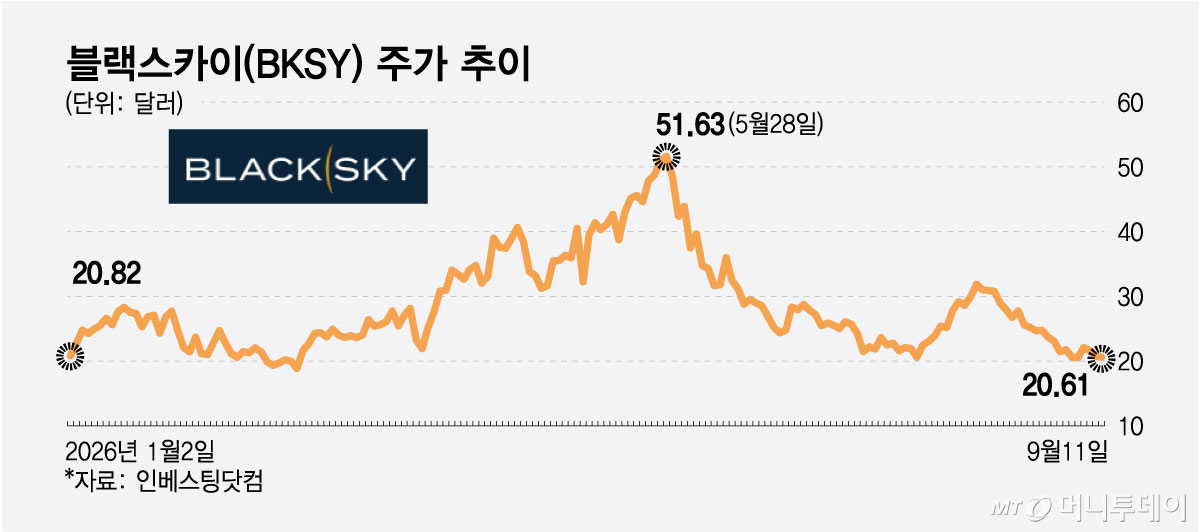
The average target price set by eight Wall Street analysts is $38.42, which is 86% higher than the current stock price of $20.61 (closing price on the 11th). However, investors should be cautious about its high volatility. The stock surged more than fourfold from a 52-week low of $12.41 to as high as $51.63 by late May this year, but has since fallen 60% from that peak. The sharp decline was triggered by reports suggesting the NRO could cut its commercial satellite imagery budget by more than 30%, compounded by insider stock sales by executives including the CEO and short-selling reports.

 in STOCK
