

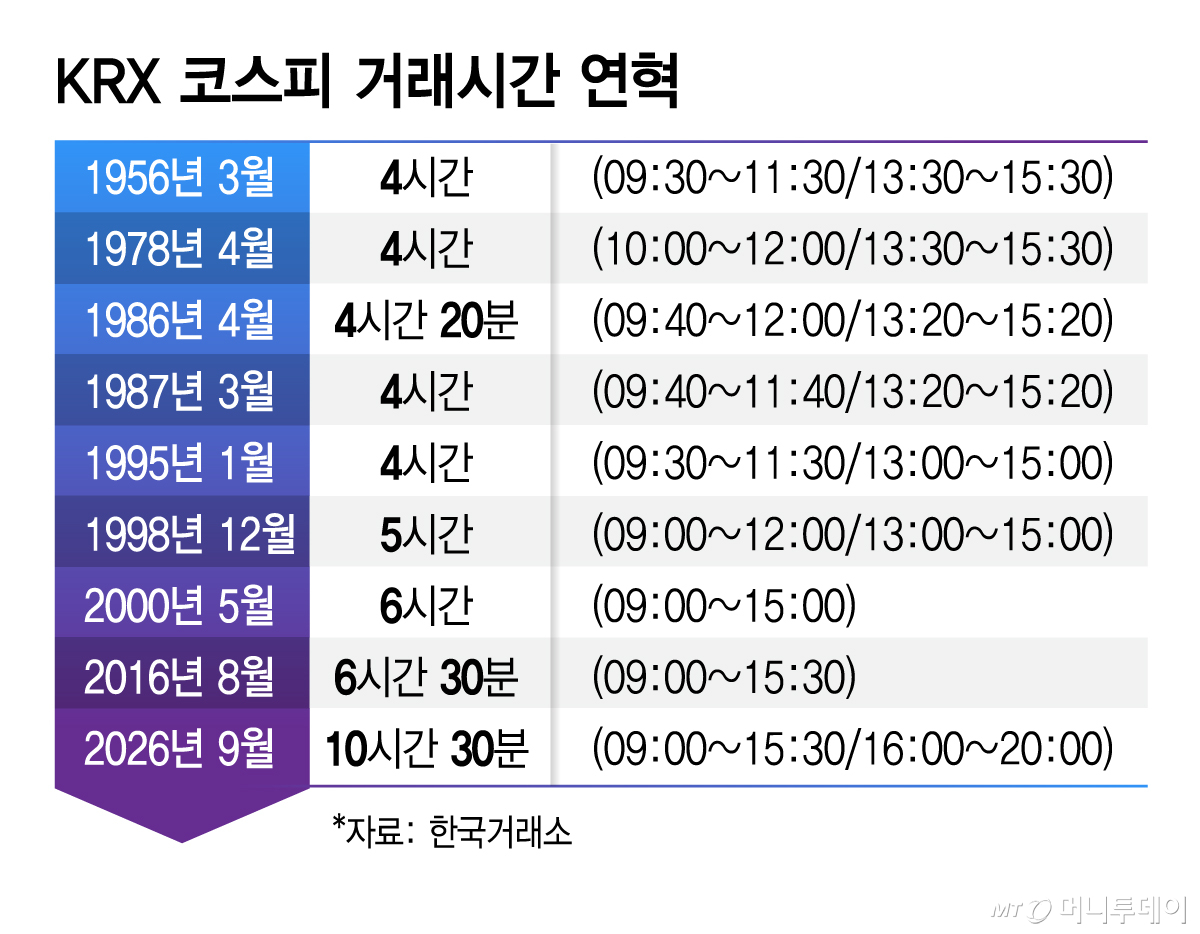
The Korea Exchange (KRX) will launch its after-market starting on Monday. Unlike alternative trading systems (ATS), which allow trading only in specific stocks, the after-market enables trading of all KOSPI and KOSDAQ-listed stocks.
Financial authorities and the exchange are considering the long-term introduction of a 24-hour trading system, making the successful establishment of this after-market crucial.
◇ After-market extended to 4 hours… Ultimate Goal is 24-hour trading
The Exchange’s after-market operating hours run from 4 p.m. to 8 p.m., extending the total daily trading time by four hours compared to the existing regular session (9 a.m. to 3:30 p.m.), totaling 10 hours and 30 minutes of stock trading availability.
Originally, the exchange had considered extending daily trading hours to 12 hours starting from late June this year, aiming for implementation since last year. Alongside the after-market, it also prepared to introduce a pre-market session allowing investors to buy and sell all stocks before the regular session begins at 7:50 a.m., even during their morning commute.
However, due to concerns raised by the securities industry regarding computational development burdens and system stability, the after-market launch was delayed from June to September, while discussions continued on introducing the pre-market at a later date.
Nevertheless, the ultimate policy direction of both the government and the Exchange remains unchanged: continuously extending trading hours over time. Policymakers agree that building a system capable of 12-hour daily trading through the pre-market — and eventually enabling 24-hour trading — is the goal.
Recently, KRX President Jeong Eun-bo visited the United States and signed a memorandum of understanding (MOU) with the New York Stock Exchange (NYSE), reflecting this strategic intent. Through this MOU, the Exchange plans to share experiences and expertise related to NYSE’s extended trading hours and associated matters, and to establish joint councils for cooperation when necessary.
◇ Drawing attention from retail Investors trading overseas
The government and the exchange are pushing for 24-hour trading because domestic retail investors investing abroad have gained significant influence since the pandemic. There is growing need to actively absorb investor demand for free, anytime, anywhere trading via online platforms and mobile devices within Korea’s own market.
In particular, as interest in the U.S. market intensifies, both NYSE and NASDAQ are also paying close attention to retail liquidity from Asia.
According to a February report released by NYSE, trading outside regular hours increased more than twofold — from 5% at the beginning of 2019 to 11% in early 2025 — driven by expanded participation from overseas investors. Notably, the report indicates that pre-market trading volume grew sevenfold from 2019 to early 2025. Considering time zone differences, NYSE’s pre-market hours (from 5 p.m. to 10 p.m. Korean time) overlap with evening hours for domestic investors.
Ultimately, extending trading hours is a policy primarily aimed at retaining investor liquidity within the country — akin to controlling wild rabbits.
Additionally, amid the recent semiconductor supercycle (a period of exceptional prosperity), there are numerous foreign retail investors showing interest in Korea’s market.
The view is that a market for foreign retail investors buying Korean stocks could emerge as regulatory improvements lower barriers to accessing omnibus accounts for foreign investors from this year.

 in STOCK
