

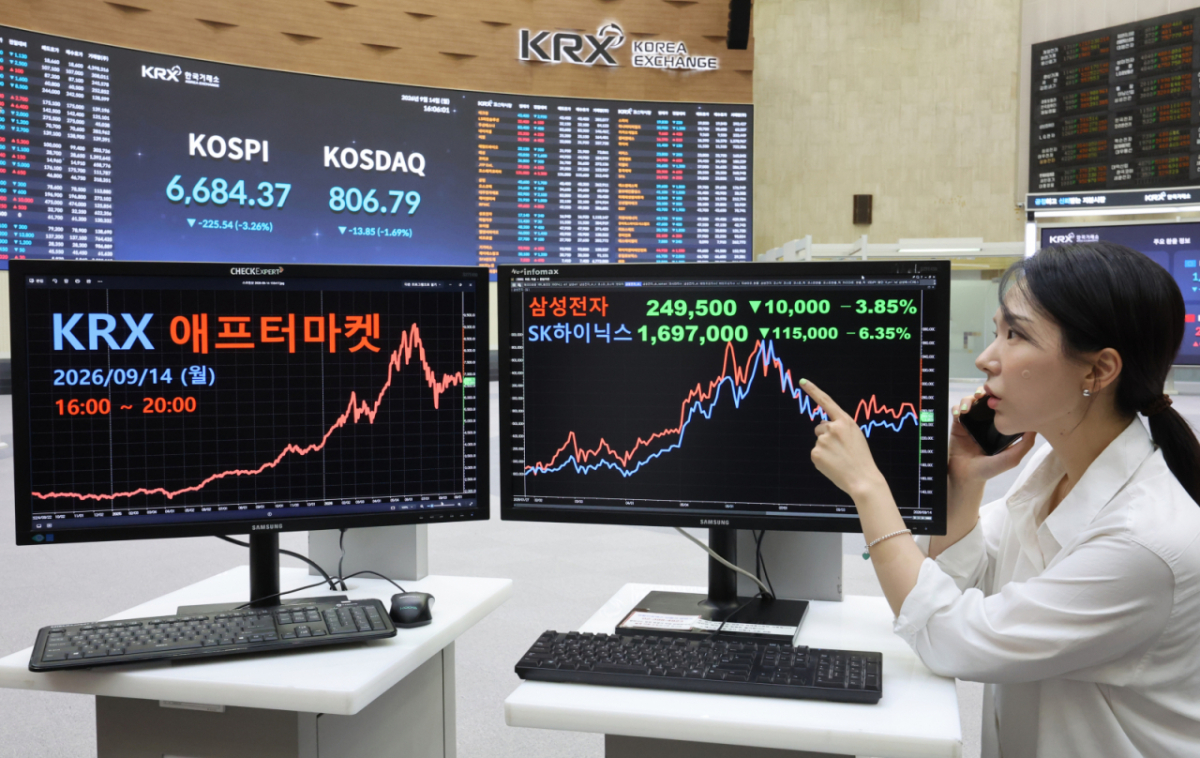
It was revealed that trading volume exceeding 1.8 trillion won took place on the first day of the KRX aftermarket. The vast majority of the total transaction value was accounted for by retail investors.
According to the exchange, after-market trading from 4 p.m. to 8 p.m. on the 14th totaled 1.8177 trillion won (72.24 million shares), with KOSPI accounting for approximately 1.3 trillion won and KOSDAQ for 492.4 billion won.
This represents 6.6% of the total trading value within the exchange on that day (27.6 trillion won). The exchange analyzed that investor demand for buying and selling continued steadily even after the regular market session ended.
Looking at aftermarket trading trends, retail investors made a net purchase totaling 53.7 billion won, institutional investors sold net 6.3 billion won, and foreign investors sold net 48 billion won.
Participation shares were recorded as follows: retail investors 93.0%, foreign investors 3.9%, and institutional investors 2.1%. Order execution was reported at 73% via Mobile Trading System (MTS) and 21% via Home Trading System (HTS).
Trading occurred in 2,414 out of 2,051 listed securities (96%). Intraday high-low volatility was 2.9% for KOSPI and 4.6% for KOSDAQ.
Starting from this day, the exchange abolished after-hours single-price trading between 4 p.m. and 6 p.m. and introduced the aftermarket running from 4 p.m. to 8 p.m.
Unlike the alternative trading system (ATS) NextTrade (NXT) aftermarket, which was limited to around 600 securities, the exchange's aftermarket allows trading in most KOSPI and KOSDAQ stocks. However, the exchange decided to exclude securities under management or suspension, as well as those with investment warnings or classified as risky, from aftermarket trading targets.
The exchange stated, "With the introduction of the aftermarket, domestic and foreign investment information generated after the regular market session can now be reflected in stock prices in real time," adding that "investors can adjust their portfolios more quickly."
It further noted, "This initiative expands opportunities for foreign investors to trade by overcoming time zone constraints, strengthening global accessibility. In a context where liquidity competition is intensifying globally—with major U.S. exchanges such as NASDAQ launching 23-hour trading in December this year—we have laid the infrastructure foundation for our capital market to compete internationally."

 in STOCK
