

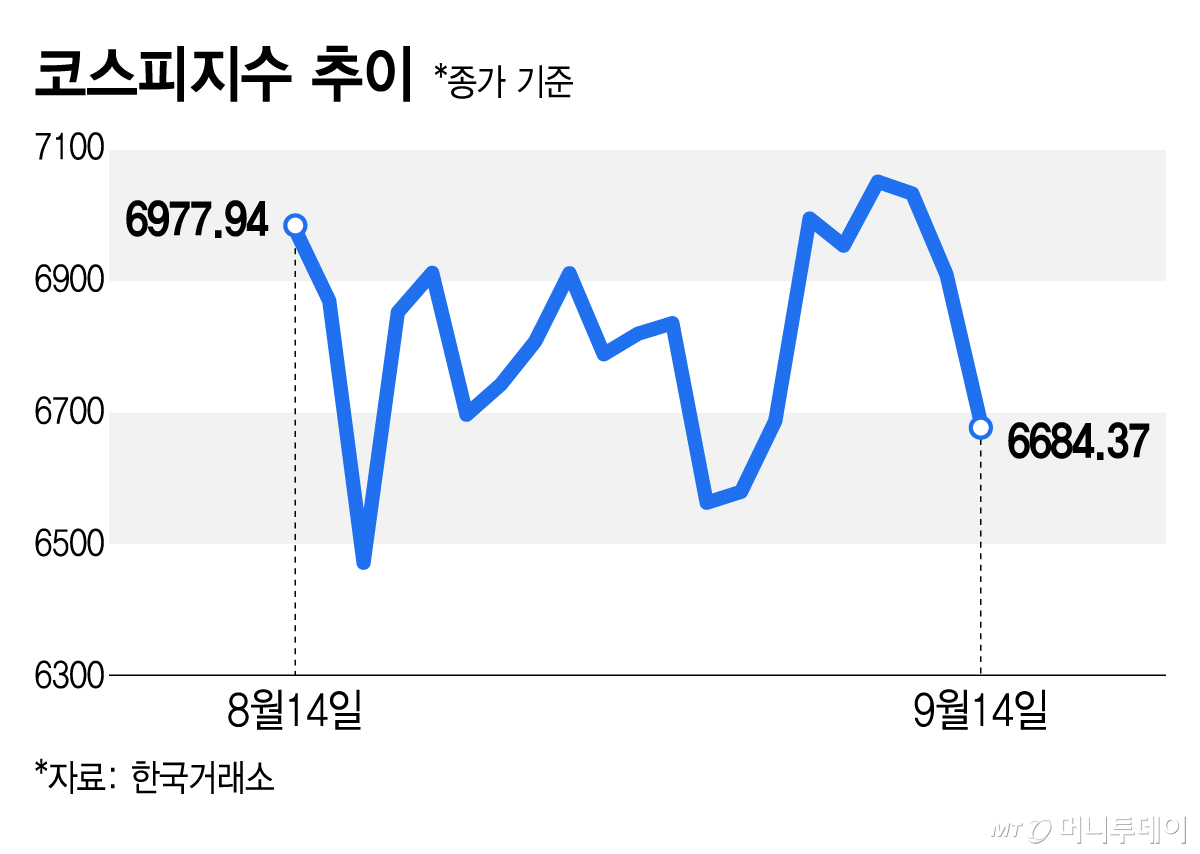
On the 14th, the KOSPI index closed down more than 3%, amid concerns over a potential interest rate hike ahead of the Federal Open Market Committee (FOMC) regular meeting and a sharp surge in international oil prices triggered by tensions in the Middle East. For the foreseeable future, domestic stock markets are expected to be influenced by movements in U.S. equities, U.S. Treasury yields, Middle Eastern geopolitical developments, and global oil prices.
The KOSPI index closed at 6,684.37, down 225.54 points (3.26%) from the previous trading day. While individuals made net purchases totaling 297.45 billion won, foreign investors and institutional investors sold off holdings worth 328.75 billion won and 117.39 billion won, respectively.
Signs of a U.S. interest rate hike, rising oil prices due to deteriorating conditions in the Middle East, and pessimistic remarks from industry players regarding the AI (artificial intelligence) sector dampened investor sentiment.
Samsung Electronics fell 4.05% to close at 249,000 won, while SK Hynix dropped 6.35% to end at 1.697 million won. Semiconductor-related stocks also declined in tandem, including SK Square (-8.17%), Samsung Electronics Preferred (-5.12%), and Samsung Electric (-4.50%). In contrast, financial stocks rose, with Woori Financial Holdings up 4.99% and KB Financial Holdings (KB Financial) gaining 2.08%.
Market attention is now focused on the September FOMC meeting scheduled for the 15th–16th (local time). According to the CME FedWatch Tool as of the 14th, there was an 86% probability that the U.S. base rate would be raised by 0.25 percentage points this month.
The situation in the Middle East remains a key variable. International oil prices surged after reports emerged that a pipeline connecting Saudi Arabia's east and west was halted due to a drone attack, and an additional vessel transiting the Strait of Hormuz was struck. Talks between Iran and Gulf states regarding navigation through the Strait of Hormuz, which were scheduled to be held in Oman, have also been postponed.
Movements in AI-related stocks also warrant attention. Kang Jin-hyuk, a researcher at Shinhan Investment Corp., stated, "Anthropic and Elon Musk have raised concerns about the need for speed control to address AI safety issues, and OpenAI withdrew its planned listing this year for similar reasons." He added, "U.S. President Donald Trump, who views AI as a strategic asset, has countered these claims, while NVIDIA is also considering investing $10 billion in Anthropic's initial public offering (IPO), indicating that the debate continues."
Han Ji-young, a researcher at Kiwoom Securities, said, "This week, with major monetary policy events approaching, short-term volatility expansion in domestic stock markets appears inevitable." She noted, "If the U.S. 10-year Treasury yield stabilizes below 5% and foreign investors resume net purchases, the stock market could continue its recovery trend." She further added, "Given that recent AI demand and memory sector outlooks remain intact, buying pressure centered on semiconductors may support the lower bound of the index even during a correction phase."
The KOSDAQ index closed down 1.69% at 806.79. Individuals made net purchases worth 109.4 billion won, while foreign investors and institutional investors sold off holdings totaling 93.1 billion won and 30 billion won, respectively. EcoPro BM fell 5.80%, Simtek dropped 4.95%, and iOTechnics declined 3.93%.

 in STOCK
