

While a debate has emerged within the AI (artificial intelligence) industry over slowing down AI model development, dampening investor sentiment, opposing views are also being voiced. The argument is that the AI industry is structurally bound to grow in the long term. In the ETF (exchange-traded fund) market, listings of AI and semiconductor-related ETFs continue, and investor interest remains steady.
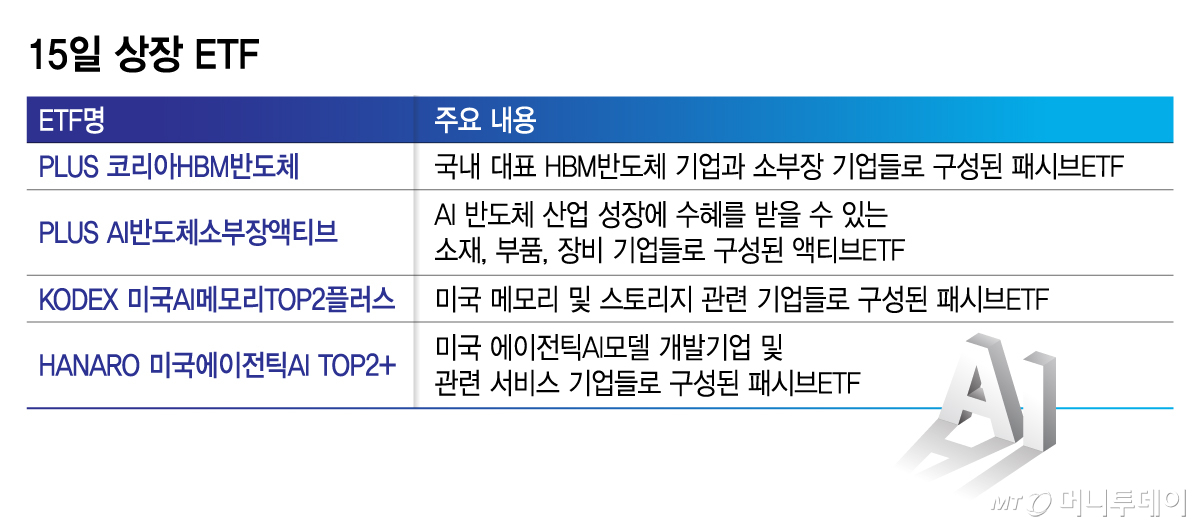
On the 15th, the KOSPI market saw the listing of 'KODEX U.S. AI Memory TOP2 Plus', 'HANARO U.S. Agentic AI TOP2+', 'PLUS AIBan Do-che-so (Director)Active', and 'PLUS Korea HBM Semiconductor'.
'KODEX U.S. AI Memory TOP2 Plus' is an ETF that invests in data storage device companies growing structurally due to the spread of the AI industry, allocating approximately 50% to Micron and SanDisk, and about 30% to Seagate and Western Digital. 'HANARO U.S. Agentic AI TOP2+' is a product investing in 10 stocks related to agentic AI listed on U.S. exchanges and the technology ecosystems supporting them. Agentic AI refers to AI that sets goals and formulates plans without individual user instructions, performing tasks autonomously.
'PLUS Korea HBM Semiconductor' is an ETF investing approximately 50% in Samsung Electronics and SK Hynix, the two leading Korean memory companies accounting for a combined 80% of the global HBM (high-bandwidth memory) market share, with the remaining 50% invested in eight core semiconductor materials, components, and equipment (materials, components and equipment) stocks. 'PLUS AIBan Do-che-so (Director)Active' is an active ETF that selects core materials, components, and equipment companies and actively adjusts stock weights, considering changes in order backlog, revenue, and estimated operating profit, as well as valuation relative to growth rates, to invest in undervalued semiconductor materials, components, and equipment companies in the market.
Recently, while U.S. tech stocks and domestic semiconductor stocks have shown weakness due to AI slowdown theories, interest in investing in AI and semiconductors persists. In particular, as the number of AI and semiconductor-related ETFs increases, investment themes such as U.S. memory companies, agentic AI companies, and HBM companies are becoming more detailed and diverse.
Previously, ETFs investing in NAND flash memory, CPU (central processing unit) semiconductors, and AI data centers were listed, with 'ACE U.S. CPU Semiconductor TOP3', 'IBKHan Mi (CEO)Corporate TOP2+ Bond Mixed Active', and 'KODEX U.S. AI Agent Active' preparing for listing.
The continued launch of ETFs investing in AI and Ban Do-che (CEO)companies signifies that expectations for growth in this sector remain strong.
Hwang Soo-wook, a researcher at Meritz Securities, stated, "Proposals to slow down AI development can be interpreted as moves by AI frontiers to prepare for continued competition." He added, "Viewing the virtuous cycle of AI infrastructure investment based on AI monetization, there is no need to interpret the slowdown theory issue pessimistically regarding AI infrastructure stocks."
However, as competition among asset managers intensifies, concerns are also raised about similar ETFs appearing consecutively and overlapping or concentrated holdings even among different theme ETFs. For example, among recently listed products, 'PLUS Korea HBM Semiconductor', 'RISE Global AI NAND Memory Semiconductor', 'KIWOOM SamsungSK GroupTOP4+', and 'ACE Semiconductor Plus Strategic Industry' all hold approximately 50% in Samsung Electronics and SK Hynix despite having different themes.
An industry official said, "While the number of AI and semiconductor products has increased recently, diversifying themes, stock overlaps are inevitable to some extent," but also noted, "Efforts to differentiate through weight differences or active strategies are also increasing."

 in STOCK
