

As high-interest rate environments continue globally, financial stock ETFs (exchange-traded funds) are gaining attention. Even among financial stock ETFs, the degree of benefit from rising interest rates varies across banks, insurance companies, and securities firms, leading to divergent returns depending on which sectors are primarily included in their portfolios.
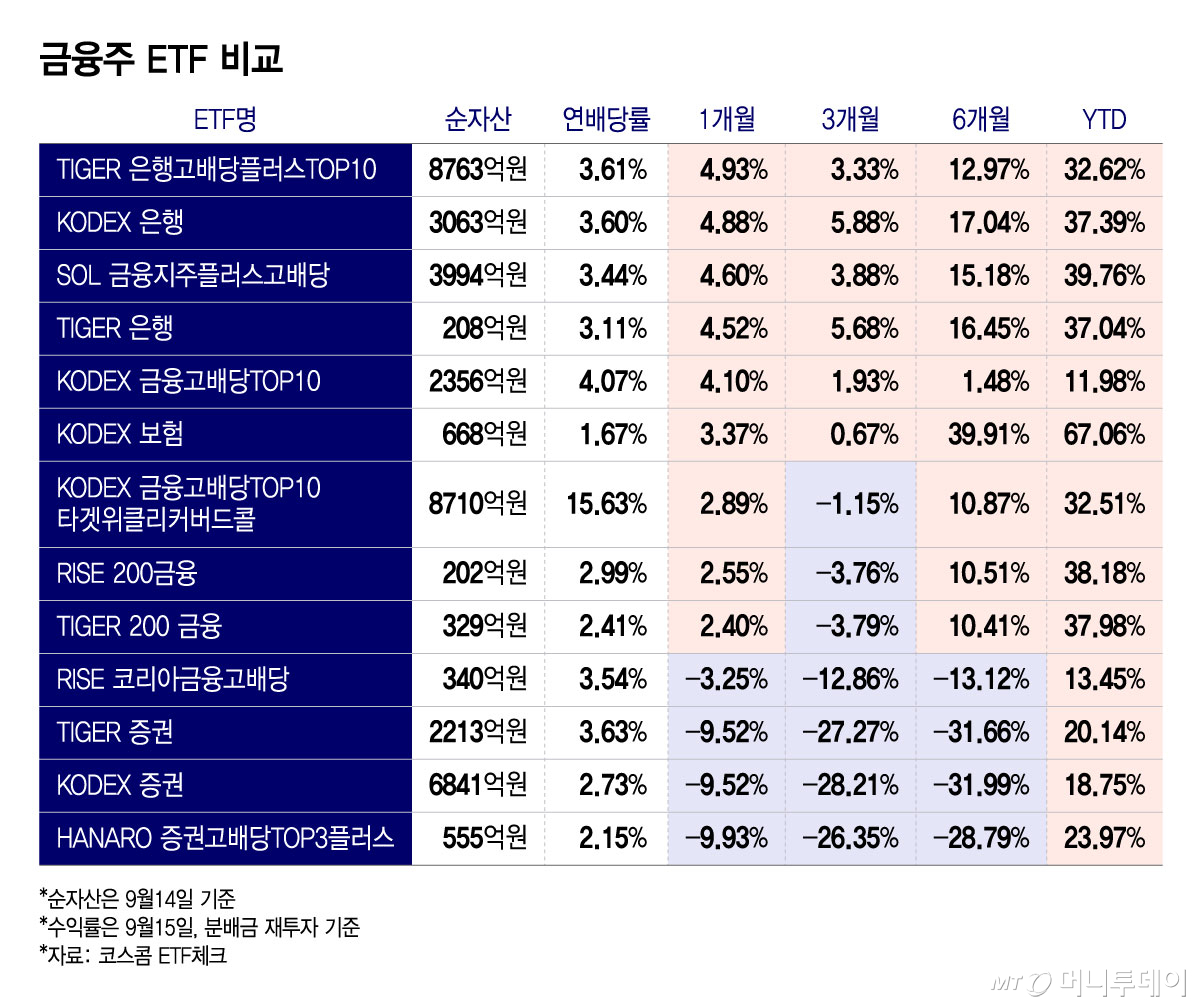
According to KOSCOM's ETF Check on the 16th, the financial stock ETF with the highest one-month return (based on reinvested distributions) as of the previous day was 'TIGER Bank High Dividend Plus TOP10', recording a return of 4.93%.
Following that were △'KODEX Bank' (4.88%), △'SOL Financial Holding Plus High Dividend' (4.60%), △'TIGER Bank' (4.52%), and △'KODEX Financial High Dividend TOP10' (4.10%).
Most ETFs with high allocations to bank stocks in their portfolios showed strong returns. This is because rising market interest rates have improved investment sentiment toward bank stocks. When market interest rates rise, loan interest rates increase quickly while deposit interest rates are reflected more slowly, leading to an expansion of the net interest margin (NIM), which represents the gap between banks' interest income and interest expenses.
Over the past month, Woori Financial Holdings (9.16%), Shinhan Financial Group (5.25%), Hana Financial Group (5.04%), and KB Financial (4.58%) all rose simultaneously.
Regarding returns since the beginning of the year, ETFs with high allocations to insurance stocks performed well. 'KODEX Insurance' recorded a return of 67.06%. 'SOL Financial Holding Plus High Dividend' (39.76%), 'RISE 200 Financial' (38.18%), and 'TIGER 200 Financial' (37.98%) also ranked among the top performers.
This was partly due to Samsung Life Insurance, which holds stakes in Samsung Electronics, rising alongside Samsung Electronics. As Samsung Electronics surged since the beginning of the year, Samsung Life Insurance and Samsung C&T, both holding stakes in it, attracted market attention. Particularly, growing expectations for shareholder returns from Samsung Electronics drove Samsung Life Insurance significantly higher. Since the start of the year, Samsung Life Insurance has jumped 81.15%.
The high-interest rate environment is also a positive factor for the insurance sector. Insurance companies calculate liabilities such as insurance payouts due decades in the future at current values, applying discount rates that reflect market interest rates. When market interest rates rise, discount rates increase, reducing insurance liabilities and thereby expanding insurance capital.
Since the beginning of the year, DB Insurance (43.94%), Samsung Fire & Marine Insurance (33.00%), and Hyundai Marine & Fire Insurance (59.74%) also surged significantly.
Conversely, ETFs with high allocations to securities stocks showed relatively lower short- to medium-term returns. 'HANARO Securities High Dividend TOP3 Plus' recorded a one-month return of -9.93%, the lowest among financial stock ETFs. Its return since the beginning of the year was 23.97%, placing it in the middle range. Returns over three and six months were -26.35% and -28.79%, respectively.
'KODEX Securities' (-9.52%), 'TIGER Securities' (-9.52%), and 'RISE Korea Financial High Dividend' (-3.25%) all recorded negative one-month returns.
Kim Jae-woo, a researcher at Samsung Securities, stated, "As market interest rates continue to remain high, the securities sector, whose fundamentals are negatively affected by rising interest rates,"
"investment sentiment continues to deteriorate," he analyzed. When market interest rates rise, returns from deposits or bonds increase, leading investors to avoid risky assets such as stocks.
Regarding annual distribution yields, the covered call ETF 'KODEX Financial High Dividend TOP10 Target Weekly Covered Call' led with 16.63%. Covered calls generate premium income by selling the right to purchase underlying assets at a specific price (call options), which is then distributed as dividends, typically resulting in higher annual distribution yields. However, returns may be lower compared to other ETFs.
In terms of net asset size, 'TIGER Bank High Dividend Plus TOP10' was the largest with 876.3 billion won as of the 14th. This was followed by △'KODEX Financial High Dividend TOP10 Target Weekly Covered Call' (net assets of 871 billion won), △'KODEX Securities' (684.1 billion won), △'SOL Financial Holding Plus High Dividend' (399.4 billion won), and △'KODEX Bank' (306.3 billion won).

 in STOCK

