

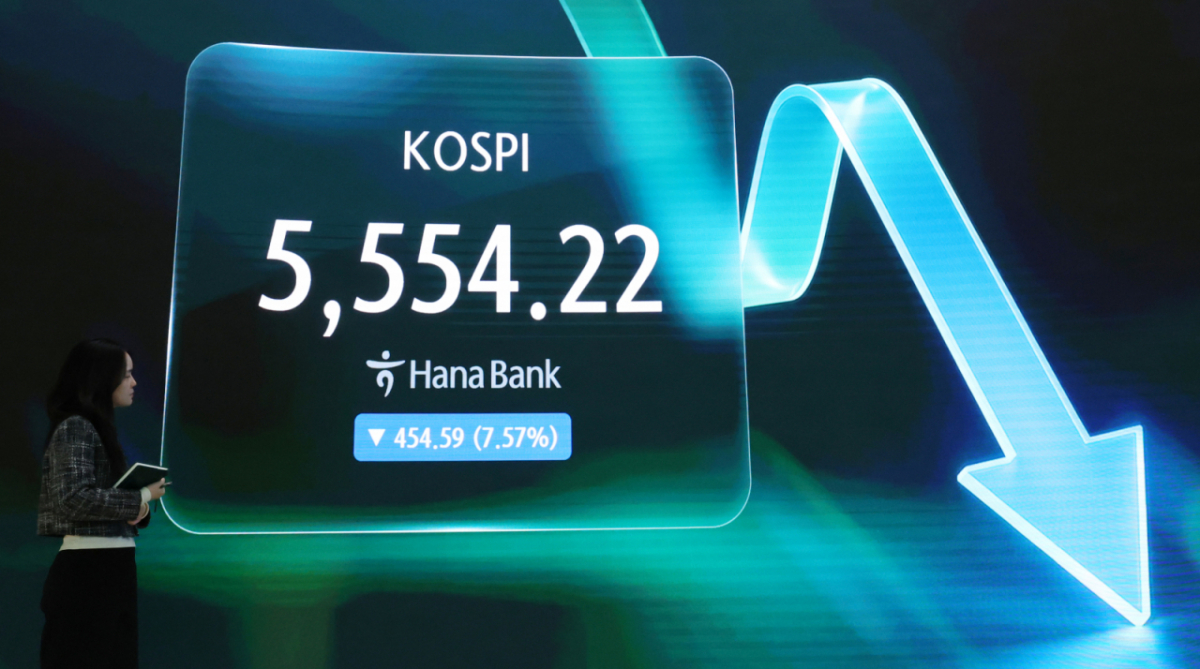
The KOSPI index plunged below the 5,500 mark on the 15th. As a U.S. inflation shock and AI (artificial intelligence) credit risks stemming from CoreWeave converged, Samsung Electronics and SK Hynix fell by around 10%. In the aftermath, sidecar (futures market circuit breaker) and circuit breakers were triggered in succession across both major markets.
On this day, the KOSPI index ended regular trading on the Korea Exchange at 5554.22, down 454.59 points (7.57%) from the previous trading day. This marked the first time the KOSPI index had fallen below the 5,500 line since July 30 (5593.56). According to exchange data, foreign investors made net sales worth 3.6254 trillion won in the KOSPI market on this day. Institutional investors and retail investors made net purchases of 1.6907 trillion won and 1.2923 trillion won, respectively, but could not offset the selling pressure from foreigners. Foreign investors had been making net sales in the KOSPI market for eight consecutive trading days.
In an unprecedented crash, sidecar (futures market circuit breaker) was followed by the activation of circuit breakers in both major markets. At 12:23 p.m., a Stage 1 circuit breaker was triggered in the KOSDAQ market, and at 12:38 p.m., one was triggered in the KOSPI market, halting all trading for 20 minutes each. Simultaneous activation of circuit breakers had not occurred since July 29, marking a span of 51 trading days. The KOSDAQ index also ended regular trading at 760.82, down 63.06 points (7.65%).
Yoon Seok-mo, head of the research center at Samsung Securities, explained, "The U.S. September CPI (consumer price index) rose 3.7% year-on-year, exceeding market expectations (3.6%), and core CPI also came in at 2.6%, surpassing the forecast (2.5%)." He added, "The Philadelphia Semiconductor Index plunged by over 4% on the New York stock exchange, exerting strong downward pressure on the domestic stock market."
Seoul apartment prices rose for the 88th consecutive week, extending the record for the longest streak of gains, while the magnitude of the increase also expanded for the second consecutive week. The upward trend strengthened across Seoul as Yongsan-gu shifted to a rising trajectory and price increases continued in mid- and low-priced areas. Gains in the southern region of Gyeonggi Province have also accelerated again. According to the weekly apartment price trends nationwide released by the Korea Real Estate Board on this day, based on data from the second week of October (as of the 12th), Seoul's transaction price index rose by 0.16%, a larger increase than Jeonju (0.12%).

 in STOCK
