

Consumer complaints have emerged at Shinhan Investment Corp., following KB Securities, alleging that the management method of brokerage firms' target-conversion wrap accounts is inappropriate. These products sold nearly 30 trillion won over the past year. The complaints state that despite achieving the target return rate, funds could not be converted to safe assets in a timely manner due to selling order or trading halts. As sales were concentrated around the market peak in June, investor losses are expected to be substantial. It is pointed out that even for accounts enrolled in the same round, management differs by account, leading to differences in returns, and that the 'Nth round' sales method makes it difficult for investors to understand this.
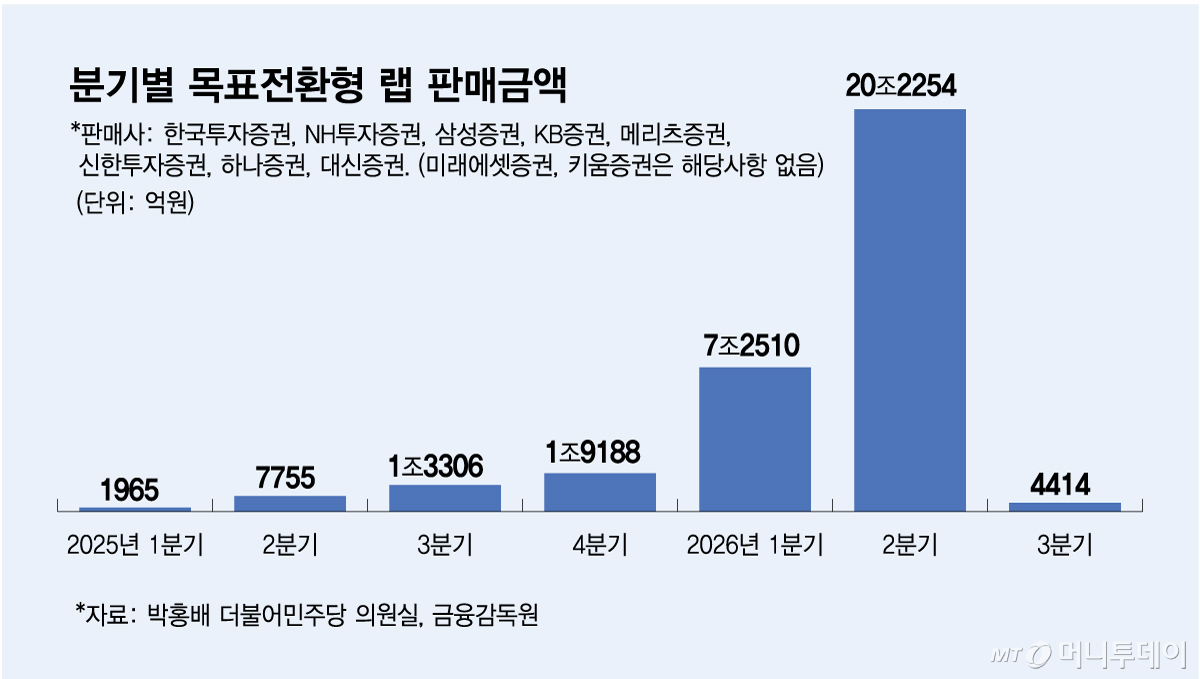
According to documents submitted on the 28th by the Financial Supervisory Service to the office of Democratic Party of Korea lawmaker Park Hong-bae, a member of the National Assembly's Political Affairs Committee, total sales of target-conversion wrap accounts at major brokerage firms reached 29.8366 trillion won from Q4 last year through Q3 this year. In particular, 27.9178 trillion won was sold this year alone, a sharp increase of 561.3% compared to the full-year sales of last year (4.2214 trillion won). Sales were 7.2510 trillion won in Q1, and 20.2254 trillion won was sold in Q2, when the KOSPI index rose vertically.
A target-conversion wrap account is a product that invests in risky assets such as stocks and converts to bonds or other safe assets upon reaching a target return rate (typically 5–8%). Its characteristic feature is that it manages customer accounts individually rather than pooling multiple customers' assets for joint management. It is primarily chosen by investors who want to shift their funds into safe assets after achieving a certain level of returns.
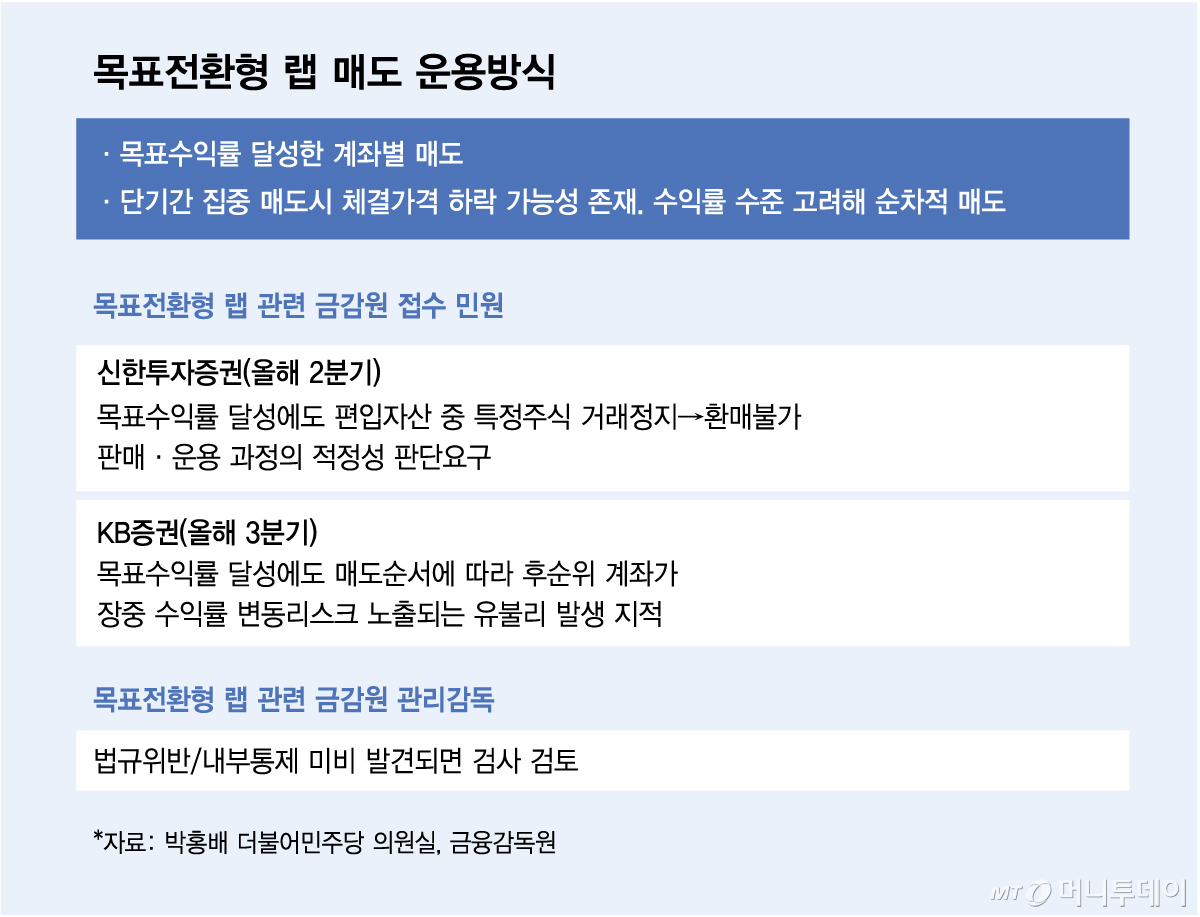
The issue is that investors are dissatisfied with the 'management method' because, despite achieving the target return rate, their investments were not converted to safe assets. According to the same documents, investors filed complaints regarding the management methods of target-conversion wrap accounts at Shinhan Investment Corp. and KB Securities, respectively.
A complaint was received by Shinhan Investment Corp. stating, "Although the target return rate was achieved, trading in a specific stock among the included assets was halted, making redemption impossible," requesting that the Financial Supervisory Service determine the appropriateness of the sales and management process. A complaint was filed with KB Securities stating that accounts whose stock selling order was delayed despite achieving the target return rate saw lower returns, creating advantages and disadvantages depending on the selling order.
The financial investment industry views it as inevitable that issues of advantage or disadvantage based on selling order arise due to the structure of target-conversion wrap accounts, where each account is managed individually. An official in the financial investment industry explained, "Even if enrolled during the same recruitment period, because the brokerage manages accounts individually, returns may differ slightly depending on the enrollment amount and time."
A greater problem is that investors find it difficult to know about such advantages and disadvantages in advance. In fact, brokerage firms recruit customers using expressions like 'Nth customer recruitment for U.S. stock target-conversion wrap account.' As investors, they become dissatisfied, asking, "Why was my order for conversion to safe assets delayed despite enrolling in the same round and achieving the target return rate?" Investors can verify whether the target return rate was achieved, but they cannot know about 'whether their account is junior' or 'the advantages and disadvantages based on selling order' during the process of converting to safe assets.
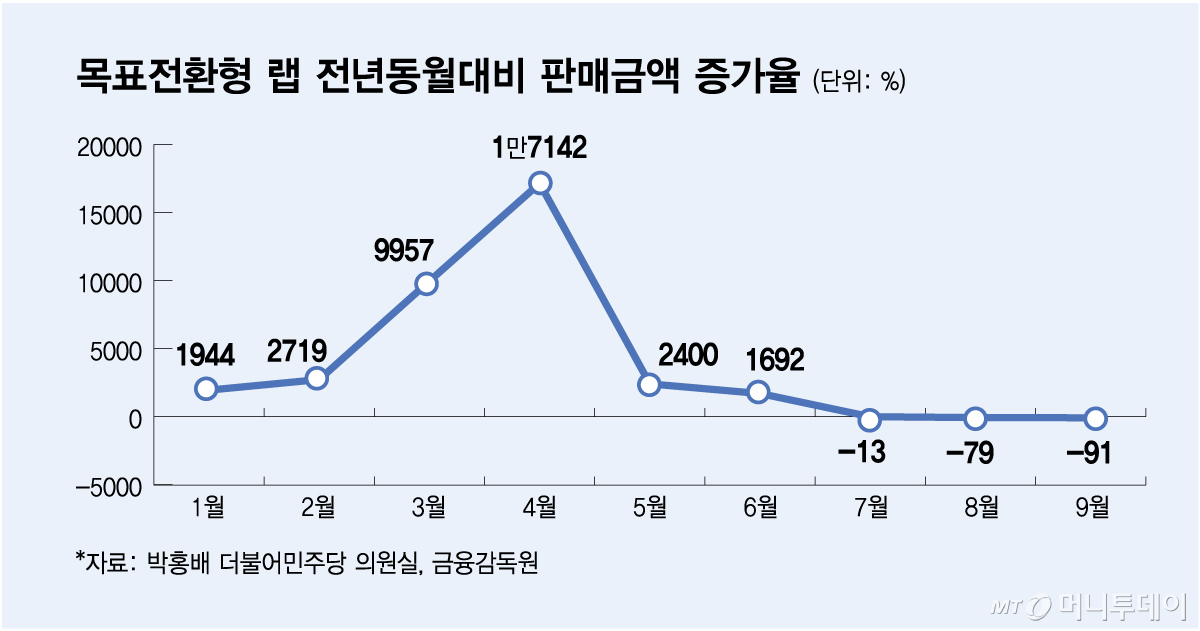
Sales of target-conversion wrap accounts in June, when the KOSPI index hit its peak, surged 1692% compared to the same month last year, suggesting that investor losses will be substantial. Of the Q2 sales of 20.2254 trillion won, those enrolled in April and May likely achieved the target return rate and converted to safe assets, while those enrolled in June may have incurred losses without reaching the target return rate. Sales reached 441.4 billion won even in Q3, when the stock market was sluggish.
The Financial Supervisory Service is also keeping open the possibility of launching an inspection if improper business practices are discovered. In documents submitted to Rep. Park's office, the Financial Supervisory Service stated, "We plan to review whether to conduct an inspection in cases where violations of laws or deficiencies in internal controls are found."
Regarding this, Rep. Park said, "Concerns over investor damage, such as redemption delays, have been raised despite achieving target return rates," adding, "Brokerage firms must strengthen their management procedures and internal controls, and financial authorities must check for any loopholes in investor protection."

 in STOCK


