

The securities industry is on edge after the government unveiled a plan to strengthen pension functions, which includes mandating retirement pensions for all workplaces, introducing a fund-type retirement pension system, and easing investment limits on risky assets.
The concern stems from the fact that if the “big player” National Pension Service enters the retirement pension market, existing operators may be at a disadvantage in terms of economies of scale. Industry players are deliberating on their business strategies while predicting the impact of the institutional improvements and market trends.
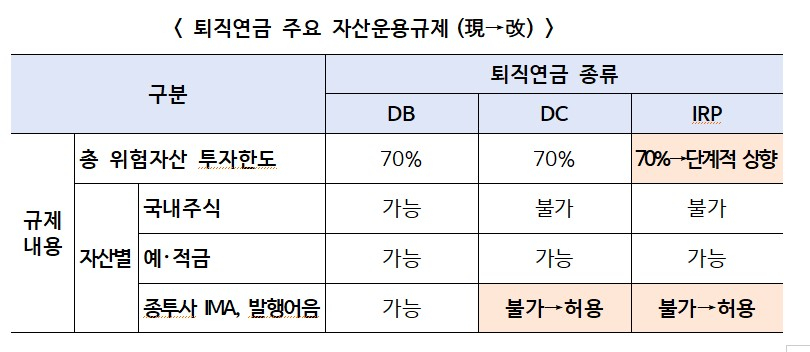
According to the “Plan to Strengthen Retirement Pension Functions” announced by the government on the 29th, the introduction of retirement pensions will be mandated for all workplaces by 2030. Additionally, to enhance the professionalism of retirement pension management, a fund-type system will be introduced, and the 70th% limit on risky assets will be gradually eased, but only for Individual Retirement Pensions (IRPs) among contract-type plans.
The government announced the “Plan to Strengthen Retirement Pension Functions” on Thursday. According to the plan, the introduction of retirement pensions will be mandated for all workplaces by 2030. Furthermore, to enhance the professionalism of retirement pension management, a fund-type system will be introduced, and the 70th% limit on risky assets will be gradually eased, but only for Individual Retirement Pensions (IRPs) among contract-type plans.
Reactions from the financial investment industry are mixed. While some evaluate the plan as a measure to grow retirement pension reserves, improve returns, and protect workers’ right to receive benefits, there is also significant concern about the National Pension Service’s entry into the retirement pension market. An official at a major securities firm said, “The introduction of fund-type retirement pensions may create new business opportunities, but competition will become fierce.”
There are strong concerns that if the “big player” National Pension Service enters as an open operator for public institutions, financial institution open and joint operators could be disadvantaged in terms of economies of scale. An industry official said, “There are differing opinions among labor, management, government, and experts regarding the method and scope of participation by the National Pension Service,” adding that “discussion at the National Assembly level will be necessary.”
It appears that securities firms affiliated with bank holding companies will actively enter the financial institution open category, where private financial institutions establish and operate separate trustee corporations. This is because if a securities firm, bank, and insurance company under the same financial holding group form a consortium to create a separate trustee corporation, they can generate synergies among affiliates and increase retirement pension management assets.
Relatively disadvantaged major securities firms are highly likely to decide whether to enter after observing market trends in the early stages of fund-type introduction. Small and mid-sized securities firms are expected to focus on strengthening their competitiveness as contract-type operators. They appear set to attract new subscribers seeking customized management by offering higher returns, differentiated portfolios, and customer services.
Positive evaluations have emerged regarding the easing of risky asset limits. It is predicted that the flow of retirement pension funds toward performance-linked products and the securities sector will accelerate. The industry also expressed expectations that allowing Investment Management Accounts (IMAs) and issued notes as investment products for Defined Contribution (DC) plans and IRPs would broaden investors’ choices while expanding demand for IMAs and issued notes.
Choi Jong-jin, Head of the Pension Innovation Division at Korea Investment & Securities, said, “As pension investors’ utilization of the capital market increases, an environment has been further built in which workers can enjoy capital market growth,” adding that “as retirement pensions shift from principal-and-interest guaranteed products such as deposits and savings to investment markets, it could help grow assets for old age.”

 in STOCK
