

Active exchange-traded funds (ETFs), where asset managers directly select stocks to pursue excess returns, are bound by regulations requiring them to track an index. This is due to the Capital Markets Act, which mandates maintaining a correlation coefficient of 0.7 or higher with a benchmark index.
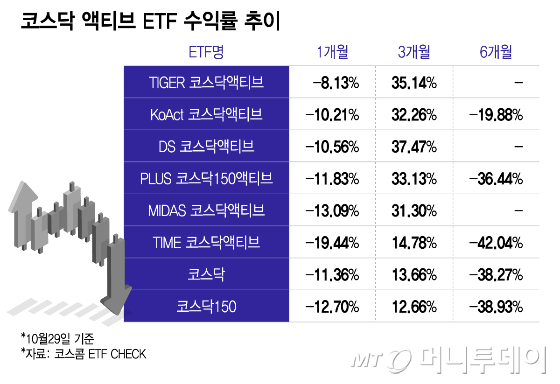
Six KOSDAQ active ETFs have all outperformed their respective indices over the past three months, demonstrating management capabilities, but legal revisions to relax these regulations remain uncertain for passage within this year.
According to KOSCOM ETF CHECK and Korea Exchange on the 29th, the returns of six domestically listed KOSDAQ active ETFs over the past three months ranged from 14.78% to 37.47% as of that day, outperforming both the KOSDAQ Index (13.66%) and the KOSDAQ 150 Index (12.66%). However, some products underperformed the index when looking at returns over the past one month and six months.
All six funds primarily invest in semiconductor materials, components and equipment stocks. As expectations for benefits to materials, components and equipment suppliers grew due to expanded capital investment by memory semiconductor companies, stock prices rose, boosting ETF returns.
While the main theme is the same, a closer look reveals slight differences. The number of constituent stocks ranges from 46 to 85. Even when holding the same stocks, weightings differ, and some stocks are included with high weights in specific ETFs, such as 'Co-sec' in TIGER products. Consequently, returns can vary depending on which stocks an asset manager selects and how much they invest.
However, there is also criticism that all six funds are concentrated in semiconductor materials, components and equipment stocks, resulting in limited differentiation between products. The asset management industry views the correlation coefficient regulation as creating this limitation.
Under the current Capital Markets Act, 'listed index collective investment securities' aim to be managed in line with index changes, making it difficult for active ETFs to deviate significantly from the index. This is why opinions are emerging that the regulation must be abolished for asset managers' distinct characteristics to stand out.
An official at an asset management company stated, "When the market moves due to supply and demand factors rather than fundamentals (basic strength), hedging strategies can be employed to defend against declining returns, such as increasing cash holdings unrelated to the index." The official added, "Even if a strategy is executed incorrectly just once, it is not easy to restore a dropped correlation coefficient for products with low volatility."
Korea Exchange Also Acknowledges Need for Regulatory Easing… China Approves First 18 Products
Korea Exchange, the market operator, also takes the position that there is a need to ease the correlation coefficient requirement. According to documents obtained through the office of Democratic Party of Korea lawmaker Han Min-soo, Korea Exchange stated, "Active ETFs aiming for excess returns need to have relaxed correlation coefficient requirements compared to passive ETFs," and noted, "Major overseas countries do not apply correlation coefficient requirements to active ETFs."
In fact, fully active ETFs are widespread in major countries such as the United States. Last year, 84% of newly listed ETFs in the U.S. and 54% of all listed ETFs were fully active ETFs.
Fully active ETFs are also set to be listed soon in China. According to the China Specialist Forum (CSF) of the Institute of Foreign Economic Policy, the China Securities Regulatory Commission approved 18 active ETFs, the first of their kind in China, on the 19th. The approved products are scheduled to be listed with nine each on the Shanghai Stock Exchange and the Shenzhen Stock Exchange.
The Financial Services Commission announced on January 30 that it would promote the introduction of fully active ETFs through legal revision, alongside single-stock leverage ETFs. This stems from the purpose of resolving asymmetric regulations between domestically listed ETFs and overseas listed ETFs to achieve a 'Korea Premium.'
The Financial Services Commission stated it would support ensuring the revised bill is submitted to the National Assembly by the first half of this year, but institutional introduction has not yet been realized.
There were also promises of institutional improvement domestically. The Financial Services Commission announced on January 30 that it would promote the introduction of fully active ETFs through legal revision, alongside single-stock leverage ETFs.
This was with the intent of resolving asymmetric regulations between domestically listed ETFs and overseas listed ETFs to achieve a 'Korea Premium.' The Financial Services Commission stated it would support ensuring the revised bill is submitted to the National Assembly by the first half of this year, but institutional introduction has not yet been realized.
Public-private discussions have also stalled. From March to April, the Financial Services Commission, Korea Financial Investment Association, and Korea Exchange held biweekly task force (TF) meetings at the Seoul Financial Investment Center to gather opinions from the asset management industry regarding the introduction of fully active ETFs. However, TF operations were suspended in May and are known not to have resumed as of now.
With other issues such as single-stock leverage ETFs taking precedence, legal revision within this year is expected to be tight. It is known that within the Financial Services Commission, there are concerns that abolishing the correlation coefficient requirement could negatively impact the market amid controversies surrounding single-stock leverage ETFs.
In the National Assembly, the office of lawmaker Han Min-soo is considering a plan to promote legal revision as early as next month. However, it was assessed that they will decide whether to push for revision after reviewing the bill submitted by the Financial Services Commission.
Lee Eog-weon, chairman of the Financial Services Commission, responded to Lawmaker Han's inquiry about the necessity of introducing fully active ETFs during the National Assembly Political Affairs Committee's national audit of the Financial Services Commission on the 8th, saying, "We will review it," and added, "If you show interest, we will actively support our discussions."
On the other hand, some in the industry argue for caution regarding the abolition of the correlation coefficient requirement. This is because in the KOSDAQ market, which has many stocks with small market capitalization, fund inflows through ETFs can significantly impact individual stock prices. There are also points noting that when KOSDAQ active ETFs were launched earlier this year, funds concentrated on some mid- and small-cap stocks, causing their stock prices to rise.
Another official at an asset management company stated, "The U.S. has a large market size, so the impact of fund inflows through ETFs on stock prices is not significant, but there are many stocks with small market capitalization in the domestic KOSDAQ." The official added, "If the price of a specific stock rises significantly due to ETF funds, investor losses may occur, so minimum management standards are necessary."

 in STOCK
