

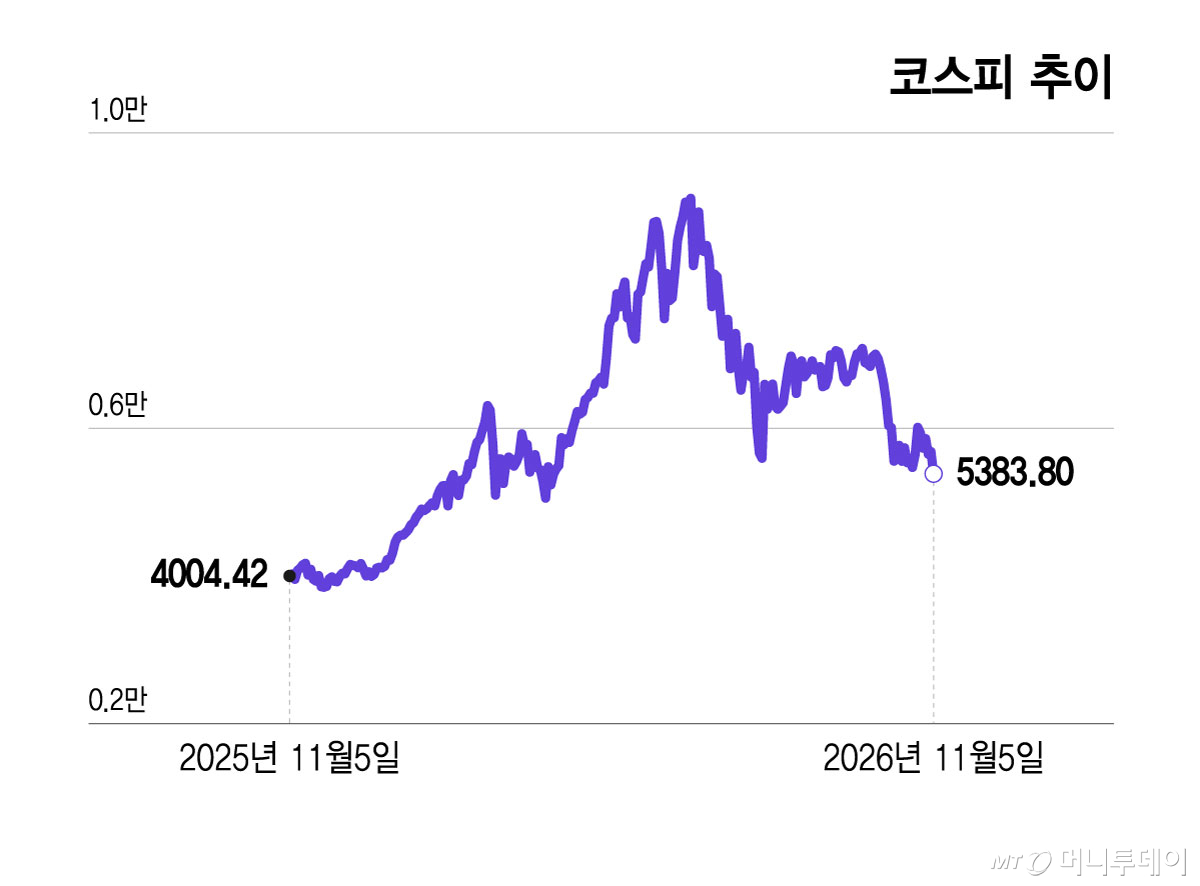
While most major overseas stock markets, including the United States, rose following the U.S. midterm elections, the domestic market closed with a sharp decline. The Taiwan stock market, which has a high semiconductor weighting, also showed weakness, as the 'blue wave' (U.S. Democratic Party victory) acted as a tsunami for AI semiconductor stocks. Foreign investors engaged in panic selling of nearly 4 trillion won, causing the KOSPI to fall to its lowest level in seven months.
According to financial investment industry sources on Thursday, foreign investors net sold approximately 10.3 trillion won in the KOSPI market over the past five trading days. In particular, they net sold 3.8 trillion won on this day, leading the decline in the KOSPI.
Kang Jin-hyuk, an anlayst at Shinhan Investment, said, "Since last April, the KOSPI has fallen below the 5,400 level on a closing price basis. Although foreign investors have shown net selling for five consecutive days, and financial investment firms and pension funds continued net buying along with share buybacks, they failed to prevent the decline."
This contrasts with the U.S. stock market's rebound following the midterm elections, driven by the easing of uncertainty. This is because the possibility of strengthened regulations on AI data centers has emerged, acting as a negative factor for semiconductor stocks. The domestic market saw a relatively large drop due to added supply-demand pressure centered on foreign investors.
On Wednesday (local time), the U.S. Dow Jones rose 3.03% to close, and the S&P 500 also rose 1.6%. The NASDAQ Composite Index closed up 1.4%. Euro Stoxx also rose 2.3%, the Hang Seng Index rose in the 3% range, and the Shanghai Composite Index showed a slight gain.
This contrasts with the KOSPI falling more than 5%, triggering an intraday sell sidecar. However, the Taiwan Weighted Index, which has a large semiconductor sector weighting, also fell in the 3% range, showing weakness, and the Nikkei declined by over 1%.
Cho Yong-gu, a researcher at Shin Young Securities, said, "With the Democratic Party winning the U.S. midterm elections, it has become inevitable that the Trump administration's policy momentum, represented by tax cuts and tariff policies, will weaken."
He added, "The possibility of the Democratic Party strengthening regulations on data center power consumption, regional burdens, environmental issues, monopolies, and labor market impacts has emerged, which could proceed in a direction that reduces profits for Korean and Taiwanese companies."
Concerns over the semiconductor sector led to selling by foreigners. In the market on this day, foreign investors net sold SK hynix and Samsung Electronics at 10.9 trillion won and 9.7 trillion won, respectively. Power stocks such as Samsung Electro-Mechanics and LS Electric were also net sold at 330 billion won and 40 billion won, respectively. In the KOSDAQ market, semiconductor materials, components, and equipment (so-bu-gang) stocks also showed a sharp decline.
Jo A-in, a researcher at Samsung Securities, said, "With Democratic Party candidates who advocated for development regulations winning in major data center investment areas such as Texas and Georgia in the U.S., concerns have been raised that new data center construction schedules may be delayed." She added, "As a result, concerns over rising data center construction costs and slowing new investment speeds have expanded, acting as a burden on earnings forecasts for domestic semiconductor companies."
However, there are continued arguments that concerns about the domestic stock market are excessive, given that uncertainty in global financial markets is being resolved and interest rates, oil prices, and exchange rates are stabilizing.
Researcher Jo said, "Thanks to recent stability in oil prices and interest rates, global liquidity is expected to gradually expand, and increased liquidity is highly likely to concentrate on AI infrastructure companies that have secured pricing power and negotiating leverage."
A shift in foreign buying is cited as a condition for a rebound. It is forecast that there is a possibility of a rebound if foreigners return, as the KOSPI index has price appeal in the early 5,000 range. The KOSPI's 5,300 level corresponds to a 12-month forward PER (price-to-earnings ratio) of about 4x, which is a valuation low point.

 in STOCK
