

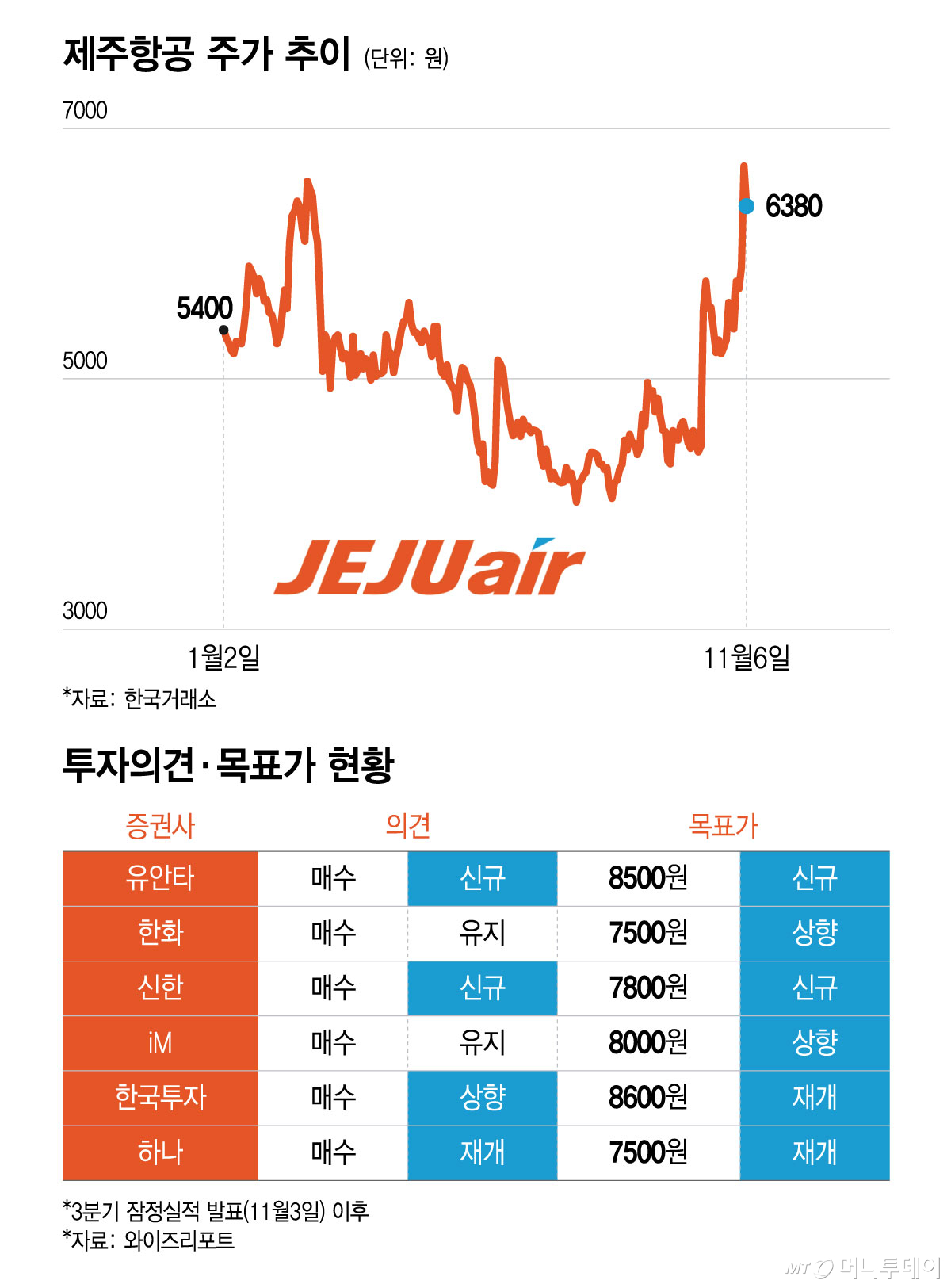
Jeju Air is drawing attention with a distinct rebound curve amid a weak market. Following its third-quarter earnings surprise, the brokerage sector continues to raise investment ratings and target prices. The atmosphere suggests a significant improvement in profit outlooks as the record-low won exchange rate and high oil price environment subside.
On the 6th, Jeju Air closed regular trading at 6,380 won on the Korea Exchange. Although it ended the day lower due to market weakness, the stock has risen by 980 won (18.15%) since the beginning of this month. Since entering the fourth quarter, it has climbed 36.91% (1,720 won), fully recovering its losses following the U.S.-Iran conflict.
Following the release of third-quarter preliminary earnings, all six domestic brokerage firms that analyzed Jeju Air issued a 'Buy' recommendation. This result reflects one firm upgrading its rating and two issuing new ratings. One brokerage also resumed coverage after a nine-month hiatus. Jeju Air has been a stock with uninterrupted neutral ratings every quarter since April 2018.
During the previous quarter's earnings season, four out of seven brokerage firms had issued neutral ratings. The driving force behind this shift in sentiment is undoubtedly the turnaround in performance. Jeju Air recorded separate third-quarter revenue of 489.6 billion won and an operating profit of 54.9 billion won, successfully turning its operating results into a profit compared to both the previous quarter and the same period last year. Notably, the operating profit exceeded the consensus estimate (9.4 billion won based on FnGuide) by more than five times.
The brokerage sector analyzed that Jeju Air's strategy of focusing on short-haul routes centered on Japan drove its profit recovery, despite a sharp drop in demand for Southeast Asian routes due to surging fuel surcharges. It is also widely assessed that the recent decline in the won-dollar exchange rate provided additional momentum.
Researcher Bae Se-ho at iM Securities stated, "Third-quarter passenger traffic on the Incheon-Narita route reached 224,000, up 48.3% year-on-year, while the Incheon-Kansai route saw 214,000 passengers, a 61.9% increase. Japanese routes accounted for 40% of passenger revenue." He added, "Considering the time lag in aviation fuel inventory, it is highly likely that the effect of stable oil prices in June was reflected in July's fuel costs."
Researcher Choi Min-gi at Shinhan Investment Corp noted, "From a non-operating perspective, foreign currency translation gains and aircraft disposal gains (three Boeing 737-800NGs) were reflected, achieving a net profit of 203.2 billion won (a turnaround to profit)." He stated, "A characteristic of this strong performance is that the exchange rate effect was simultaneously reflected in both operating and non-operating results."
Market attention is now turning to the possibility of further earnings improvement this winter. Analysts suggest that with reduced cost burdens, the industry has entered the peak season for low-cost carriers (LCCs), which see concentrated demand for short-to-medium-haul travel. The competition over supply expansion, long cited as a chronic investment burden, has subsided due to deteriorating industry conditions. Opinions also emerge in the stock market that Jeju Air's undervaluation has been maximized, as aviation stock investments have previously been concentrated on Korean Air.
Researcher Park Su-young at Hanwha Investment & Securities stated, "Even after market interest rose following favorable macro variable changes and robust demand, market interest and estimates regarding the industry outlook and performance for this year's fourth quarter and next year remain conservative." He added, "We are in a phase where foreign inbound demand is rising sharply and the number of operators is decreasing due to market restructuring."
Researcher Choi Go-un at Korea Investment & Securities stated, "As stock market volatility increases and leading sectors waver, interest is recovering in neglected sectors with less supply-demand burden, presenting an opportunity for Jeju Air as well." He noted, "The combined market capitalization of the four LCCs is only one-tenth that of Korean Air. With the aviation sector emerging as a beneficiary of won strength and ceasefire effects, and Korean Air having already hit its all-time high this year, relying solely on Korean Air (as an investment destination) has become insufficient."

 in STOCK
