

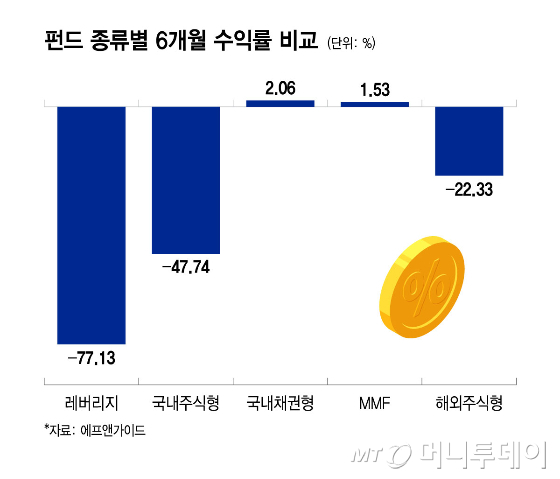
Despite the average return of leveraged funds plummeting to -77% over the past six months, large sums of money continue to pour in. This is due to expectations that a rebound would allow for the rapid recovery of losses. However, voices are growing warning against excessive leverage investment, as it can be difficult to cover losses even if the index rebounds during periods of sharp market volatility.
According to financial information platform FnGuide on the 29th, the average return of domestic leveraged funds over the past six months was recorded at -77.13% as of the 26th. The return over the past three months was -54.58%, and the one-month return was -32.33%.
Leveraged funds track the daily returns of specific stock indices or stocks at a set multiple. Exchange-traded funds (ETFs), which can be bought and sold in real time like stocks, are representative, but there are also general public offering fund formats available through securities firms or banks.
While higher returns than ordinary equity products can be expected when the price of the underlying asset rises, the structure is such that losses also expand significantly if prices fall. It appears that leveraged fund returns have deteriorated sharply as the domestic stock market decline has been steep in the second half of this year. The average return of domestic equity funds over the past six months was approximately -47%. Leveraged funds suffered much larger losses due to this structure.
Even in this situation, capital inflows into leveraged funds are still active. Funds flowing into leveraged funds over the past six months totaled 16.5102 trillion won, approaching five times the 3.5025 trillion won inflow into domestic bond funds during the same period. This is also a considerable amount compared to the 33.3385 trillion won inflow into domestic equity ETFs.
However, despite capital inflows, the net asset size of leveraged funds falls significantly short of their initial investment amounts. As of the 26th, the total initial investment in leveraged funds was 36.5601 trillion won. Net assets were 13.6946 trillion won, approximately 37% of the initial investment amount.
The initial investment amount is the original size set for the fund. Net assets reflect the current asset value based on management performance. The fact that net assets fall significantly below the initial investment amount means that fund management losses have accumulated to that extent.
Analysis suggests that despite such accumulating losses, investor sentiment toward leveraged funds remains steady due to expectations of a stock market rebound. It is explained that as stock price declines have been large, there is continued demand from investors seeking to quickly recover existing losses or achieve high returns through leveraged products if a rebound appears.
The securities industry advises caution against approaching leveraged products simply because stock prices have fallen significantly. An official at a domestic securities firm said, "The psychology of trying to quickly recover losses incurred in previous investments can lead to taking on even greater risks," adding, "One should first consider the scale of losses one can tolerate in the event of further declines, rather than expecting return recovery, before determining investment allocation."
Concentration in overseas leveraged products is also evident. Domestic investors have been the top net buyers of SOXL, which tracks the daily returns of the U.S. semiconductor index at three times, in the U.S. stock market over the past month. The amount was approximately 5.7 billion dollars (approximately 7.6 trillion won), about seven times that of the second-ranked net buy stock.
The issue is that losses on leveraged products can accumulate even during periods when the stock market fluctuates sharply without a clear direction. In situations of high market volatility like recently, the speed at which leveraged product investors recover losses may not meet expectations even if the index rebounds.

 in STOCK
