

Our country has established an international standard for the first time in the field of software-defined vehicles (SDV) and is taking on the role of international Pyo Jun-hwa (Chairman), securing leadership in future mobility standards. This achievement is evaluated as laying the foundation to lead not only automotive manufacturing competitiveness but also international standards for vehicle software.
The Ministry of Science and ICT and the Electronics and Telecommunications Research Institute (ETRI) announced on the 6th that an ITU-T recommendation and technical report on SDV (software-defined vehicles), developed through the Information and Communication Broadcasting Standard Development Support Project, were officially established by the International Telecommunication Union's Telecommunication Standardization Sector (ITU-T).
This achievement was pursued to respond to the era of SDV, where vehicles continuously update software from a hardware-centric approach to expand functionality. From 2024 to 2026, the Ministry of Science and ICT, together with the Information and Communication Technology Promotion Institute (IITP) and ETRI, invested a total of 1.1 billion won in the project titled "Development of GuideLine and Interface Standards for Software-Defined Vehicle Services."
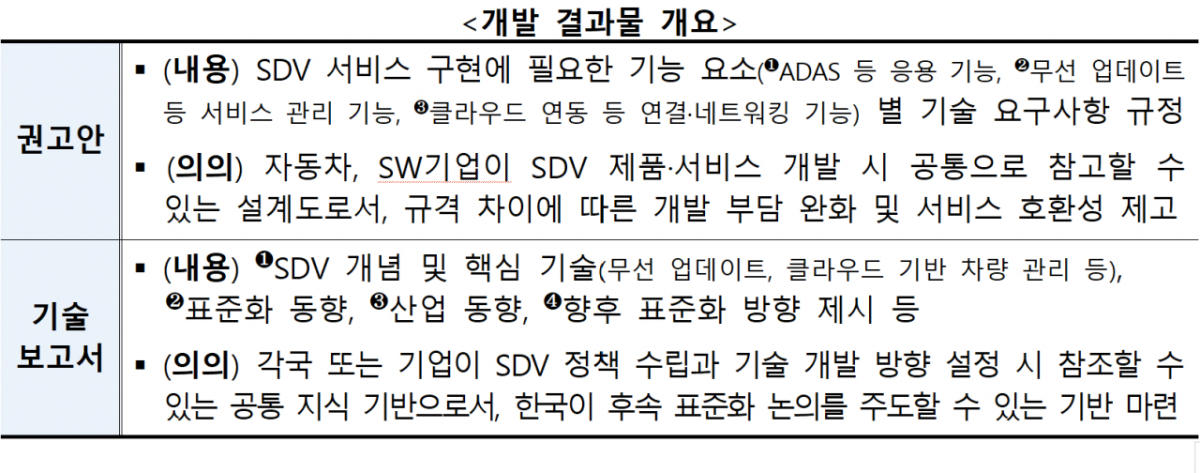
The newly established recommendation includes core technical requirements necessary for implementing SDV services. It standardizes application functions such as advanced driver assistance systems (ADAS), over-the-air (OTA) wireless software updates, service management functions, cloud-based vehicle connectivity, and networking functions. The goal is to allow automotive manufacturers and software companies to develop products and services according to common standards, reducing development burdens caused by differing specifications among manufacturers and enhancing service compatibility.
The jointly adopted technical report covers the concept of SDV, core technologies, international standardization trends, industrial status, and future standardization directions. It is expected to serve as a reference material for governments and companies worldwide in formulating SDV policies and technology development directions.
Particularly, according to the Ministry of Science and ICT, this recommendation holds significant meaning as it is the first SDV international standard established by ITU-T. The recommendation and technical report were officially approved at the ITU-T Study Group 21 (SG21) meeting held from July 6 to 17 in Geneva, Switzerland.
International standardization leadership has also been strengthened. Cha Hong-gi, Director of Intelligent Information Pyo Jun-yeon-gu (Head) at ETRI, who led this project, was recognized for his contributions and appointed as the international chair (rapporteur) of the Autonomous Driving and Vehicle Multimedia Standardization Working Group (Q10/21). For the first time, a Korean national will hold the chair position, which has been held by the United States and Japan. He will lead future international standard discussions in the SDV and autonomous driving fields and oversee the discovery and approval procedures for new standard projects.
ETRI expects that this international standard will promote technology development and service expansion across the entire SDV ecosystem, including not only complete vehicle manufacturers but also software companies, and will be widely utilized in the policies and industrial sites of 194 ITU member countries.
Park Tae-wan, Minister of Information and Communication Industry Policy at the Ministry of Science and ICT, stated, "It is a meaningful achievement that South Korea, an automotive powerhouse, can lead not only in automotive manufacturing but also in international software standards." He added, "We will continue to support research on international standards for end-to-end (E2E) autonomous driving following SDV."

 in TECH
