

A building that once gathered crowds for 66 years through trade shows and auto exhibitions is now preparing to house AI servers. This refers to Dallas, Texas’s large-scale exhibition venue, Market Hall.
Real estate developer Kro Holdings is advancing plans for a data center campus spanning up to 245 megawatts (MW) across approximately 40 acres around Market Hall. While the existing exhibition hall won’t simply be filled with servers, the long-term vision involves redeveloping the area surrounding Market Hall into a data center hub.
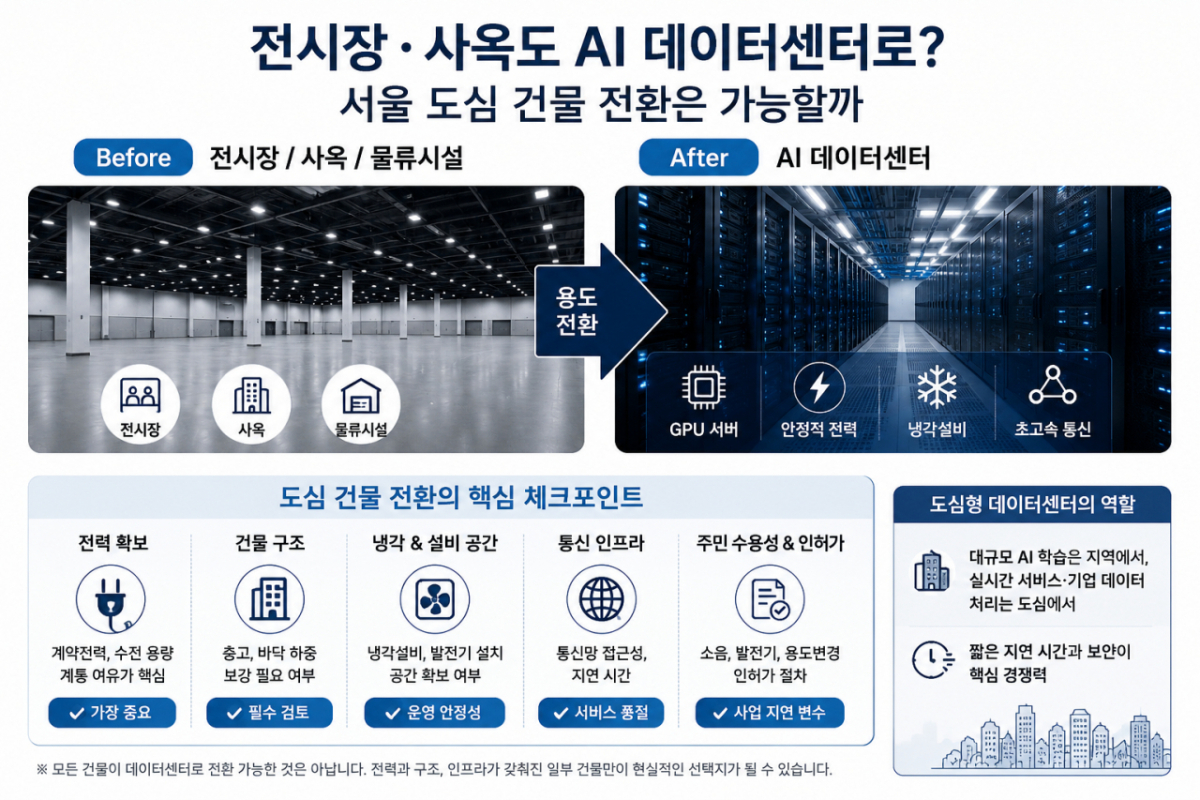
AI data centers are emerging as a new demand for urban commercial real estate, extending beyond suburban industrial parks. Large-scale exhibition halls and logistics facilities typically feature higher ceilings and stronger floors than standard office buildings. They also offer ample space for generators and cooling systems, making them prime candidates for data center conversion.
In Seoul, interest is growing in converting vacant office buildings, office towers, and logistics facilities into small-scale data centers. While large AI training facilities benefit from regions with abundant land and power, AI systems that process corporate data or respond rapidly to user requests must be located close to customers—in urban centers. However, securing an empty building does not automatically make it a viable data center. The first condition to verify is not the building’s price or vacancy rate, but its power capacity.
According to materials submitted to the National Assembly, among 522 initial technical reviews for data center power supply applications in the Seoul metropolitan area, 279 were deemed unfeasible due to insufficient power supply. Only 10 projects passed the final review. Even with a building and investment secured, no servers can operate without electricity.
Recently highlighted modular data centers (PMDCs) also cannot resolve power constraints. While pre-fabricating servers, cooling systems, and power infrastructure allows for faster on-site assembly and reduced construction time, this approach does not generate the actual electricity required for operation.
Building structure presents another hurdle. Office buildings and server facilities differ fundamentally. AI servers pack graphics processing units (GPUs), batteries, and cooling equipment densely, requiring floors to support significantly greater weight than standard offices. Existing building floors and columns may need reinforcement, and sufficient ceiling height is necessary to install power lines and cooling pipes.
Space must also be secured for cooling systems that expel heat from servers and emergency generators for use during power outages. If renovation costs become too high, it may be more practical to demolish the existing structure and construct a new building dedicated solely to data center operations.
In urban areas, community acceptance is another variable. Data centers operate cooling systems 24/7 and regularly test generators. Proximity to residential zones could trigger complaints related to noise, vibration, and visual impact. Building use changes must be re-evaluated alongside fire safety and evacuation standards.
Ultimately, not all vacant office buildings in Seoul can be converted into data centers. The most feasible candidates are those that already have sufficient power capacity and possess adequate floor load-bearing capacity, ceiling height, and space for cooling infrastructure. This explains why standalone office towers, exhibition halls, and logistics facilities hold a relative advantage over typical office buildings.
Urban data centers are likely to focus on smaller-scale facilities under several megawatts rather than ultra-large installations. Large-scale AI training will be handled by regional data centers, while Seoul’s small-scale facilities will manage rapid response times and sensitive corporate data processing.
In the AI era, a building’s value can no longer be judged solely by its location or vacancy rate. The critical new metric is how many megawatts of power it can receive.

 in TECH
