

The flagship of Korea’s largest game exhibition, G-Star 2026, is not a gaming company. It is Lutton Technologies, the operator of the AI chat app "Crack." This marks the first time in the event's history that a non-gaming company has served as the main sponsor.
Previously, main sponsors have been major gaming companies such as Nexon, NC, Wemade, Kakao Games, and Netmarble. The G-Star organizing committee explained that they selected Crack as the optimal partner because "the two most important keywords permeating the industry are AI and narrative."
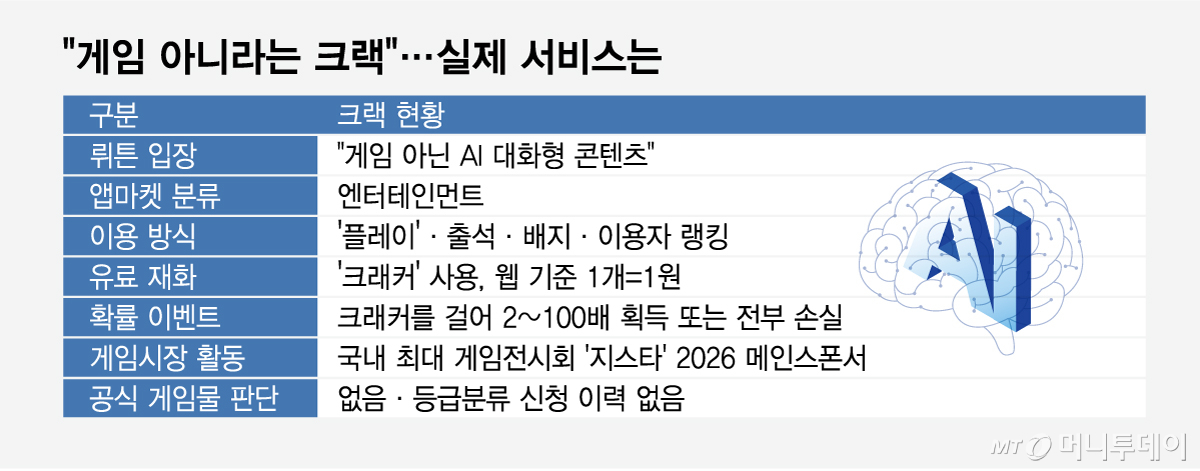
When asked about Crack's nature, Lutton responded: "It is an AI interactive content service, not a game product." Crack is also classified as "entertainment," not a game, in app stores. Within Crack, users spend "Crackers," a paid currency, for conversations and image generation. On the web, one Crack costs 1 won. Lutton maintains that Crackers are not game items but in-platform currency used to access platform features.
Sponsorship at G-Star alone does not make Crack a game product. However, the fact that a service explicitly defined by its company as non-gaming has taken center stage at Korea's largest gaming event highlights the ambiguous position of AI chat apps in the market.
The usage mechanics also resemble games. Users create worlds and characters with AI, then shape stories through dialogue and choices. Crack refers to user actions as "play" and encourages repeated logins through attendance rewards, badges, and user rankings.
The revenue model is also similar to mobile games. Crack users spend paid currency for conversations, image generation, and premium chat modes. Another AI chat app, Zeta, offers free conversations but charges paid currency for ad removal and image generation. The structure is designed to increase usage time and recurring payments.
Last December, Crack launched a "Cracker Baking" event where users could win 2 to 100 times their stake or lose everything entirely based on probability. The event, which had no age restrictions, was shut down after just 19 hours following user complaints about gambling-like behavior. Lutton announced that it would fully compensate minors for any paid Crackers spent during the event and will not hold similar events again.
Seven months after the event ended, in July, Crack reported 800,000 users with 122 million executions. Zeta recorded 4.28 million users and 2.08 billion executions, surpassing ChatGPT's 1.817 billion executions.
As of the 18th, Crack and Zeta ranked sixth and eighth, respectively, in the highest-grossing charts for the Entertainment category on Google Play. Even when expanding the scope to include all apps excluding games, they ranked 15th and 17th. Crack surpassed Wave, Coupang Play, and Disney+ in ranking. AI chat apps have grown into immersive content competing with game users for time and spending.
The Game Rating and Administration Committee (GRAC) stated that while the ability to converse with AI alone does not make something a game product, the structure where paid currency is used and acquisition or loss of currency is determined by probability is an important factor in judging game-like qualities. It also noted that separate review may be needed to determine if it qualifies as a gambling-type game product.
However, Crack has never applied for a game rating classification. Neither the GRAC nor any other government institutional investor has ever comprehensively evaluated whether Crack's dialogues, stories, paid currency, badges, rankings, and probability events collectively qualify it as a game product.

 in TECH
