

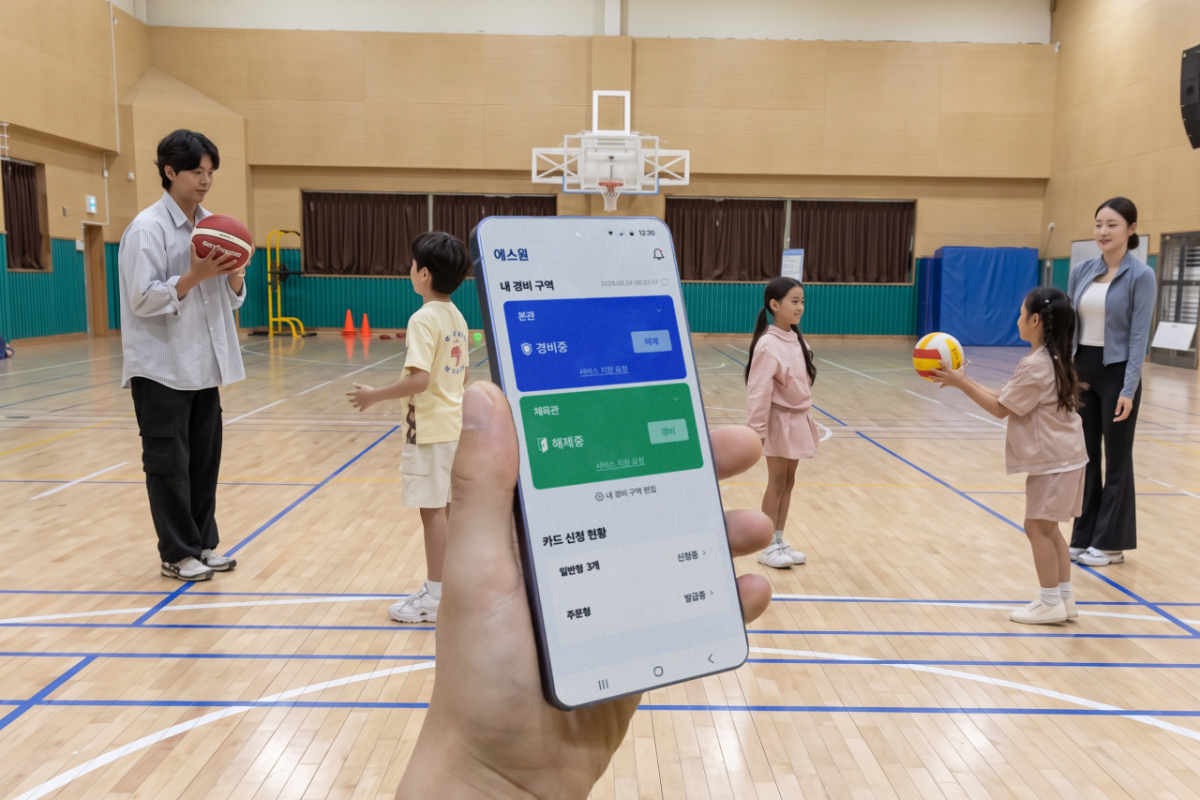
At 7 p.m., lights turn on and doors open in a school gymnasium after classes end. Residents begin to enter one by one for badminton and basketball. When the usage time ends at 10 p.m., an announcement is made, and once the last user has left, the doors automatically lock. No management personnel are present during this process.
School security is shifting from merely preventing unauthorized entry to taking responsibility for facility operations and user safety. As evening and weekend access to gymnasiums expands, demand is growing to manage access, accidents, and equipment malfunctions during unattended hours using AI and IoT (Internet of Things).
The Ministry of Education is establishing 200 school complex facilities from 2023 through 2027. The initiative aims to secure insufficient community sports spaces by opening gymnasiums and athletic fields to residents. According to the Ministry of Culture, Sports and Tourism, the proportion of citizens participating in community sports for at least 30 minutes once a week has risen to 62.9%, yet 31.3% of respondents cited "lack of access to sports facilities" as their reason for not exercising.
Managing entry and verifying that the last person has exited is required, and liability follows if accidents occur. For schools where it is difficult to assign separate staff to manage facilities after teachers and staff have left work, opening them up itself poses a burden.
The Gyeonggi Gunpo-Wang Education Office is addressing this through unmanned operations. It has piloted S-ONE's "Unmanned Gymnasium Management System" in three schools within its jurisdiction. The system opens doors and activates lighting and heating/cooling according to registered schedules. A middle school in Wangheung operates its gymnasium from 9 a.m. to noon on weekends without management staff. When usage time ends, voice guidance announces departure, verifies that no one remains, and then locks the doors. Thereafter, sensors monitor internal movement; if intrusion is detected, it triggers an emergency dispatch.
A facility officer at the school said, "On weekends, there were no duty officers, so opening the gymnasium was always a burden," adding, "Now, door operations and lighting control are carried out according to the entered schedule, allowing operation without staff."
According to the Central Association for School Safety Insurance, of 220,136 school safety accidents last year, 60.6% (133,487 cases) occurred during sports activities. S-ONE uses its AI video analysis-based "Intelligent School Safety Package" to detect seven types of abnormal situations in real time: signs of fire, entry into hazardous zones, loitering after school hours, intrusion, school violence, and smoking. When an issue is detected, a notification is sent to the responsible person's smartphone, and both the school and the local education office review the on-site video together.
Piping and electrical facilities are also under management. According to the Ministry of Education, among 61,251 public and private school buildings nationwide, 14,531 (23.7%) were completed more than 40 years ago. Since building equipment has a shorter service life than the structure itself, leaks or equipment malfunctions during nights or holidays can lead to significant damage if overlooked. S-ONE is currently providing leak response consulting for 60 schools in the Incheon area. Sensors are installed on water supply pipes, electrical facilities, and fire alarm control panels to collect signals 24 hours a day; when abnormal signs appear, managers and monitoring centers are notified before water stains become visible.
A S-ONE official stated, "Schools are becoming not only spaces where students learn but also community infrastructure used by local residents," adding, "We will expand the construction of safety infrastructure that can monitor not only access control but also user safety and facility conditions."

 in TECH
