

[For more diverse company information on the startups mentioned in this article, visit the Unicorn Factory big data platform 'Data Lab'.]
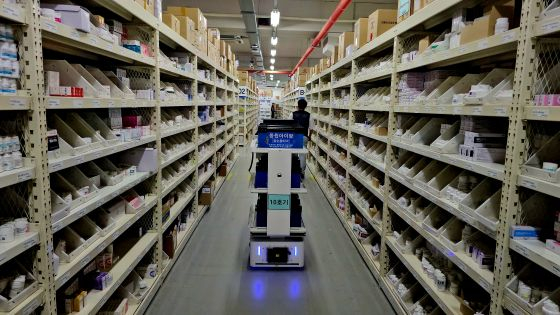
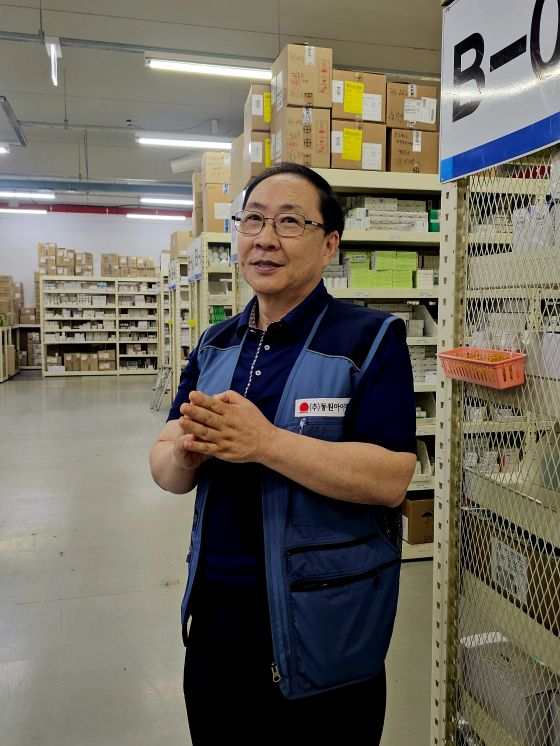
"In the days when we pulled carts, we walked more than 20,000 steps a day. Now, we only move back and forth over 10–15m sections, so my legs feel much better."
On the 18th, at Dongwon iFarm Logistics Center in Gochon-eup, Gimpo-si, Gyeonggi Province. Inside a warehouse of about 600 pyeong (1,980㎡), an announcement sound saying "Moving" was heard, and a logistics robot carrying nine baskets at adult waist height sped past. Executive Director Ha Kyung-tae said, "In the past, we had to pull manual carts and wind through the entire warehouse in an S-shape, but now it's different."
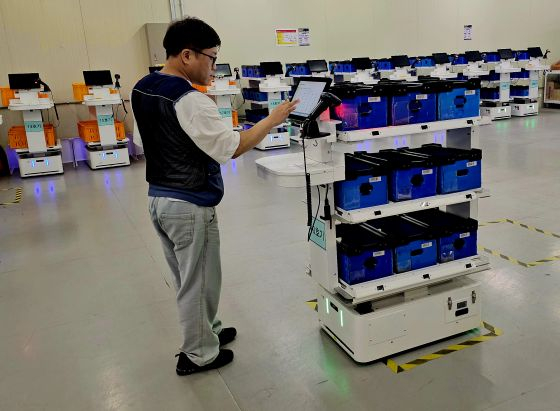
Robots handle everything from orders to invoice printing; human hands only "pack"
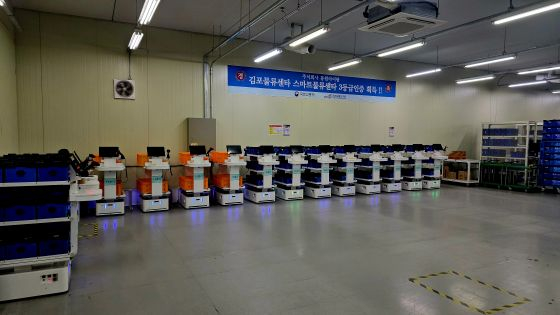
In this pharmaceutical logistics center requiring high precision and strict traceability, there are 25 autonomous robots working alongside humans. These are products supplied by AMR Lab, a small but strong company specializing in autonomous mobile robots (AMRs). The robots move back and forth between racks, and once all medicines are filled, they return to their starting point. The spot where the robot stops is called the "pick zone." Seventeen workers, so-called "pickers," are assigned to each area, focusing on the precision of their fingertips rather than taking steps. Notably, large items were separated onto separate carts, and areas with low order frequency were handled by humans, showing a detailed division of labor.
The starting point for work is a single "tag" about the size of a palm. When a pharmacy places an order, the logistics system generates a tag containing not only the drug name, zone, and quantity but also weight information for inspection. Up to nine tags can be inserted into the robot's docking station, and once the start button is pressed, the robot draws its own route and positions itself in front of the picker. After the picker scans and packs the medicine, a single touch sends the robot to the next stop. The moment the last item is scanned, the transaction invoice is automatically printed.
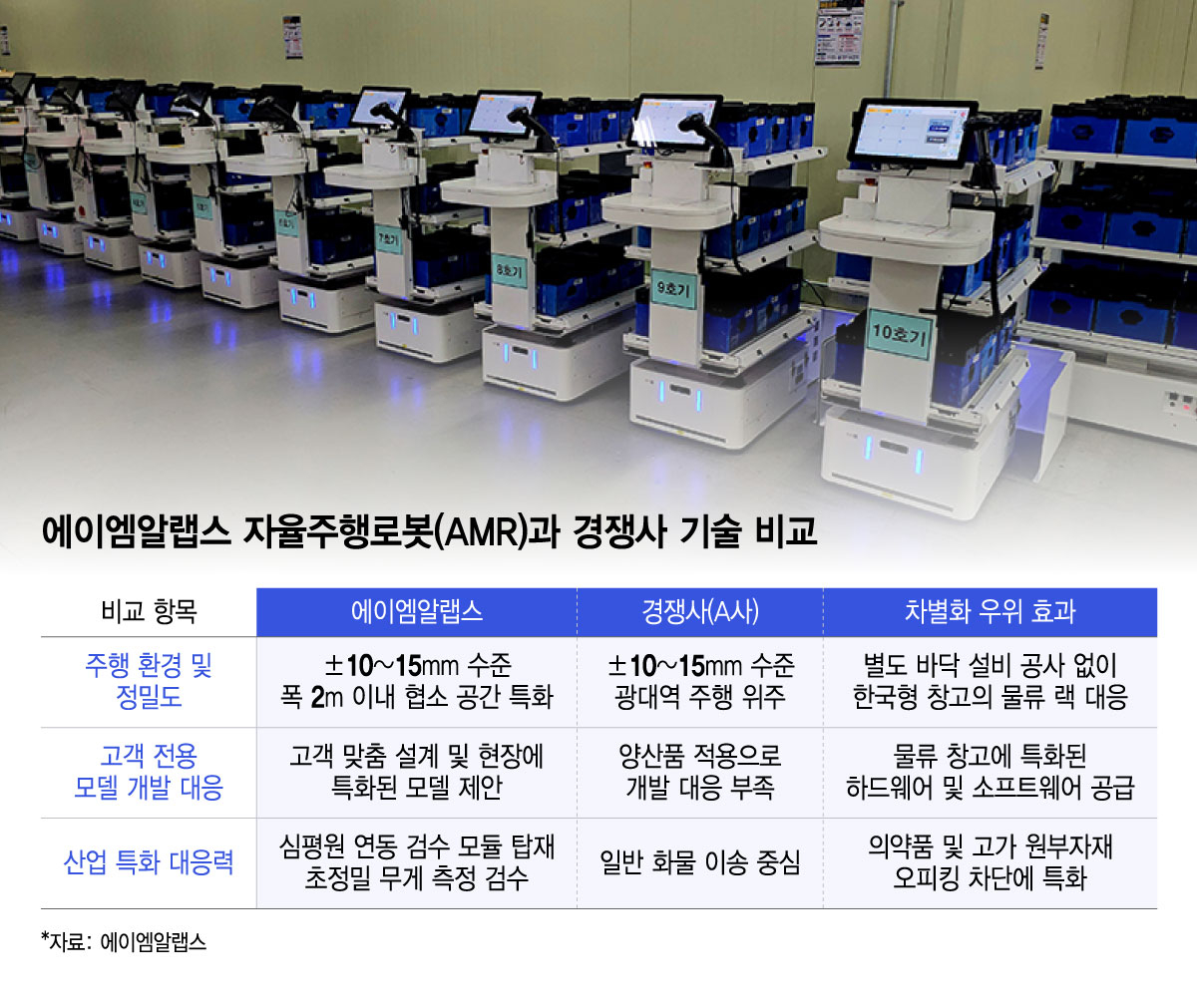
This represents a complete departure from traditional automation methods that require fixed conveyors or floor QR codes. Park Seung, CEO of AMR Lab, stated, "Equipped with our own developed LiDAR and 3D vision sensor-based SLAM (Simultaneous Localization and Mapping) technology, we support cross-driving between robots and precise obstacle avoidance even in narrow rack spaces under 2m wide, without any floor construction." Additionally, for the first time in the industry, a precision weight measurement module was mounted on AMRs to ensure picking accuracy, and RFID inspection reduced the off-picking rate to the industry's highest level. Executive Director Ha said, "Productivity improved by more than 30% compared to manual work, and outbound waiting times were shortened by up to one hour."
Dongwon iFarm considered introducing robots due to a severe labor shortage. As a logistics complex built on a landfill, transportation was inconvenient, and with large logistics centers like Market Kurly, E-Mart, and Lotte opening nearby, workers were drawn away. Although manual carts weighing 45kg were introduced, they could not prevent musculoskeletal disorders among workers.
The schedule was also tight. Orders started at noon, and those received by 2 p.m. had to be delivered to pharmacies by 3 p.m. If delayed, delivery drivers would get stuck in traffic congestion, causing a chain reaction that pushed next-day early morning deliveries back. The 3 p.m. deadline was an unbreakable line. The problem lay in the aisles. The space between racks was only 1.7–2m wide, and the facility handled over 20,000 items in a low-volume, high-variety, high-precision structure.
The initially considered "O-Toss-Tower" method moved only at fixed speeds within designated ranges, lacking flexibility when volumes surged. Alternatives from several large corporations and mid-sized companies required 3m-wide aisles for forklifts, making them unsuitable. Ultimately, AMR Lab was chosen for its proprietary technology allowing operation in narrow aisles. Oh Ki-yeol of Dongwon iFarm said, "The biggest advantage was the ability to introduce the system without altering existing infrastructure."
Narrow and Complex "K-Type Warehouse"... This Constraint Became a Weapon
Oh Ki-yeol stated that many domestic logistics sites are "K-type warehouses." While large centers in the U.S. and Europe assume wide spaces and straight aisles, Korean distribution logistics use space densely due to high land prices and small-scale operations. He said, "Robots must be operable under poor conditions for supply to be possible." Paradoxically, these narrow aisles became a niche untouched by large corporations. Oh Ki-yeol noted that since November 2024, alongside Dongwon iFarm's orders, hundreds of simulations were run using delivery data, and after the contract in April 2025, robots were gradually increased from two to thirteen, then to twenty-five for on-site validation.
Results appeared in numbers. Outbound waiting times for long-distance deliveries were reduced by up to 50 minutes, and for short-distance deliveries by up to 1 hour 20 minutes. Robots could run all day with just battery swaps, and flexible operations became possible—running twenty units during slow periods and thirty during busy ones. Most importantly, the barrier of expertise, which previously took at least a year to master drug locations, disappeared. With robots indicating locations, even beginners could be deployed immediately. As overtime decreased, employees' expressions brightened, turnover dropped noticeably, and part-time workers began requesting conversion to regular employment.
AMR Lab is expanding this experience to industries handling low-volume, high-variety goods such as cosmetics and clothing. Oh Ki-yeol stated, "We supplied AMRs for F&B fulfillment to Company A, a cafe raw material distribution enterprise, and are currently preparing for expansion into the United Arab Emirates (UAE)." He added, "The Dongwon iFarm project is a case that demonstrated overwhelming performance in the most demanding precision logistics environment. We will turn the constraint of narrow and complex warehouses into a weapon, developing technology that works globally."
MoneyToday startup media platform 'Unicorn Factory']

 in TECH


