

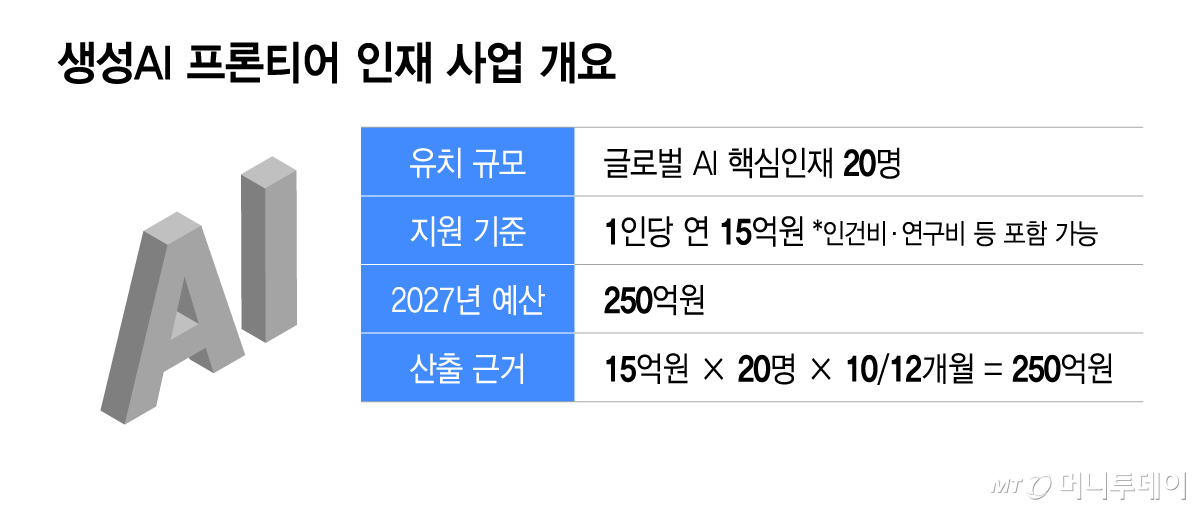
The government is launching a support program offering up to 1.5 billion won annually per individual to encourage top Korean AI (artificial intelligence) experts currently active overseas to return to Korea. Through the newly established 'Generative AI Frontier Talent' program next year, the government aims to secure 20 individuals and bolster efforts to catch up with global technology in developing independent AI models.
According to the Ministry of Science and ICT's project description document for the 'Generative AI Frontier Talent' initiative, obtained through the office of Lee Jeong-heon, a member of the Democratic Party of Korea, on the 7th, the government plans to invest 25 billion won in this program next year. While the 25 billion won budget was disclosed during last year's budget announcement, this marks the first time that specific details regarding the number of supported individuals and the methods of support have been confirmed.
The primary target group initially considered by the government is top-tier AI researchers and developers of Korean nationality currently active overseas. The plan aims to attract talent who have gained research and development experience abroad to domestic AI companies, thereby accumulating not only human resources but also research capabilities and technology within Korea.
The government calculated the 25 billion won budget as '20 global talents × 1.5 billion won per person × 10/12 months'. This reflects a 10-month period for next year's program, based on an annual support of 1.5 billion won per individual. The 1.5 billion won is not merely a salary figure but a budgetary support unit that can include costs necessary for the talent's research activities, such as labor expenses and research funds. Specific support items and methods will be determined during the project execution process, and both the support amount and number of individuals may vary depending on circumstances.
Support will be provided through capital injection. The Ministry of Science and ICT will inject 25 billion won into Korea Development Bank (KDB), which will then re-inject the funds into domestic AI companies and other entities. Companies will utilize these invested funds to secure global talent and develop and enhance independent AI models.
The project is also closely linked with the development of frontier-level independent AI models. Currently, competition for 'Independent AI Foundation Models' (referred to as 'Dokpa-mo') has narrowed down to three elite teams: LG AI Research, SK Telecom, and Upside. The Generative AI Frontier Talent program explicitly designates companies developing independent AI models as support targets, raising expectations of potential collaboration with these firms. Specific supported companies and the allocation of personnel are expected to be determined in the future.
The government is moving to secure 'AI brains' following its efforts to build computing infrastructure such as GPUs (graphics processing units), driven by intensifying global competition for talent. While major U.S. tech giants are offering substantial compensation packages to top AI researchers, talent costs are also rising in China. It is reported that Xiaomi offered an annual salary of around 10 million yuan (approximately 2 billion won) when recruiting Luo Fuli, a key researcher who participated in the development of DeepSeek-V2.
The project will be implemented from 2027 to 2030. The government's medium-term fiscal plan includes an annual investment of 25 billion won. The success or failure of the initiative is expected to hinge on how effectively companies can combine their own compensation, research environments, and computing resources with government support to actually attract top Korean AI talent from abroad back to Korea.
Lee Jeong-heon (Rep.) stated, "We actively welcome the government's decision to bring back top-tier talent who have left for overseas and to build an independent AI foundation model," adding, "The annual support of 1.5 billion won per person, including labor costs and research funds, is a core strategy to safeguard South Korea's future growth drivers and AI sovereignty."

 in TECH
