

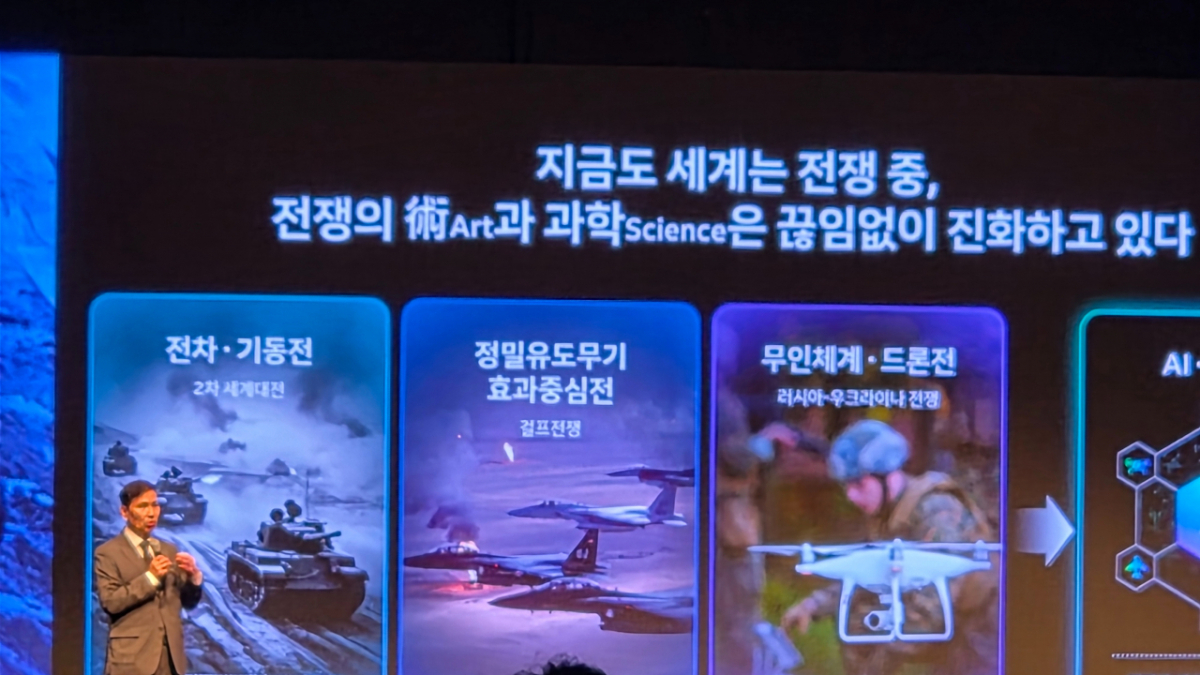
"Beyond introducing new systems, we need reforms that fundamentally change how wars are conducted."
Former Deputy Minister of National Defense Kim Sun-ho made these remarks at the 'Defense AI Day' held at the Shilla Hotel in Jung-gu, Seoul, on the 18th. Kim, recently appointed as an advisor to Naver, presented on the topic "The Essence of Defense AX (AI Transformation) from a Military Perspective" at the event hosted by Naver Cloud.
Kim emphasized the importance of Defense AX using the war in Ukraine as an example. He stated, "According to CSIS estimates, total casualties between the two sides are approximately 2 million, with 1.4 million, or 70%, being Russian casualties; among them, about 400,000 were killed." He added, "This is the first war in history where a militarily superior nation has suffered such massive losses."
Kim pointed to AI as the cause. He explained, "Unlike the early stages of the war, which involved deploying low-cost drones merely for target identification, four years later, drones are now linked with AI and communicate with each other, establishing a new combat system." He noted that the same applies to the war between the United States and Iran, often called the first AI war.
A key characteristic of Defense AX is that the primary actor has shifted from the military to the civilian sector. Kim stated, "Until now, the military designed the foundation while civilian technology provided support; recently, however, the military directly adopts systems built by civilians." He further explained, "Placing these new systems within the military command structure was considered 'reform,' but AI is now changing the very way wars are conducted."
Nevertheless, he also noted that final decisions must still be made by humans. He said, "While civilians can create closed technologies capable of handling classified data, and AI has advanced to the point of integrating and connecting data, analyzing it, and proposing countermeasures through reasoning, the role of making decisions and issuing orders must remain in human hands."
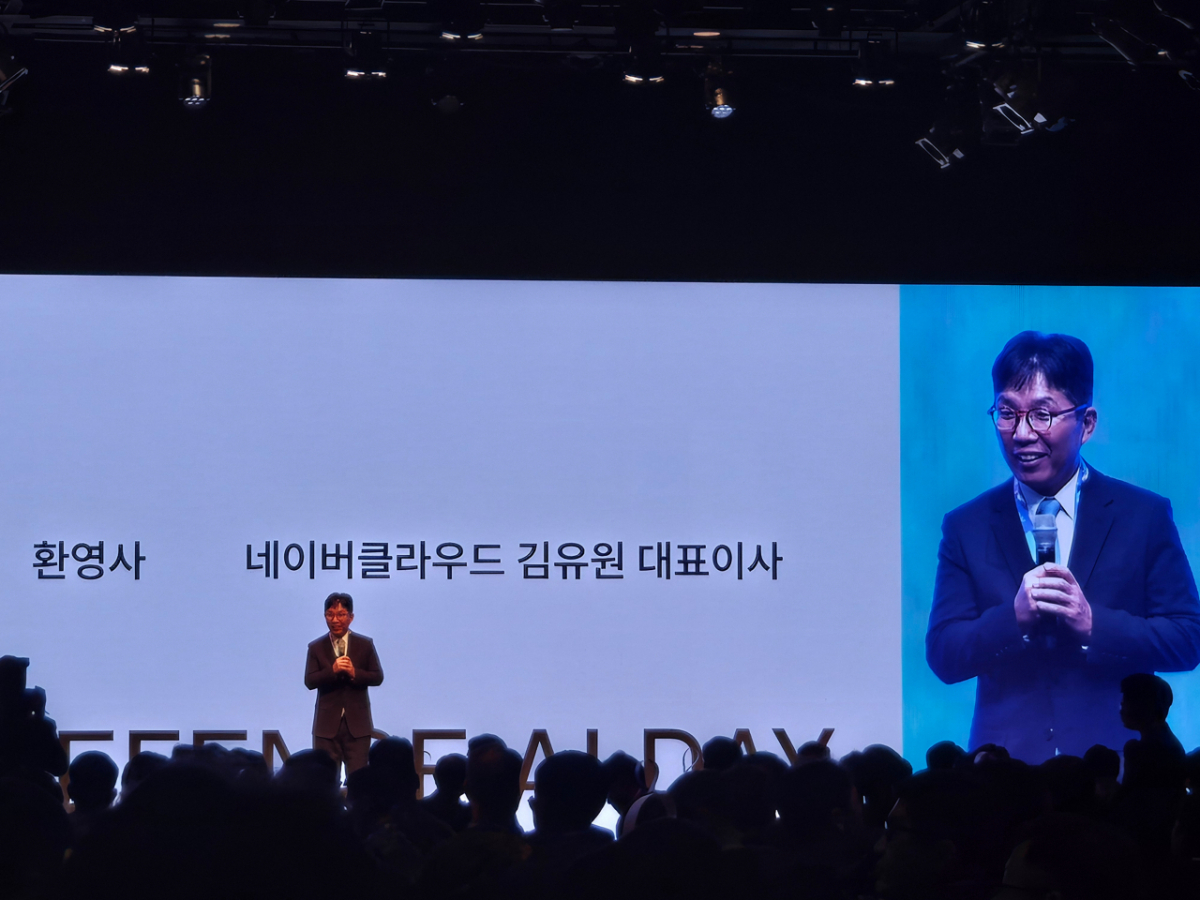
Naver Cloud introduced its full-stack AI to defense officials. Naver possesses a Defense AI full stack consisting of: Field Deployment Engineers (FDE), Applications, Data Fabric, AI Models, and Infrastructure. Kim Yu-won, CEO of Naver Cloud, stated, "Aside from the United States and China, South Korea is the only country capable of building an AI full stack."
FDEs are engineers who develop technology on-site to ensure it translates into actual combat power enhancement and diagnose and verify challenges. Yoo Kyung-beom, Executive Vice President in charge of Naver Cloud's Defense Business, explained, "While it would be ideal for the military to build AI models directly, it is realistically difficult due to the need for massive GPUs (graphics processing units) and data centers to run them." He added, "It is more efficient to produce semi-finished products in civilian areas close to the military and have FDEs bring them into the field."
Applications are technologies that analyze data by connecting various AI tools such as the Common Operational Picture (COP), object search and analysis, integrated alerts, secure chat, and report generation to assist commanders' decision-making. Data Fabric serves as a knowledge base that aggregates scattered data from the army, navy, and air force to enable AI to understand the entire battlefield.
Naver utilizes defense-specific models of its HyperCLOVA X AI model, which is developed through "From Scratch" (designing and learning independently from the beginning). These specialized models are equipped with an Omni-model capable of comprehensively understanding video, images, audio, and documents, as well as VLA (Vision-Language-Action) that can autonomously identify targets and move. Finally, Naver's infrastructure supports AI utilization even in field environments with limited communication and enables data synchronization during recovery.
Kim (CEO) stated, "Naver Cloud engineers also share the view on the necessity of self-reliant defense and sovereign AI," adding, "We hope that Naver Cloud's AI and software technologies will contribute to strengthening national defense capabilities."

 in TECH

