

The AI infrastructure capabilities of Korean companies are crossing borders. As demand for data centers capable of handling large-scale computing resources grows with the spread of generative AI, AI agents, and physical AI, domestic operators are accelerating their efforts to capture overseas markets.
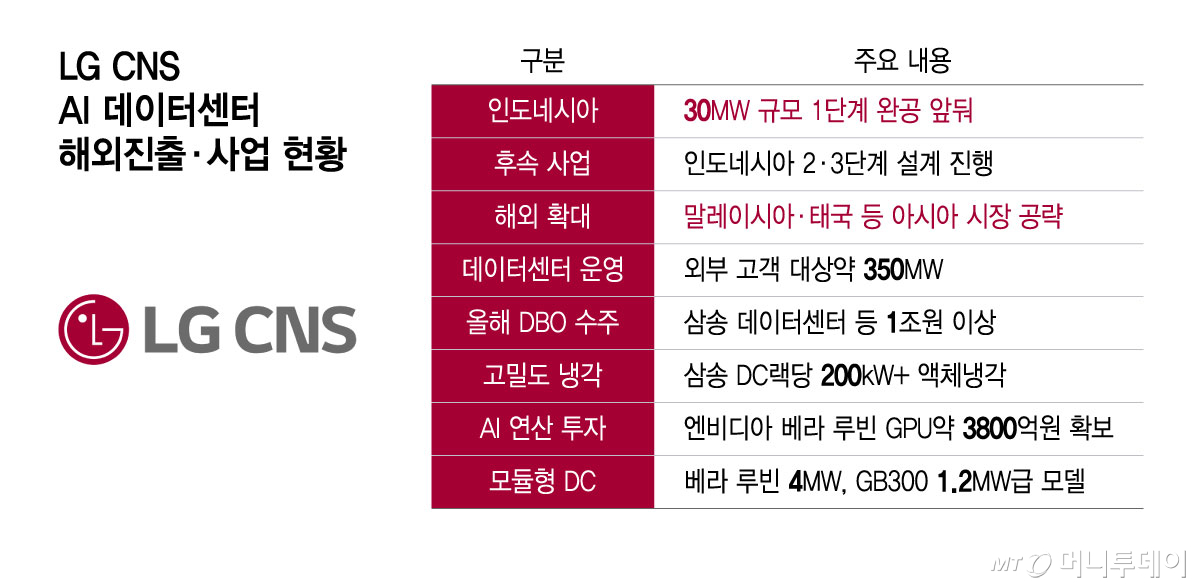
LG CNS (LG Cee En Ess) has secured its first contract among domestic companies to build an AI data center in Indonesia. It is currently on the verge of completing Phase 1 of a 30MW project. Design work for Phases 2 and 3 is also underway. The company plans to expand its data center business to key Asian regions, including Malaysia and Thailand, starting with Indonesia.
Overseas data center projects differ from simply constructing buildings. Each country has different power grids, permits, and site conditions, and cooling technology is required to operate high-density GPUs stably. Experience in not only design and construction but also the long-term stable operation of facilities is essential.
The foundation LG CNS leverages in overseas markets is this experience in data center projects. In 1992, it built South Korea's first dedicated data center in Incheon, and in 2019, it introduced the DBO (Design·Build·Operate) business model to the domestic market for the first time, taking charge of everything from design to construction and operation of customer-invested data centers.
Currently, the scale of data centers LG CNS operates for external customers is approximately 350MW. In the first half of this year, it secured a large-scale DBO project worth over 1 trillion won, including the Samsong Data Center in Goyang City, Gyeonggi Province.
AI data center has also acquired technologies to respond to high-density and high-power environments required for . The Samsong Data Center applies a liquid cooling method that supplies coolant directly to chips, enabling it to handle ultra-high-density GPU environments of over 200kW per rack.
It is also diversifying construction methods to expand overseas business. In September last year, LG CNS unveiled "prefab modular data centers," which are pre-fabricated as standardized modules including GPUs, servers, and power and cooling equipment, and then installed on-site. This reduces on-site processes to shorten construction periods and allows for scale expansion by adding modules in response to increasing AI demand.
It is also pursuing container-type modular data center projects. Currently, it operates a 4MW IT load model based on NVIDIA's next-generation GPU "Vera Rubin" and a 1.2MW-class model based on GB300.
It bundles computing resources and AI services to be installed in data centers together. LG CNS has invested approximately 380 billion won to secure Vera Rubin GPUs. It is promoting an "AI Factory Full-Stack Service" that combines GPUaaS, which provides GPU resources as a cloud service, services supporting real-time learning and inference for physical AI, and power and cooling technologies.
The strategy is to provide everything from data center design, construction, and operation to GPUs and AI platforms all at once, reducing the burden on overseas customers who would otherwise have to build their AI infrastructure piece by piece.
With the spread of AI, the data center market is moving beyond a stage of competing solely over domestic demand. As AI computing demand grows rapidly overseas as well, competition for contracts among operators equipped with power, sites, cooling technology, and operational experience is fierce.
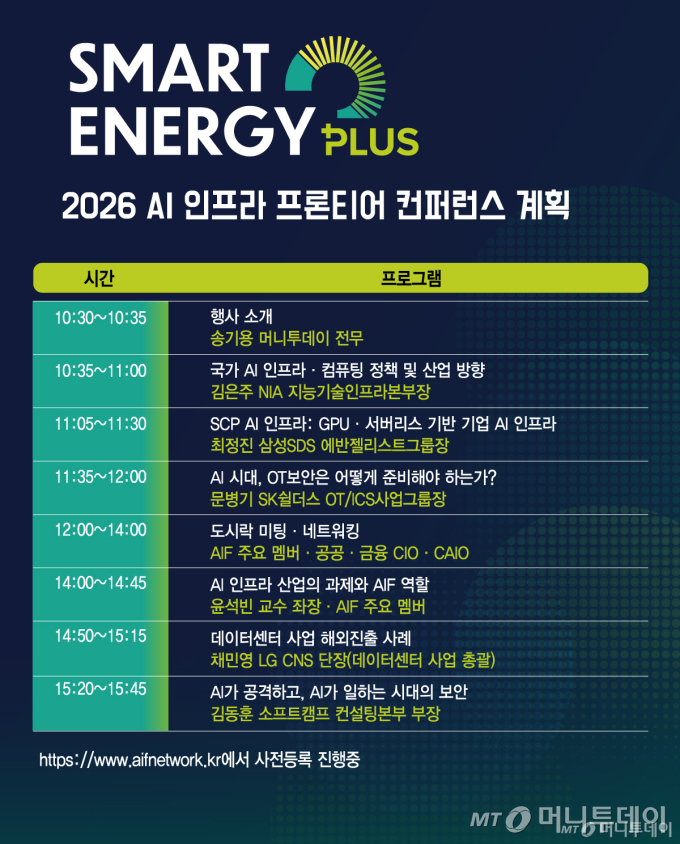
Chae Min-young, Head of the Data Center Business Division at LG CNS, will introduce cases of overseas expansion in data center business at the "AI Infrastructure Frontier Conference" to be held at COEX in Seoul on the 29th. He is expected to share experiences from overseas projects, including Indonesia, and changes in the AI data center market.

 in TECH

