

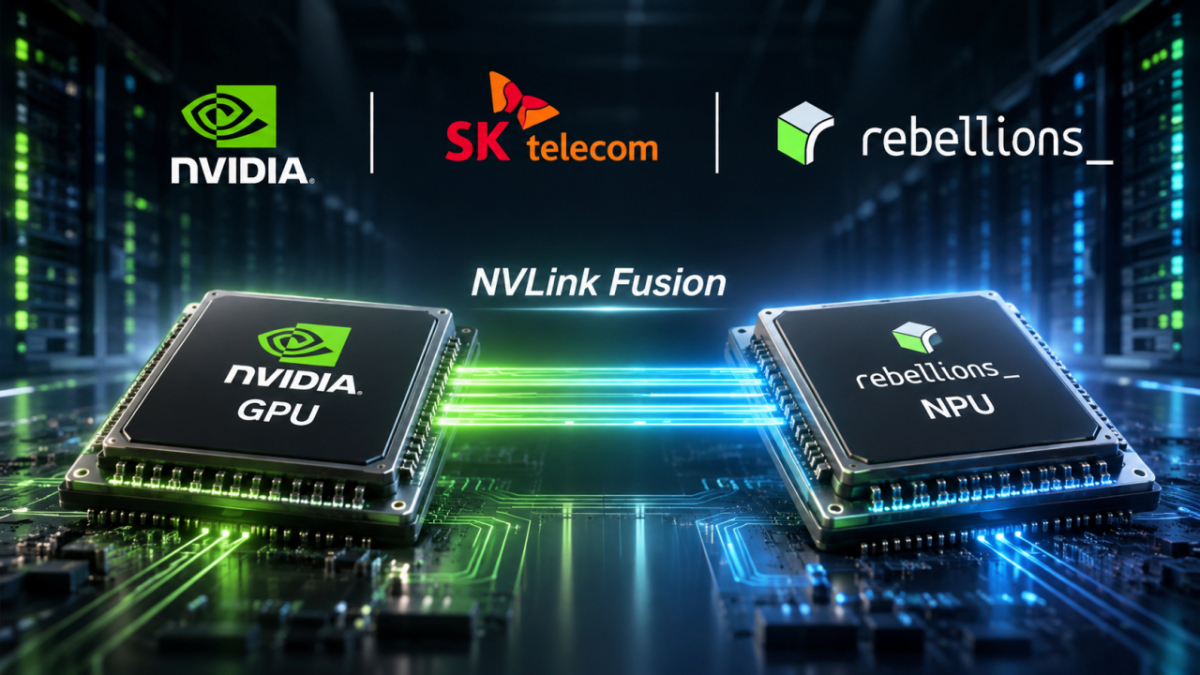
Nvidia is teaming up with SK Telecom and Rebellions to build an AI computing system that combines its GPUs with domestically developed neural processing units (NPUs). The goal is to use Nvidia's high-speed NVLink Fusion technology to run both types of chips together at SK Telecom's AI data centers.
The Ministry of Science and ICT said the three companies signed a memorandum of understanding on NVLink Fusion cooperation at Nvidia AI Day Seoul 2026, held at COEX in Gangnam-gu, Seoul, on Nov. 9.
The signing ceremony was attended by Lee Do-gyu, head of the ministry's ICT policy office; Raymond Te, Nvidia senior vice president; Jeong Seok-geun, SK Telecom's chief technology officer; and Rebellions CEO Park Sung-hyun.
Under the agreement, the companies will work to build a heterogeneous AI computing system linking Nvidia GPUs with Rebellions' NPUs as SK Telecom develops its AI data center infrastructure. The deal gives concrete form to discussions between the ministry and Nvidia on integrating Korean-made NPUs into global AI computing systems.
NVLink Fusion is a platform developed by Nvidia that allows external companies to integrate their XPUs, including CPUs, GPUs and NPUs, into infrastructure based on Nvidia's NVLink technology. NVLink enables high-speed data transfers between chips, allowing Rebellions' NPUs to operate alongside Nvidia GPUs.
The partnership is seen as opening a path for Korean-made NPUs to enter Nvidia's AI computing ecosystem.
As demand for AI inference grows, heterogeneous computing systems that combine GPUs and NPUs are attracting attention. GPUs excel at large-scale parallel processing, while NPUs are designed to handle specific AI workloads efficiently.
Using the two types of chips for different tasks can help data centers allocate computing resources more efficiently, although actual cost and power savings will depend on system design and operations.
The agreement follows an earlier initiative to integrate Korean NPUs with AMD technology. By advancing cooperation with Nvidia after AMD, the government aims to expand opportunities for Korean AI chips to be used across different global computing ecosystems. It also plans to extend cooperation beyond Rebellions to other domestic NPU makers.
Meanwhile, the ministry and Nvidia also co-hosted an AI Startup Partnership Forum on the same day. The event was attended by Deepu Talla, Nvidia vice president of robotics and edge AI, and Jonathan Cohen, vice president of applied research.
Twenty-two Korean startups in AI models, semiconductors and physical AI participated, including Upstage, TwelveLabs, FuriosaAI, DeepX and Rebellions. They discussed potential technology partnerships and commercialization opportunities.

 in TECH
