

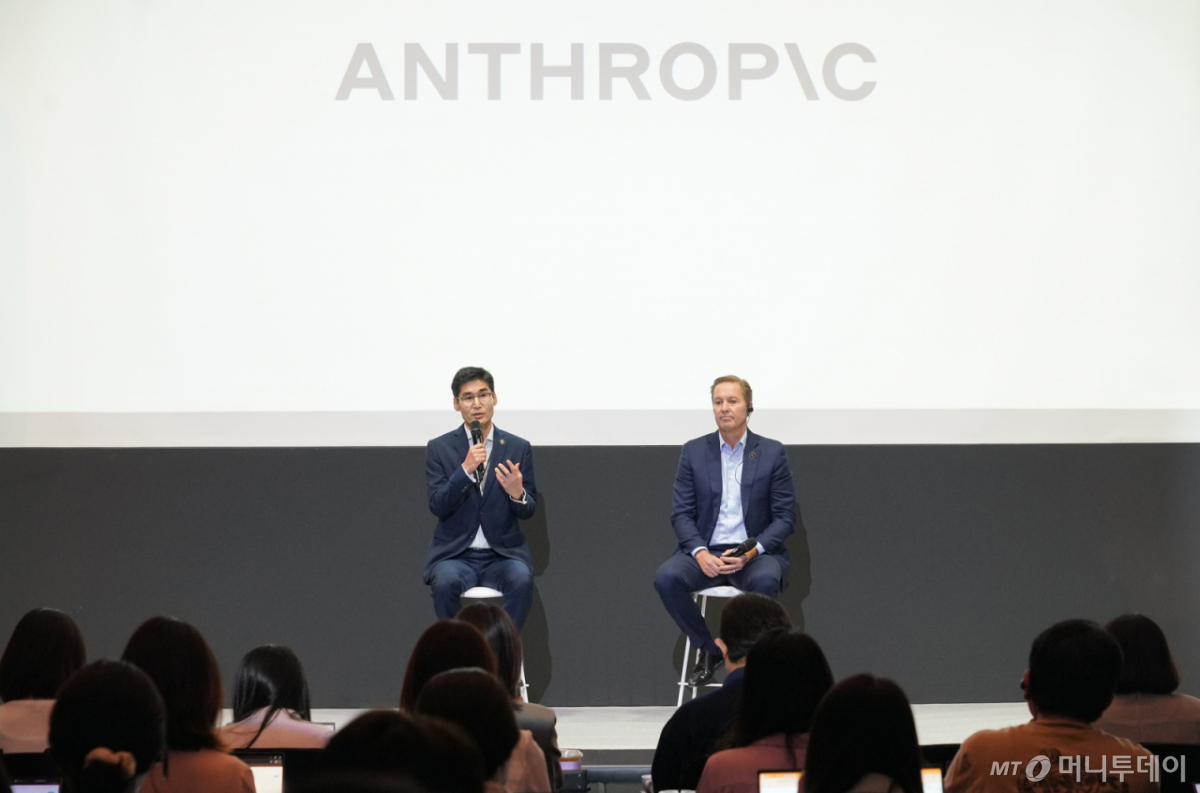
Anthropic, the operator of 'Claude,' a competing service to ChatGPT, is set to enter the U.S. stock market. The expected corporate valuation is up to $1.4 trillion (approximately 2,000 trillion won). This scale far exceeds Samsung Electronics' market capitalization. Anthropic is still a company growing while bearing enormous investment costs. What exactly is the market looking at to assign such a valuation to this company?
Anthropic is scheduled to list on NASDAQ in the U.S. on the 19th (local time). The planned offering price is $70 to $78 per share. The maximum offering size is $64.4 billion (approximately 9 trillion won). If the listing proceeds as planned, a giant company representing the global AI industry will be evaluated in the public market.
Anthropic's main product is the generative AI service Claude. Like ChatGPT, it answers questions, writes text, and assists with program development. The company is expanding its AI services for corporate clients and its coding tool business.
The annualized revenue disclosed by Anthropic as of the end of last month was approximately $81 billion. In Korean won, this exceeds 100 trillion won. However, this is not the revenue actually earned over a year. It is a figure calculated on the assumption that recent revenue levels will be maintained for the next year. If revenue grows to this extent, will there be significant profits? Not necessarily.
For typical internet services, additional costs are often relatively low even as the number of users increases. Generative AI is different. Every time a user asks a question and receives an answer, high-performance semiconductors and servers must be operated. As the number of users grows, computing costs required for service operation also arise.
To secure this computational capacity, Anthropic has entered into long-term contracts with data center operators such as Google and Amazon. The costs committed to be spent over the coming years approach $900 billion. Of course, these are not debts that must be repaid immediately, but they are costs that will need to be borne in future business operations.
Among the companies investing in Anthropic are firms like Google and NVIDIA that supply AI semiconductors and cloud services. By investing in Anthropic, they are simultaneously securing Anthropic as a customer.
This itself is not a problematic transaction. If AI demand continues to grow and Anthropic's business expands, both the investing companies and Anthropic can benefit. However, if funds secured through investment are used for purchasing semiconductors and cloud services, even if it appears that revenue across the entire AI industry is increasing, it must be separately verified how much end consumers are actually paying for AI.
Until now, the value of non-listed AI companies like Anthropic has been primarily evaluated by large technology firms and specialized investment companies. After listing, general investors will also compare performance and costs to judge corporate valuation. It becomes important how quickly revenue is growing, how much it costs to provide AI services, and whether the business can be sustained without continuously securing investment funds.
Anthropic's listing does not immediately prove the growth potential of the AI industry. Conversely, the fact that it is not currently profitable does not mean all corporate valuations are bubbles.
However, one question is difficult to avoid: Can the company actually earn enough money in the future to support a corporate valuation of 2,000 trillion won?

 in TECH
