

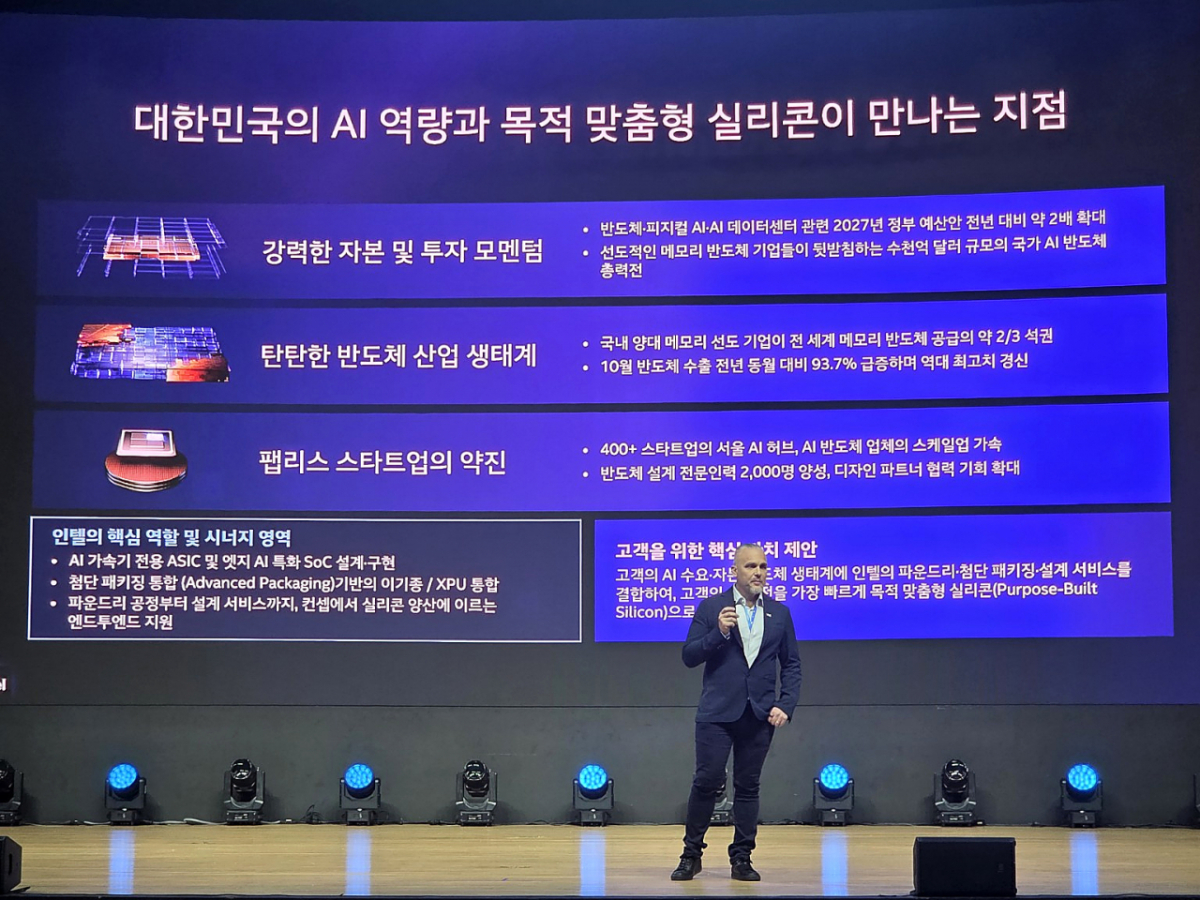
Intel has proposed custom semiconductor development collaboration to South Korean AI companies. The plan is to combine domestic firms' AI technology with Intel's semiconductor design, advanced packaging, and foundry capabilities to develop semiconductors optimized for each customer's needs.
Marcus Lawrence, Vice President and General Manager of Intel's Central Engineering Group, stated this at the 'Intel AI Summit Seoul 2026' held on the 12th at COEX in Gangnam-gu, Seoul, saying, "South Korea is at the center of memory, advanced manufacturing, and a rapidly growing AI semiconductor industry."
Vice President Lawrence assessed that South Korea has an advantageous environment for custom AI semiconductor development. He explained, "Two major Korean companies (Samsung Electronics and SK hynix) produce approximately two-thirds of the world's memory semiconductors," adding, "South Korea's semiconductor exports in October increased by 93.7% year-on-year, recording an all-time high."
He also mentioned the growth potential of domestic fabless (semiconductor design-specialized) companies. He said, "There are more than 400 startups at the Seoul AI Hub, and AI semiconductor companies are rapidly expanding their business scale," adding, "This leads to substantial demand for semiconductor design partners."
Targeting this demand, Intel presented different collaboration models for each customer. These include a turnkey method covering everything from semiconductor design to production, joint design utilizing IP (design assets) developed by the customer themselves, migration from existing external foundry processes to Intel's processes, advanced packaging, and custom design of existing Intel products—five methods in total.
In particular, it also presented a service for migrating semiconductor designs developed on other foundry processes to Intel's processes. This method involves adjusting existing designs to fit Intel's process to optimize power efficiency, performance, and area, while supporting packaging, manufacturing, and supply chain management.
It also supports methods where customers combine Intel's chiplets (small semiconductors divided by function) with their self-developed semiconductors, or integrate CPUs (Central Processing Units), GPUs (Graphics Processing Units), and NPUs (Neural Processing Units).
This broadens the scope of collaboration so that customers can utilize Intel's manufacturing and packaging technology while maintaining their existing designs.
Lawrence predicted that the importance of custom semiconductors optimized for specific tasks will grow over general-purpose semiconductors in the AI market.
He emphasized, "In an environment where AI is spreading on a large scale, even small performance improvements create enormous business value," adding, "Even a 1% improvement in efficiency can become a competitive advantage."
Indeed, AI computing demand is surging. According to data presented by Intel, global monthly token processing volume increased from 9.7 trillion in 2024 to 3,200 trillion in 2026, an increase of approximately 330 times. It also projected that monthly network data transmission volume will increase more than eightfold, from 51 exabytes (EB) in 2020 to 430 EB in 2030.
Lawrence said, "South Korea possesses capital, a semiconductor ecosystem, and the dynamism of startups," adding, "Intel can be a partner that realizes Korean companies' AI concepts into actual semiconductor products through design expertise, advanced packaging, and foundry services."

 in TECH
