

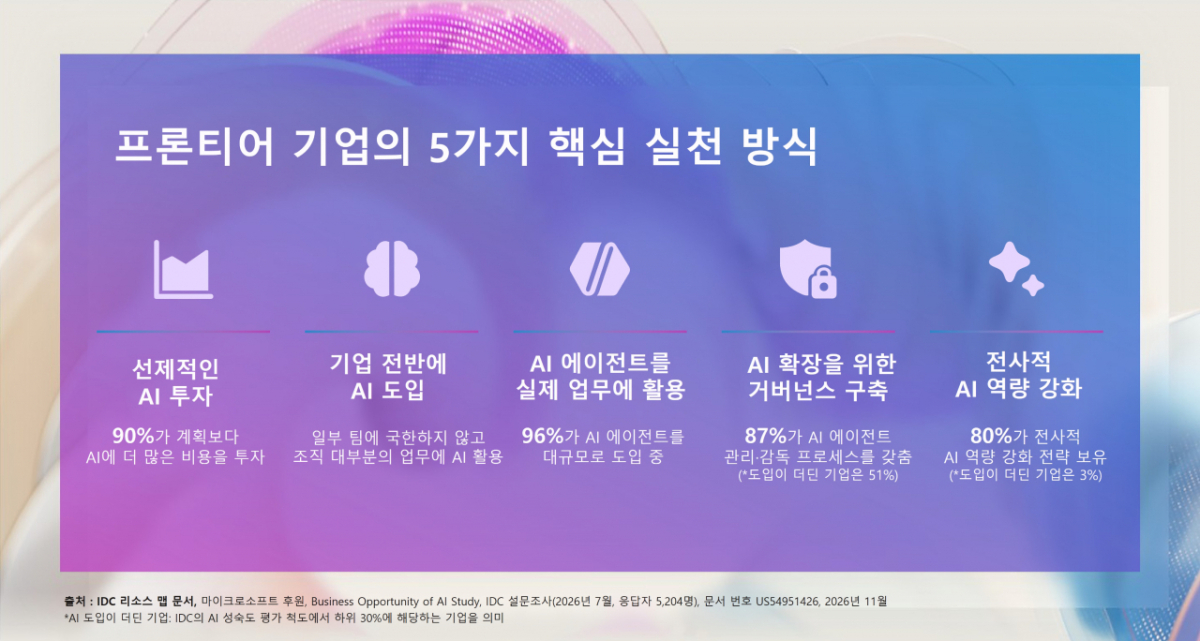
Companies with a high level of AI adoption are also leading in employee training and management and oversight systems, in addition to investment returns. The average return on AI investment for companies in the top 10% of AI maturity was four times higher, and 80% had enterprise-wide AI capability enhancement strategies in place.
Microsoft (MS) announced the results of its "AI Business Opportunity Study," commissioned from market research firm IDC, on the 26th. More than 5,200 senior IT and business leaders across 28 industries worldwide participated in the survey.
IDC classified the top 10% as "frontier companies" based on a comprehensive assessment of AI investment management, scope of utilization, level of agent adoption, organizational capabilities, confidence in risk management, and business performance. The average return on AI investment for these companies was four times higher, exceeding that of bottom 30% companies by 2.7 times. The proportion of respondents reporting returns of five times or more was also significantly different: 39% among top-performing companies versus 4% among lower-performing ones. Return figures were aggregated based on self-reported responses from company leaders, and the relationship between company characteristics and performance identified in the study is correlational.
Gaps were also evident in organizational readiness. While 80% of frontier companies had enterprise-wide AI capability enhancement strategies, only 3% of lower-performing companies did. In the overall survey, 67% of companies reported that employees highly trust AI, but only 20% had enterprise-wide capability enhancement strategies.
The rate of applying AI agents to actual work was also high. 96% of frontier companies had deployed agents at scale, and 53% were linking and coordinating agents across multiple business processes. The proportion with agent management and oversight procedures in place was 87%, surpassing the 51st% among lower-performing companies.
Disseminating AI performance across the entire organization remains a challenge. 66% of all company leaders responded that AI had delivered significant or innovative results, but only 48% of companies were disseminating these results across multiple business divisions. 36% of all surveyed companies remained at the pilot stage for AI agents.
Differences were also seen in performance measurement. While 61% of all companies expressed high confidence in their ability to measure the business value and return on investment of AI, this figure reached 93% among frontier companies. 71% of surveyed companies expected to increase their AI budgets by more than 10% within the next 12 months.
Microsoft presented principles for expanding AI utilization performance: selecting AI models suited to specific work characteristics, redesigning business processes centered on agents, managing and overseeing AI decision-making and execution, and continuously measuring and optimizing investment performance. It explained that human oversight should be maintained in critical decision-making and execution processes, and that pre- and post-AI adoption work performance should be compared to determine investment priorities.
Cathy Lang, IDC Director of Research for AI, Data, and Automation Software, said, "Companies expanding the value of AI do not simply increase investment." She added, "They manage AI investment, models, agents, governance, and organizational capabilities in an integrated manner, converting initial results into a value that can be repeatedly generated across the entire organization."

 in TECH
