

South Korea's Personal Information Protection Commission (PIPC) is launching an emergency response and inspection support system to counter AI-driven hacking threats.
The initiative centers on strengthening cooperation with relevant government agencies and helping public and private organizations implement priority security measures.
The commission said it will take a proactive approach by reducing fines for organizations that have made sufficient investments and efforts to protect personal data, while imposing strict penalties for data breaches that could have been prevented.
According to the PIPC on Nov. 27, a total of 1,019 personal data breaches were reported from January to October, more than double the 447 cases reported throughout last year.
The monthly average exceeded 100 cases. The figures were 74 in January, 94 in February, 56 in March, 86 in April, 60 in May, 62 in June, 67 in July, 112 in August, 175 in September and 233 in October. Reports have surged since August.
The increase is attributed to the use of AI in hacking, which has made attacks more automated and sophisticated while lowering the barrier to entry to the point that even nonexperts can launch them.
In response, the PIPC plans to share information promptly and work closely with security-related agencies, including the Ministry of Science and ICT, the Financial Services Commission and the National Intelligence Service. It will also analyze the types and causes of data breaches and establish and distribute specific priority security measures.
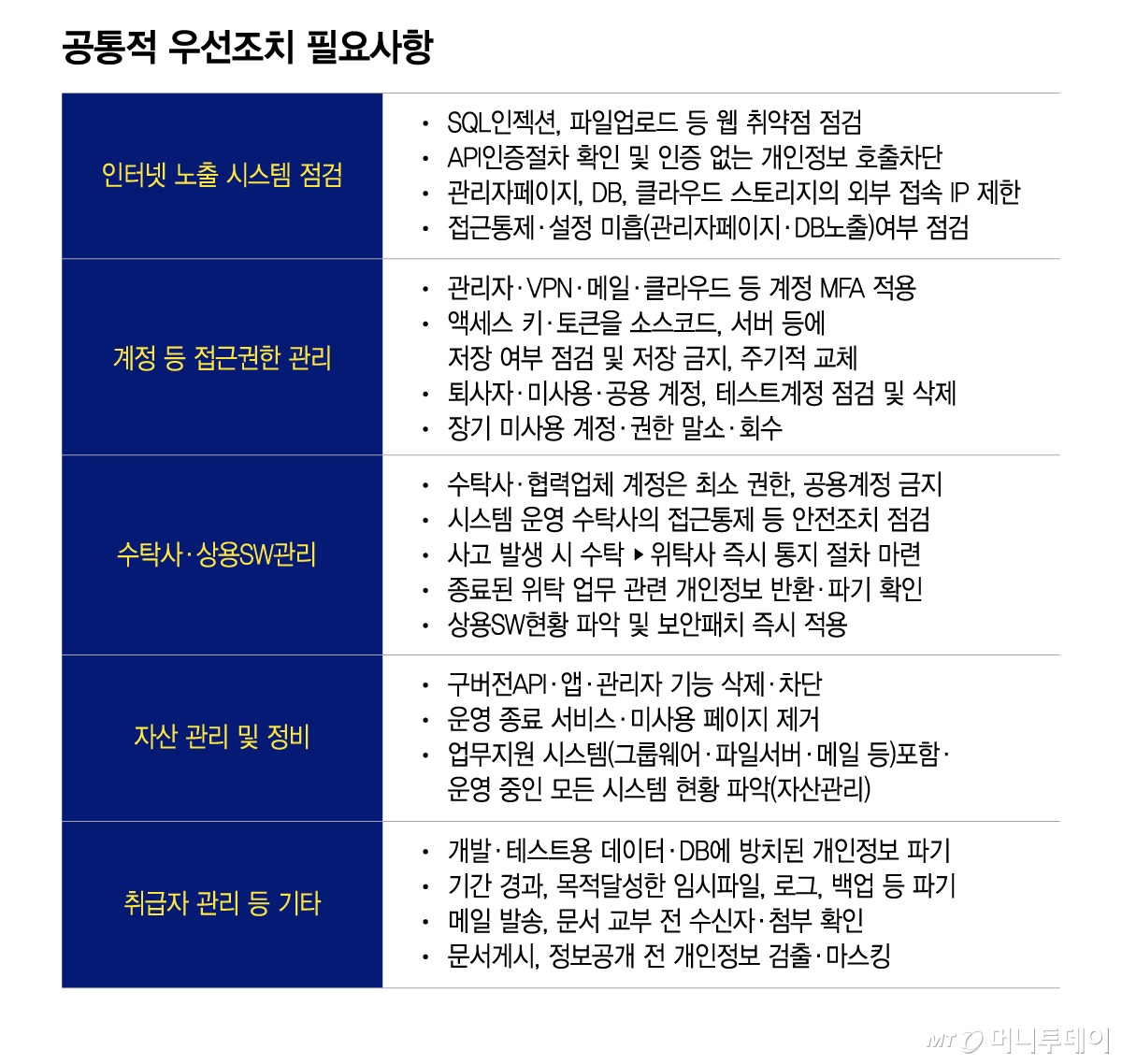
The common priority measures fall into five categories: checking systems exposed to the internet; managing access rights, including user accounts; overseeing contractors and commercial software; managing and maintaining IT assets; and other measures, including personnel management. Each category includes three to five specific actions.
For example, checks on internet-exposed systems include examining web vulnerabilities such as SQL injection and file uploads; verifying API authentication procedures and blocking personal data requests without authentication; restricting external IP access to administrator pages, databases and cloud storage; and checking for inadequate access controls and security settings.
The PIPC also plans to place institutions under intensive management for three months starting in December. Each government ministry and metropolitan or provincial government must activate an emergency inspection and response system led by a vice minister or deputy head of the local government.
The commission will also ask ministries to guide and supervise their affiliated and subordinate agencies to ensure they promptly implement the priority measures. Recognizing that ministries have traditionally relied on document-based reviews or outsourced inspections due to a shortage of specialized personnel, the PIPC will actively support on-site inspections.
For private companies and institutions, the commission plans to communicate the priority measures through chief privacy officer (CPO) councils and self-regulatory organizations.
It will also conduct emergency inspections focusing on high-risk entities whose data breaches could have far-reaching consequences. In addition, it will establish and operate a technical support system in cooperation with industry, academia and research institutions to respond swiftly to emerging technical issues.
"We have consistently maintained that fines will be reduced for organizations that have made sufficient investments and efforts to protect personal information, while breaches that could have been prevented will be subject to strict investigations and penalties," a PIPC official said. "We plan to complement the existing system, which focuses on corrective measures after investigations are completed, by establishing a framework for sharing early threat information and responding proactively."

 in TECH
