

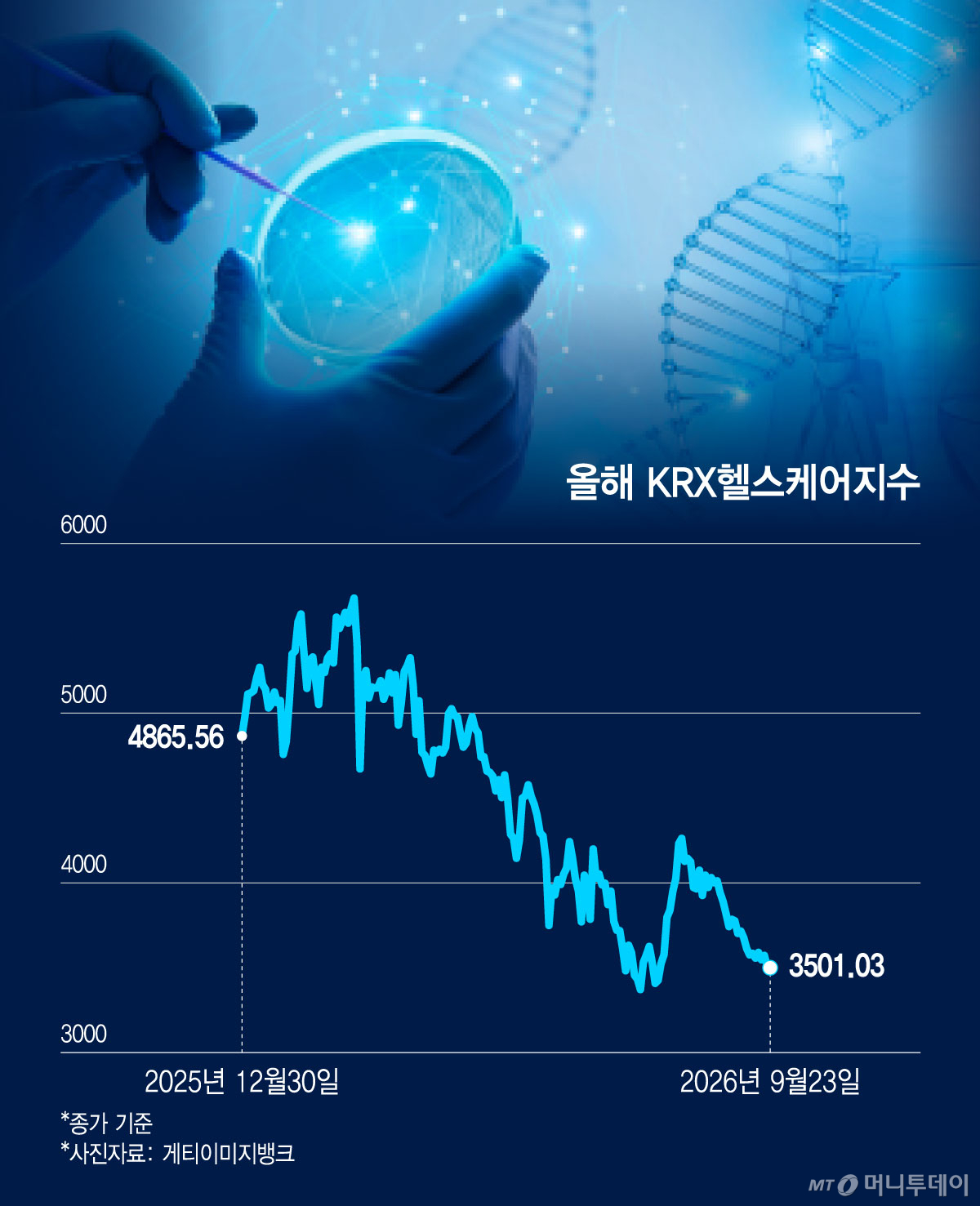
Biotech investors have had a rough time in the stock market this year. While the KOSPI index surged past 9,000 points, indicating a massive rally in the domestic equity market, the biotech sector actually moved backward. The "KRX Healthcare Index," composed of representative domestic pharmaceutical and biotech companies, fell by nearly 30%.
It remains uncertain whether biotech investment sentiment will recover after the Chuseok (Mid-Autumn Festival) holiday. Considering trends such as interest rate hikes in global financial markets, the environment does not allow for an unconditionally positive view of biotech, a sector often cited as a growth industry. However, major global academic conferences that draw attention from both domestic and international markets, including "World ADC" and the "European Society for Medical Oncology" (ESMO), are scheduled to be held next month, which could increase stock market interest in biotech. Following these, a series of global events are lined up for November, including the "Society for Immunotherapy of Cancer" (SITC), the "American Association for the Study of Liver Diseases" (AASLD), and obesity-related academic meetings.
In particular, given that the biotech sector's stock price performance has been relatively sluggish this year, expectations of undervaluation may stimulate investment demand in the sector. Analysts suggest paying close attention to companies that have proven earnings growth or possess technological competitiveness, especially those on the verge of announcing technology transfers or key clinical trial results. Who will emerge as the winner in the third-quarter earnings season following Chuseok is also a point of interest.
Hana Securities advised that in an interest rate hike cycle, actual performance is a more reliable catalyst than mere expectations. Kim Sun-a, a researcher at Hana Securities, analyzed, "The more unstable the outlook, the more reliable actual performance becomes as a material," adding, "It appears difficult for stock prices to be sustained by expectations alone at this point." She recommended Samsung Biologics, Hanmi Pharmaceutical, Alteogen, and OliX as stocks to watch.
Researcher Kim stated, "Samsung Biologics' rights offering (paid-in capital increase) is seen as a preview of the rapid expansion of production capacity disclosures that will be announced from the second half of this year through 2029, so we recommend it from both short-term and long-term perspectives." She evaluated Hanmi Pharmaceutical by noting, "In addition to inflows of upfront payments from technology transfers, domestic sales approval for its obesity treatment is approaching."
She further explained, "Alteogen is expected to show remarkable performance in the third quarter of this year, and full-year operating profit is projected to exceed 300 billion won." Regarding OliX, she noted, "There is confidence in the clinical data for its hair loss treatment, and there is a high probability that results will be disclosed in the fourth quarter."
D&D Pharmatech, InJenniea Therapeutics (Reg.S) (hereinafter InJenniea), and Boronoi are also biotech companies that have consistently received favorable reviews from the securities industry.
Expectations for technology transfers of D&D Pharmatech's treatments, including "DD01" for MASH (metabolic dysfunction-associated steatohepatitis), are high. Lee Ho-cheol and Lim Jae-hyun, researchers at Shinhan Investment Corp, stated, "We have entered a phase where the momentum for new MASH drugs and oral obesity treatments is fully kicking in." They added, "In particular, DD01 is currently in discussions regarding technology transfer with multiple big pharma companies based on successful Phase 2 global clinical trial data."
InJenniea is drawing attention as its technology transfer partner, U.S.-based Merck (MSD), has initiated a large-scale Phase 3 clinical trial for its retinal disease pipeline "IGT-427" (MK-8748). Lee Ji-soo, a researcher at Daol Investment Securities, evaluated, "The core pipeline MK-8748 is being verified by MSD in late-stage clinical trials for wet age-related macular degeneration (nAMD) and diabetic macular edema (DME) to confirm efficacy and dosing intervals compared to Ailiya." She added, "If the clinical trial succeeds, it can be expected to become a Best-in-class drug."
Boronoi is accelerating research and development for multiple pipelines, including lung cancer treatments. Kim Hyun-seok, a researcher at Hyundai Motor Securities, analyzed, "The core pipeline 'VRN11' has the potential to expand as a first-line standard treatment if it discloses data from patients with no prior treatment history in Phase 1b/2a trials." He added, "It aims for the throne of the EGFR-mutated non-small cell lung cancer market, surpassing Tagrisso."

 in THEBIO
