

IlDong Pharmaceutical is placing greater emphasis on the oncology field by directly acquiring external investor stakes in Idion, a specialized anticancer drug development company within its group. Following the absorption merger with Unovia last June to integrate its new drug research and development (R&D) organization into headquarters, the company aims to strengthen strategic ties with Idion to solidify the foundation for group-level anticancer drug development.
IlDong Pharmaceutical announced on the 1st that it decided on the 30th of last month to acquire 7,097,016 shares of redeemable convertible preferred stock (RCPS) in Idion for approximately 36.755 billion won in cash. This amount corresponds to 15.35% of its equity under consolidated standards as of the end of last year. After the acquisition, the ownership ratio will be 13.95%, including RCPS with voting rights. The company will acquire 400,000 shares for 2 billion won on the 7th of this month and the remaining 6,697,016 shares for approximately 34.755 billion won on the 15th.
This transaction involves purchasing existing shares held by external investors. It is distinct from a rights offering (paid-in capital increase) that would supply new clinical funds to Idion. An official from the IlDong Pharmaceutical Group explained, "This is to effectively respond to changes in market conditions and institutional environments, and to more firmly establish the R&D foundation for anticancer drugs at the group level."
IlDong Pharmaceutical's existing major new drug development areas include metabolic diseases, digestive system diseases, infectious diseases, and central nervous system disorders. According to its semi-annual report this year, key pipeline candidates include the oral GLP-1 receptor agonist diabetes treatment 'ID110521156', the P-CAB class gastroesophageal reflux disease treatment 'ID120040002', the coronavirus disease 2019 (COVID-19) treatment 'Jocova', and the Parkinson's disease treatment 'ID119040338'.
In June last year, IlDong Pharmaceutical absorbed and merged its new drug R&D subsidiary Unovia, integrating its research organization and pipeline into headquarters. This time, by directly securing a stake in Idion, it is strengthening ties with the anticancer drug business in addition to its existing development areas. While the group has already been developing anticancer drugs through Idion, IlDong Pharmaceutical's direct participation as a shareholder has strengthened this connection.
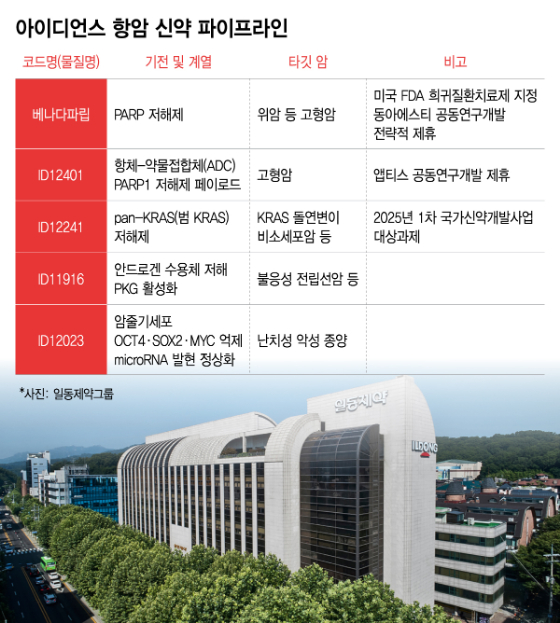
Currently, Idion's major clinical pipeline candidate is the oral targeted anticancer agent 'Benadaparib'. It operates by inhibiting PARP, an enzyme involved in DNA damage repair in cancer cells. The company is promoting combination use with other anticancer agents and expansion of indications by improving hematological safety compared to existing PARP inhibitors.
Benadaparib has completed Phase 1b/2 clinical trials for monotherapy in solid tumors in Korea. It is currently conducting Phase 2a clinical trials for combination therapy targeting gastric cancer in South Korea, the United States, and China. In 2022, it was designated as an orphan drug for the treatment of gastric cancer by the U.S. Food and Drug Administration (FDA).
In the Phase 1b/2a trial combining Benadaparib with irinotecan, the median progression-free survival was 4.2 months, and the median overall survival was 8 months. In the subgroup of patients with homologous recombination deficiency (HRD), such as ATM or BRCA1/2 mutations, these figures were 8.3 months and 9.9 months, respectively. HRD refers to a condition where there is a defect in the function that repairs DNA damage.
Alongside clinical development, technology transfer and co-development are also being pursued. Last year, Idion signed a technology transfer agreement for Benadaparib worth approximately 70 billion won targeting the Eurasian Economic Union (EAEU) and Gulf Cooperation Council (GCC) regions. It has also established strategic partnerships with Dong-A ST for PARP inhibitors and Aptis for antibody-drug conjugates (ADCs) for joint research, development, and commercialization.
The follow-up pipeline is expanding to include targeted anticancer agents targeting various KRAS mutations and ADCs utilizing novel payload drugs. Last year, at the American Association for Cancer Research (AACR), the company announced research results for four candidates: the pan-KRAS inhibitor 'ID12241', the PARP1 inhibitor-based ADC 'ID12401', the cancer stem cell-targeted anticancer agent 'ID12023', and the treatment for castration-resistant prostate cancer 'ID11916'.
ID12241 targets various mutations of KRAS, an intracellular signaling protein involved in cancer development. The company explained that it confirmed anticancer activity against multiple mutations, including G12C, G12D, and G12V, in preclinical studies. Development targets include KRAS-mutant non-small cell lung cancer, as well as pancreatic and colorectal cancers. It was selected for the National New Drug Development Project last year and will receive support for candidate molecule derivation and related research costs for two years.
ID12401 is an ADC candidate using a PARP1 inhibitor as the payload drug. By delivering the drug to cancer cells using antibodies, it aims to resolve resistance and toxicity issues associated with existing anticancer treatments. According to the company, anticancer effects were confirmed in in vitro experiments and animal tumor models.
ID12023 is a candidate that normalizes microRNA expression within cancer cells to target cancer stem cells. ID11916 operates by simultaneously inducing androgen receptor inhibition and PKG activation; preclinical studies confirmed anticancer activity against prostate cancers showing resistance to existing androgen receptor inhibitors.
An official from IlDong Pharmaceutical stated, "Idion's fundamental direction is to pursue a technology transfer strategy that secures revenue at intermediate development stages alongside the clinical development of individual candidate molecules." The official added, "We also plan to promote open innovation activities, such as identifying co-development partners and securing investors to accelerate commercialization."

 in THEBIO
