

Recently, 'NMN' (Nicotinamide Mononucleotide), belonging to the vitamin B3 family, has emerged as a new anti-aging substance capable of rejuvenation, driving up the prices of various "health foods" containing NMN as an ingredient.
In Korea, companies are engaged in promotional competition by featuring famous doctors and celebrities as advertising models, selling these products at prices 5 to 10 times higher than typical vitamin B complex supplements. Can consuming NMN effectively prevent aging?
Professor Bae Seok-cheol, director of the Chungbuk National University Cancer Research Institute, a leading authority on vitamin B research in Korea, warned in a phone interview with reporters on the 23rd that "it has not been scientifically studied sufficiently or deeply to determine how much anti-aging effect NMN has when consumed, or how beneficial or harmful it is to health."
He added, "In particular, no one knows what side effects may arise from long-term consumption of NMN, so caution is required regarding intake."
Previously, David Sinclair, a professor at Harvard Medical School, highlighted NMN as an anti-aging substance after revealing in animal experiments that old mice fed NMN maintained physical fitness and metabolic functions at levels comparable to those of young mice.
NMN is the abbreviation for Nicotinamide Mononucleotide, a substance belonging to the vitamin B3 family. Professor Bae explained, "NMN is an intermediate-stage substance in the process where niacinamide, one of the vitamin B3 compounds, becomes NAD+, its final Busan product."
So what is niacinamide, and what is NAD+?
Niacinamide is one of three vitamin B3 substances (niacin, niacinamide, and niacinamide riboside) and is the most stable and safe among them.
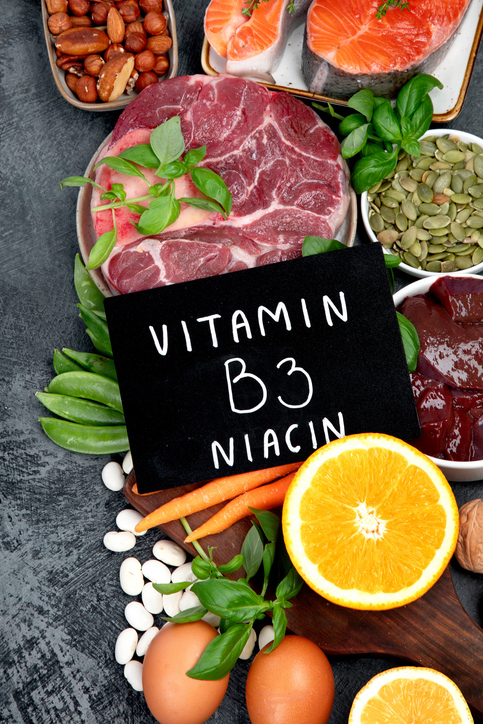
Until now, niacin, the representative substance of vitamin B3 and familiar to us, has been abundantly found in lean meat, organ meats (kidneys and liver), fish, shellfish, shrimp, and dairy products. However, no matter how much of these foods one eats, the amount of niacin absorbed by the body is only a few dozen milligrams. Consequently, high-dose vitamin supplements containing refined niacin are commercially available; however, the issue is that consuming high doses of niacin can cause "flushing" in the face and entire body.
Professor Bae explained, "Niacinamide possesses all the health benefits of niacin without the concerns about niacin's side effects." He added, "Numerous papers have shown that consuming several thousand milligrams of niacinamide daily over long periods does not result in significant side effects."
In fact, it has been proven that niacinamide can be expected to provide functions such as △anti-aging, △immune enhancement, and △energy metabolism promotion without significant side effects even when consumed in large quantities over the long term. Accordingly, the Ministry of Food and Drug Safety has approved niacinamide as a functional ingredient usable in health functional foods, and it is currently available as such. Like niacin, niacinamide is found in foods rich in vitamin B3, such as meat and nuts.
Niacinamide (NAM) consumed through food or health functional foods becomes NMN in the body when it encounters the enzyme NAMPT. NMN then becomes NAD+, its final metabolic product, upon encountering another enzyme (NMNAT). NAD+ is the abbreviation for "oxidized form (+) of nicotinamide adenine dinucleotide" and exists in almost all cells of the human body. NAD+ is involved not only in energy production in mitochondria within cells but also deeply in the activation of longevity genes such as SIRT1 (sirtuins).
The problem is that NAD+ levels in the body naturally decrease with age, which is cited as a major cause of aging, inflammation, and delayed recovery from cellular damage. Professor Bae explained, "As people age, specific proteins (CD38, PARP) increase in the body, leading to significant consumption of NAD+. This causes NAD+ levels within cells to decrease, thereby accelerating aging." Ultimately, this means that filling the body with more NAD+ can slow down the rate of aging.
The issue is that safety has not been proven when consuming NMN—the stage immediately preceding NAD+—rather than niacinamide to replenish depleted NAD+.
Professor Bae stated, "When you consume niacinamide, enzymes in the body naturally break it down, converting it through NMN into NAD+, allowing one to expect the anti-aging effects of niacinamide while naturally replenishing NAD+ to slow the aging process." He continued, "However, there are no long-term research results on whether it is safe to artificially consume NMN itself, an intermediate-stage product."
He then likened this to a daily scenario: "Artificially introducing NMN into the body, bypassing niacinamide, is like receiving a glucose IV drip instead of eating rice to supplement natural sugar when blood sugar drops." He added, "When you eat a meal, natural sugar supplies energy evenly throughout the body. But if you receive a glucose IV drip, wouldn't the risk of side effects such as blood sugar spikes increase because blood sugar levels in specific areas rise sharply?" He concluded, "In a situation where the safety of consuming artificially produced NMN at high concentrations over long periods has not been secured, one should be wary of excessive high-price marketing tactics."

 in THEBIO

