

Food allergy is an allergic disease that commonly occurs during infancy and early childhood. While it may naturally improve with growth, it persists into school age in some cases. In particular, children whose food allergies persist are at increased risk of developing other allergic diseases, such as asthma and allergic rhinitis, making early prediction and management important.
On the 26th, the KDCA National Institute of Health announced that "when food allergies persisted until age 7, this was associated with gene regulation characteristics of the placenta at birth and immune indicators during growth."
Until now, it had not been sufficiently established what biological differences exist between children whose food allergies naturally improve and those in whom they persist for a long period.
Accordingly, the team from the large-scale Respiratory Allergy Disease Birth Cohort (COCOA) study, supported by the National Institute of Health, conducted long-term follow-up observation of 1,518 children until age 7 to analyze the natural course of food allergies and investigate the association between gene regulation characteristics of the placenta at birth and immunological indicators.
The research team classified children into four types based on the onset and remission timing of food allergies: △ 'No allergy type' (89.9%), in which no food allergy developed; △ 'Early remission type' (5%), in which an allergy developed during infancy or early childhood and improved early; △ 'Early persistence type' (4.2%), in which an allergy developed during infancy or early childhood and persisted until age 7; and △ 'Late remission type' (1%), in which the allergy improved relatively late after onset.
As a result, among children with the early persistence type, where food allergies continued until age 7, changes regulating the activity of certain genes (RPS6KA2, GCSAML) in the placenta at birth were higher than in children who had no allergies or whose allergies improved early.
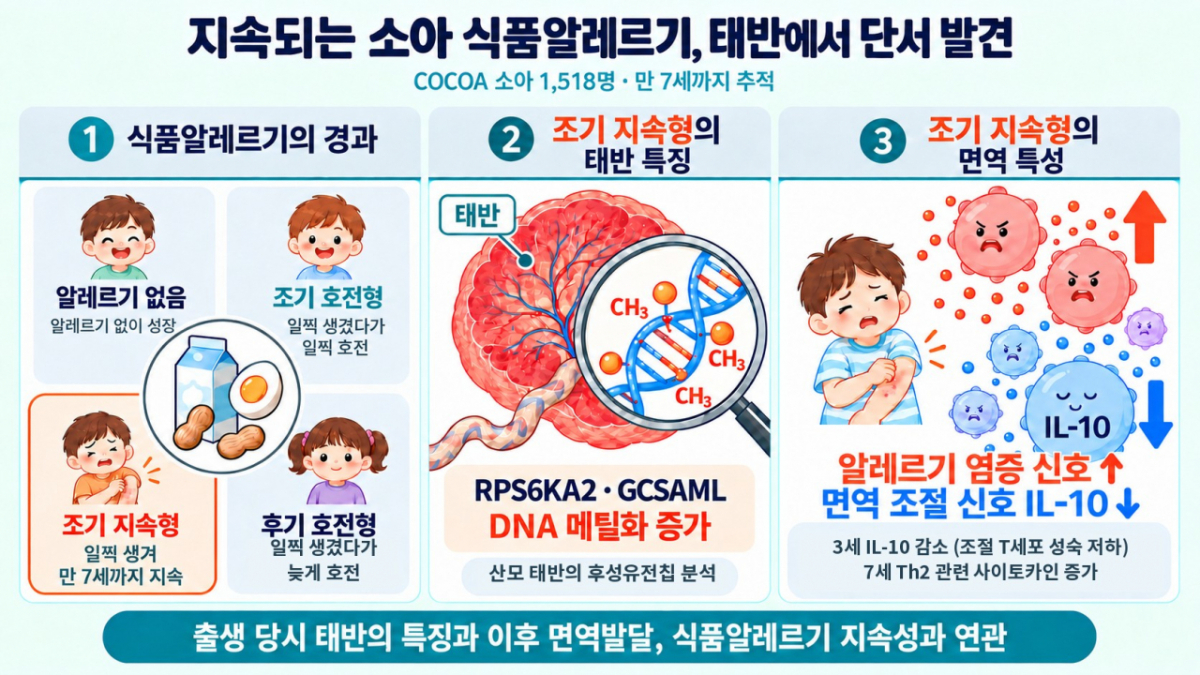
Differences by type also appeared in immune indicators. Children with the early persistence type showed higher levels of immune response substances related to allergic inflammation at ages 3 and 7 compared to children with the no allergy type. On the other hand, substances regulating immune responses were lower at age 3 than in the late remission type.
In addition, the proportion of children diagnosed with asthma at age 7 was 15% among those whose food allergies persisted, which was higher than among children who had no food allergies (2.3%). The gene regulation changes identified in the placenta were also associated with some allergy and immune test results.
This study shows that when food allergies starting at a young age persist until age 7, they may be related to gene regulation characteristics of the placenta at birth and immune responses during growth. However, this result does not mean that changes in the placenta are the cause of food allergies; further follow-up studies are needed to better understand the course of food allergies and related factors.
Hong Su-jong (Prof.), the principal investigator from the National Medical Center, analyzed, "Food allergy is not a disease that shows the same course in every child," adding, "This study specifically showed that food allergies starting at a young age and persisting increase the risk of childhood asthma later on, and suggested the possibility that epigenetic characteristics of the placenta and subsequent immune dysregulation are involved as mechanisms."
Kim Won-ho, Deputy Director of the Chronic Disease Convergence Research Division at the National Institute of Health, said, "While this result does not prove a direct causal relationship for pediatric food allergy symptoms, it suggested the possibility that the persistence of food allergies is related not only to phenomena after clinical symptoms appear, but also to biological differences existing before birth and subsequent immune development."
He added, "A prevention and management strategy focused on high-risk groups is needed to diagnose children at high risk of allergy persistence early and predict their natural course using this information."
Meanwhile, the results of this study were published last month in the online version of 'Allergy,' an international academic journal in the field of allergy and immunology.

 in THEBIO

